Episode 3 of the Six-Part Series
“The Corrupt Regime of Cherniss, Frazier, Youngblood & Blades.”
Read the Intro and Episode 1 HERE, Episode 2 HERE, Episode 3 HERE.
Episode 4: 2024 Campaign Lies
Before the transfer of USI assets to the OCSCS could be made durable, Cherniss needed political protection. He had to preserve the board majority that made USI possible, and to do that he needed voters to believe two things: that his signature programs were succeeding and that the district budget remained sound. Neither claim could withstand serious scrutiny
Campaign Lies 1: Enrollment Numbers

In the 2024 election, for the first time in PYLUSD history, a superintendent directly inserted himself into school board campaigns on behalf of specific candidates. In Area 1, Cherniss supported Ryan James Miller against Tricia Quintero; in Area 2, he supported Maria Lupita Stubbs against Marilyn Anderson; and in Area 3, he supported Leandra Blades against Misty Janssen. His involvement included appearances at campaign events as well as more surreptitious forms of support.
That support aligned with the formal endorsements those candidates received from Moms for Liberty, the Pat Nixon Republican Women’s Federation, the Orange County Republican Party, the Republican Party of Orange County, the Orange County Congress of Republicans, all five members of the Orange County Board of Education, Stefan Bean, members of the Yorba Linda Water District—including Brett Barbre, a prospective CEO for OCSCS—Sheriff Don Barnes, Pastor Jack Hibbs, Jeremy Yamaguchi, and the Yorba Linda Taxpayers Association. The common thread was unmistakable: the coalition backing these candidates was composed largely of organizations and officials invested in weakening local public schools and the elected school boards responsible for protecting them.

Cherniss gave that political alliance what it needed most: a false public narrative built on inflated enrollment numbers. The board candidates he was trying to protect needed proof that his leadership and signature programs were working, so Cherniss supplied that proof by repeatedly overstating enrollment in the months before the November 2024 election. At the May 7, 2024 board meeting, he claimed that enrollment had increased by 500 students. At the June 18 meeting, he reduced the figure to 400. Yet even as the number shifted, the political purpose remained the same: to persuade voters that the district was growing stronger under his leadership. Then, in the annual State of the District report released during the final month of the campaign, Cherniss continued to present the false enrollment narrative. Here is the graph he released at that time.
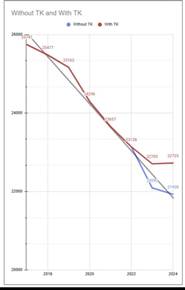
The actual numbers told a very different story. When the district issued its First Interim Report in December, covering financial activity through October 31, it showed an increase of only 22 students. That modest gain came from transitional-kindergarten enrollment driven by statewide TK expansion, not from any district-created program or incentive associated with Cherniss’s leadership. In fact, if the increased enrollment due to TK expansion is factored, the district witnessed an overall drop in enrollment conservatively estimated at over 500 students. Here is a chart that more accurately reflects the enrollment numbers after millions were wasted in USI and OCSCS.
USI became the second example of Cherniss falsely inflating enrollment numbers to help his candidates in the same campaign. At the August 13, 2024 board meeting, Cherniss claimed that “hundreds” of students were enrolled in the program. By October 18, only weeks before the election, he lowered the claim to between 150 and 200 students. After the election, at the December 17 meeting, the public learned that the actual number was 84. The pattern was unmistakable: before voters cast their ballots, Cherniss inflated the district’s successes; after the election, the numbers collapsed into something far smaller.
Campaign Lies 2: Financial Numbers
The budget record under Cherniss shows a rapid collapse in the district’s fiscal position. In the 2023–2024 First Interim Report in December 2023, PYLUSD projected a $4.3 million surplus. By the Second Interim Report in March 2024, that projection had become a $3.2 million deficit—a $7.5 million negative swing in just over three months. By June 2024, the projected deficit had grown to $9.7 million. By the 2024–2025 First Interim Report in December 2024, it had reached $12.4 million. In one year (2023-2024), the district moved from a projected $4.3 million surplus to a projected $12.4 million deficit, a deterioration of $16.7 million. Explaining that collapse requires a professional accounting, but the available record already points to one central problem: Cherniss’s favored projects consumed extraordinary resources while producing little demonstrable return.
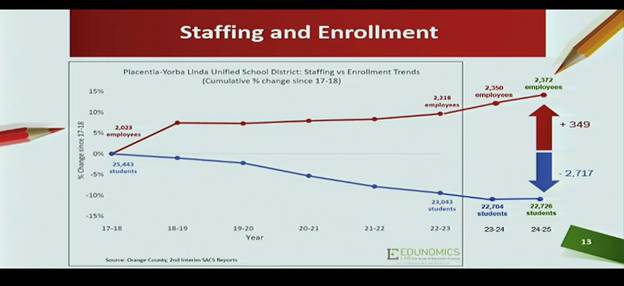
Cherniss did not merely exaggerate enrollment for political theater; he used those false numbers to rationalize real spending decisions. By portraying the district as thriving under his leadership, he created a pretext for adding staff and raising salaries even as enrollment was declining beneath the surface. Trustees Frazier, Youngblood, and Blades did not challenge the fiction. They amplified it, cheering on a superintendent who continued feeding the public a distorted picture of the district’s condition. The result was a widening disconnect between what Cherniss claimed was happening and what the district’s own enrollment and hiring data showed. The following chart captures that disconnect between falling enrollment and rising staffing costs.
False Numbers for USI
USI is the clearest example of Cherniss using false numbers to paint a rosy picture of the state of the district. Recent district audit and budget materials indicate that each student enrolled in USI through Parkview Homeschool Academy cost the district substantially more than the ADA revenue generated by that student. Of the known estimated USI costs, approximately $3.5 million supported a program serving only 84 students—roughly $41,667 in district funds per student. That kind of spending cannot be dismissed as ordinary program development. It reflects a fiscal priority: protect a politically favored initiative even when the cost far exceeded the educational value received.

The cost of that priority fell on other students and programs. To cover USI and related OCSCS expenses, the district diverted developer fees from the long-planned Valencia High School kitchen project and redirected music and early-education grant funds toward the OCSCS Innovation Lab, which reportedly received $1 million. Trustee Quintero underscored the larger imbalance at the January 14, 2025 board meeting when she pointed out that OCSCS’s operating budget exceeded its ADA revenue by roughly $1.5 million. At the same time, projected upgrades for secondary-school music programs were reduced by approximately $900,000, early-education funding was reduced by approximately $430,000, and “miscellaneous instruction” increased by approximately $630,000. The logic was consistent: resources moved away from broad district needs and toward selected projects tied to Cherniss’s agenda.
The public narrative did not match that fiscal reality. In the lead-up to the November 2024 election, Trustee Blades publicly claimed that USI had brought $600,000 into the district. Later disclosures suggest the opposite. The Local Control and Accountability Plan mid-year report presented on February 11, 2025 reported a USI-related district deficit of $2,918,796, excluding $62,469 spent on USI marketing. Blades’ public claim also omitted major cost categories, including salaries, materials, contracts, district-wide administration, and special-education contributions. Although Blades may have broader protection for campaign-related speech, an email reportedly shows that Cherniss supplied the claim she repeated. That matters because a superintendent is not a campaign surrogate; he is a public administrator with a duty to provide accurate financial information to the board, the public, and district stakeholders. If he knowingly gave Blades false or misleading fiscal information for use during an election campaign, the issue becomes more than bad budgeting. It becomes a possible misuse of official position to protect a political majority by disguising the true cost of USI. One can hear the echoes of Palos Verdes.
The Misappropriation of Developer Fees

The Valencia High School kitchen project shows the harm in concrete terms. Developer fees are meant to help districts address facilities needs created by residential, industrial, and commercial development. Valencia, whose attendance area was especially affected by development, had a long-documented need for kitchen improvements. Although it has the largest enrollment of the district’s comprehensive high schools, Valencia has only one oven to prepare meals for its students; the other three comprehensive high schools each have four ovens. The disparity is especially troubling because Valencia also serves one of the district’s largest populations of lower-income and minority students. Using developer-fee revenue to support USI through Parkview Homeschool Academy is therefore difficult to justify. Parkview’s students are primarily enrolled in homeschool or independent-study programs and do not create the same on-campus facilities burden that developer fees are intended to address. They were not increasing demand for cafeteria capacity, classroom space, or other core facilities at a comprehensive high school in the way new residential development had affected Valencia. Redirecting those fees to Parkview-linked USI costs is therefore inconsistent with the purpose of developer-fee revenue, especially when Valencia’s planned kitchen renovation received nothing.
The kitchen project was not vague or aspirational. At a November 14, 2023 board study session, the board agreed to a five-year budget projection allocating $4.5 million to the Valencia kitchen. Of that amount, $2 million was to come from developer fees: $350,000 in 2023–2024 for design and planning and $1.65 million in 2024–2025 for construction. Another $1 million in developer-fee funding was budgeted for construction in 2025–2026. The plan also identified $500,000 in redevelopment-agency funds and $1 million from Fund 4040, both apparently tied to eligible capital or facilities purposes. In other words, the district had already identified the need, assigned the funding sources, and mapped the timeline before those resources were redirected toward OCSCS and USI-related priorities.
The later developer-fee reports make the diversion even clearer. The Annual and Five-Year Report for Fiscal Year 2024–2025, submitted on November 21, 2025 and presented at the December 16, 2025 board meeting, again showed no developer-fee expenditure for the Valencia kitchen. Instead, it showed an additional $456,055.95 in developer-fee spending for USI. Combined with the $1,421,146.72 reported for USI in the prior fiscal year, approximately $1.88 million in developer fees went to USI while the Valencia kitchen project received none. In 2024–2025, USI alone accounted for nearly 57% of all developer-fee expenditures. The only other large categories were “Annual Lease Growth” at $127,260.16 and “Program Administration/Planning/Consultant Services/Legal Counsel” at $131,461.58. Together, those three categories totaled $714,777.69, or approximately 89% of all developer-fee expenditures that year. Of the ten listed projects, USI was the only one marked completed. The fiscal pattern is therefore difficult to miss: a basic facility need at a large comprehensive high school stalled while developer-fee money flowed to the superintendent’s failing pet project.
A Summer School Shell Game

Superintendent Cherniss also appears to have been involved in a fiscal maneuver that may have hindered a proper audit of district funds and helped produce misleading financial information for taxpayers during the 2024 campaign. In June 2024, shortly before the annual audit, he directed that restricted funds raised by local elementary school PTAs for sixth-grade outdoor-education camp be moved into an unidentified district account. The details of that transfer remain unclear, but the questions it raises are straightforward: where were the funds moved, how were they recorded, whether auditors were fully informed, and whether the temporary transfer affected the district’s public financial picture. Nigro & Nigro, PC, the accounting firm that performed the 2024–2025 audit, should be able to provide further detail, as should Gary Stine. The key records would include the Elementary School Outdoor Education Account 9015 and the related resource-code records.
The funding structure for outdoor education makes the June transfer especially troubling. Each year, elementary school PTAs in the district raise tens of thousands of dollars to fund sixth-grade outdoor-education camp as a culminating experience for approximately 60 sixth-grade students at each site preparing to enter middle school. Those PTA-raised funds are deposited with the school site and then submitted to an account administered by the Orange County Department of Education, which disburses payment to the camp operator. Before Cherniss, any surplus was commonly returned to the school-site account maintained in cooperation with the PTA and applied toward the following year’s program.
In June 2024, for the first time, the district office redirected whatever surplus had been raised into an account that was not disclosed to the school sites. When site secretaries questioned the new practice, accountants in Business Services assured them that the money would be returned. It was returned in the fall—but only after the June audit was complete and after the audit report had been made public in September. That timing is the core problem. If the temporary relocation of restricted PTA-raised funds made the district’s finances appear stronger, cleaner, or less restricted than they actually were, then the maneuver may have distorted the fiscal information available to voters just as Cherniss was arguing that the district remained financially sound before the November 2024 election.
The Voters Send a Clear Message to Cherniss:
LEAVE!

Despite the efforts of Cherniss and his supporters to cook the books, voters in Areas 1, 2, and 3 sent a clear message that they no longer wanted what Cherniss was serving. Tricia Quintero defeated Ryan James Miller by a full 30 points, despite Cherniss’s false enrollment narrative and despite outside efforts to protect the board majority, including the Yorba Linda Taxpayers Association’s endorsement of Miller. The YLTA also appears to have supported Nicolas Cardenas’s challenge to Quintero by funding his yard signs and possibly other campaign efforts, an obvious attempt to draw Latino and Democratic votes away from Quintero. Marilyn Anderson’s victory was also impressive, she defeated Maria “Lupita” Stubbs by nearly 11 points. Even in Area 3, where Trump defeated Harris by 30 points, Leandra Blades only defeated Misty Janssen by 6 points. The voters had sent a clear message: enough with the loss of educational leaders, the culture wars, and the waste of money on ill-conceived programs.
Subverting the Results of an Election
Trustees Frazier, Youngblood, and Blades refused to accept the clear message of the voters. They endeavored to ensure that any attempt to terminate Cherniss or any of his closest advisors would come at great legal and financial cost to the district. They also attempted to consolidate OCSCS and the USI as public funded resources that would benefit private interests outside the control of elected school board. Most disturbingly, they continued with what by all appearances is an effort to transform Esperanza into a campus for the CRLA private charter school.
Supermajority Nullification of the Election
At the November 19, 2024 board meeting, the outgoing majority used 3–2 votes to extend the contracts of Superintendent Cherniss and selected assistant superintendents in ways that conflicted with district bylaws and state law. The pattern had begun months earlier. At the February 13, 2024 meeting, Cherniss, Deputy Superintendent Isaac Gates, Assistant Superintendent Olivia Yaung, and Assistant Superintendent Renee Gray all received three-year contract extensions and salary increases without completing the annual performance reviews required by district bylaws. The November contract revisions went further: Trustees Blades, Youngblood, and Frazier inserted provisions requiring a supermajority vote to remove those officers, including removal for cause.

That structure was not simply unusual; it was designed to obstruct the newly elected board majority before it could take office. Earlier superintendent contracts had included supermajority language only with unanimous board approval and without eliminating the performance-review obligation. Cherniss’s revised contract did something different. District bylaws state that the superintendent shall receive an annual performance review, but his contract changed that mandatory duty into a discretionary possibility by saying he may receive one. A contract cannot override bylaws.
The practical purpose of the revisions was clear. After voters rejected the direction of the outgoing majority in November 2024, the lame-duck board attempted to make it legally and financially painful for the incoming board to change leadership. Even if these provisions were ultimately illegal or unenforceable, challenging them would require litigation, expense, delay, and uncertainty—costs borne by taxpayers, not by the officials who created the problem. For people willing to weaken public schools, litigation risk was not a deterrent. It was part of the strategy: make removing unwanted administrators like Cherniss and Gates so costly that the incoming board might decide reform was not worth the price, then leave students and taxpayers to absorb the damage.
What kind of democratic governance permits an outgoing simple majority, just rejected by the voters, to entrench its own defeated agenda by requiring a future supermajority to undo it? Not one that has much respect for constitutional democracy.
Counsel for the Coup

The contracts also raise serious questions about the role of Orbach, Huff, and Henderson (OHH). If the firm drafted, approved, or advised on contract language that weakened bylaw compliance, insulated administrators from required review, and burdened the district with avoidable litigation exposure, then its advice may have served the outgoing majority’s political interests rather than the district’s legal and financial interests. That possibility belongs in any investigation of how these contract provisions were created, who requested them, and whether counsel protected the client it was retained to represent: the school district itself, not the political interests of the outgoing board majority.
The contract revisions were the central item at what should have been the outgoing board majority’s final regularly scheduled meeting. Cherniss, however, worked in concert with that majority to add two more regular meetings before December 17, when the newly elected trustees would take control. The additions passed on a 3–2 vote, though only one of the two meetings ultimately occurred.
That December 10 meeting was not merely a spectacle of lame-duck absurdity. It had a specific purpose: to lock OCSCS into a more autonomous charter structure operating outside the practical authority of the elected school board, and to place under that structure a substantial portion of the public assets purchased for USI. In other words, after voters had rejected the outgoing majority’s mandate, that majority tried to use its final days in power to convert public investment into charter-linked control before the new board could stop it.

Hang on, there’s much more:
Episode 5, The Final Grab Fails.
Coming soon!


