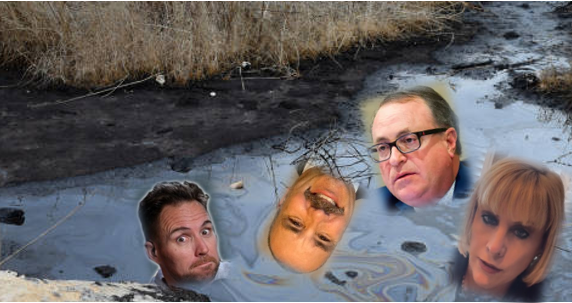
The 2022 election of Todd Frazier to the PYLUSD Board of Trustees began a chain of policies that, taken together, point to a likely effort to move Esperanza High School toward control by the California Republic Leadership Academy (CRLA). The circumstantial evidence suggests more than isolated mismanagement: it shows a pattern of decisions that advanced charter-aligned interests, weakened district oversight, and redirected public resources away from locally accountable governance.
The network behind those decisions appears connected to influential figures and organizations within the Orange County Republican Party and the broader charter-privatization movement. What nearly happened at Esperanza—and what may still happen—fits a wider Republican strategy to defund public education and shift taxpayer dollars into private or semi-private charter schools, including schools aligned with Christian nationalist politics. Personnel removals, controversial contracts, opaque facilities work, fiscal transfers, misleading public claims, charter restructuring, and political intimidation all point toward the same concern: that Esperanza, a public campus built with taxpayer money, was being positioned for transfer to private or charter-linked interests, undermining both the district’s fiscal stability and the authority of the elected school board to protect local taxpayers.

The available public record already documents a troubling pattern of waste, mismanagement, and alleged misconduct in PYLUSD under Cherniss, Frazier, Youngblood, and Blades. But the broader scheme suggested here—whether public assets were deliberately steered toward charter-linked control—cannot be fully proven through public records alone. That question requires subpoena power: emails, texts, contracts, campaign communications, vendor records, and closed-session materials. Because the Orange County District Attorney has appeared politically aligned with broader GOP charter-privatization efforts and Sheriff Don Barnes is even more complicit, the Orange County Grand Jury may be the appropriate body to investigate the district’s losses and the decisions behind them. Anyone with specific evidence of corruption, waste, retaliation, or improper asset transfers should consider submitting it to the Grand Jury, where reports may be made confidentially.
This account is a citizen’s effort to hold former Superintendent Cherniss, Trustees Frazier, Youngblood, and Blades, and other district officials accountable to the law. It draws on PYLUSD board meeting videos, reports, legal complaints, minutes, and public records, as well as key documents obtained through public-records requests and shared by community members. The reporting by PYLUSD for Truth has been especially valuable. This essay is also an invitation: readers who know parts of this story in greater detail are encouraged to add those details in the Orange Juice Blog comments. For many years, the OJ Blog has served as an important repository of Orange County civic history, and its comment sections often preserve the supplemental facts, context, and firsthand accounts that help the public understand what happened.
This account cannot be told briefly. The damage caused by Cherniss, Frazier, Youngblood, and Blades unfolded over time through connected decisions rather than a single event. For that reason, the story is organized chronologically into a six-part chronicle.
This presentation has four purposes:
- To remind readers and voters what Cherniss and his board supporters did to PYLUSD. The best candidates to clean up that damage are Carrie Buck and Barb Buckley.
- To build a fuller public record through community comment, firsthand knowledge, and shared documentation.
- To provide the Joint Legislative Audit Committee with evidence of how OCBE-backed charter schemes imposed costs, waste, and disruption on local school districts.
- To encourage individuals with direct knowledge of waste, fraud, abuse, retaliation, or improper asset transfers to submit that information to the Orange County Grand Jury.
Episode 1
A Fraudulent Search For a Predetermined Candidate
or if you prefer…
When Trustee Frazier took office in November 2022, he joined Trustees Youngblood and Blades in breaking with the board’s longstanding practice of elevating the vice president to the presidency. Rather than allowing Vice President Marilyn Anderson to succeed President Carrie Buck when her term expired in January 2023, the three trustees voted to install Youngblood as board president. While this action was not prohibited by district bylaws, it marked a significant departure from a tradition that had long promoted stability, trust, and collegiality on the board. The decision signaled that the new majority was willing to set aside established norms in pursuit of its agenda.
Lopez Leaves

The message to Assistant Superintendent of Human Resources Rick Lopez was clear: the new regime was on a mission to destroy what he and his father before him had helped build over his 28 years in the district. The new regime knew little and cared less about the programs PYLUSD had built over generations. For Lopez, that disregard was not abstract. He had grown up in the district, known Marilyn Anderson since childhood, and as a child lived only a five-minute walk from Valencia High School. Leaving was therefore not simply a career move; it meant walking away from the district that had shaped his life and to which he and his father had devoted decades of service.
Lopez therefore faced a stark choice: remain and spend the next two years fighting a board majority plainly hostile to him, or take his experience to a district where he could continue serving students and families. He chose the latter.
Soon after the decision to circumvent the succession of Marilyn Anderson to the board presidency, Lopez announced his decision to rejoin Dr. Jim Elsasser in Claremont. Elsasser had left the PYLUSD Superintendency in June of 2022 after growing tired of battling extremists in the district even prior to Frazier’s joining the board. There was a group of families in the district who had chosen culture war over serious educational policy. The Critical Race Theory Ban, other book bans, lawsuits related to COVID protocols, and the pressures to accommodate private charter schools all made working in this district a challenge to anyone averse to the agenda of Christian Nationalism. Since Elsasser was not as deeply rooted in the district as Lopez, it was a somewhat easier decision for him to leave it.
It was not difficult for an administrator of Elsasser’s caliber to find employment. Before coming to the PYLUSD in late 2020, he had worked for the Claremont USD for nine years. When he let Claremont know that he was interested in returning, they welcomed him back with open arms and a nice raise. When Elsasser learned that Lopez was looking for a job, he helped convince the Claremont Board that Lopez would be a great candidate for an open Assistant Superintendent for Human Resources position in Claremont. PYLUSD’s loss became Claremont’s gain as Lopez brought 28 years of educational expertise, program leadership, and a powerful regional network of educators to his new district.
Great leaders rarely leave alone. When Lopez moved to Claremont, several of PYLUSD’s most respected administrators followed him there, including Missy Samson, Dinah Felix, Julie Pak, Geoff Smith, and ultimately Richard McAlindin. Lopez’s professional reputation and regional network also helped many of the roughly 20 other administrators who left PYLUSD find opportunities elsewhere rather than remain in the increasingly toxic environment that developed under Superintendent Alex Cherniss. The resulting loss of experience, institutional knowledge, and leadership talent weakened the district at every level. The damage inflicted during the Cherniss era, enabled by Trustees Frazier, Youngblood, and Blades, will likely take years to reverse.

Lopez Banished
The board majority’s treatment of Lopez following his resignation announcement vindicated his decision to leave. What happened to Lopez soon proved to be part of a larger pattern: other respected educators and administrators would also be isolated, sidelined, smeared, or forced out. Soon after the board denied Anderson the presidency, Lopez announced he was leaving, forcing the board to decide how to handle the remainder of his contract through June.

The board majority handled Lopez’s departure in the most secretive and destructive manner. Rather than address his remaining contract openly, Board President Shawn Youngblood (right) called a special meeting for Saturday, April 22, 2023, at 9:00 a.m., with only the minimum 24 hours’ notice. The focus of that special session was to place Lopez on “special assignment,” a euphemism that would soon prove to mean removing him from meaningful district work while continuing to pay his salary. The timing was not incidental. The meeting fell on Love Placentia, the city’s annual community service day, an event in which Trustees Anderson and Buck had played historically important organizing and implementation roles. Scheduling the special session for that morning made it almost impossible for them to attend.
That scheduling choice ensured that the board’s two dissenting members would be absent while the majority acted against one of the district’s most respected administrators. Despite Youngblood’s later denials, it strains credulity to treat the scheduling conflict as accidental. Even if the maneuver did not violate the letter of the Brown Act, it plainly violated its purpose: public business should be conducted openly, with meaningful participation by all elected representatives. Instead, the public was denied a full discussion by the trustees elected to represent it. That choice was more than a procedural abuse. It was a revealing display of the new board majority’s moral bankruptcy and lack of integrity.

Anderson’s response three days later at the regularly scheduled board meeting underscored the point. In her own gracious manner, she nevertheless made clear her disdain for the maneuver: she publicly rebuked Youngblood and, with unmistakable pointedness, handed him her schedule for the remainder of the year. The point was not that every trustee could attend every meeting, but that board leadership had a duty to make a credible effort to schedule special meetings when all trustees could participate.
The so-called “special assignment” given to Lopez was a masterpiece of Orwellian doublespeak. There was no assignment, special or otherwise. Lopez was stripped of access to his district email, barred from his office, prohibited from setting foot on district campuses, and excluded from district events unless he attended as a parent. In effect, one of the district’s most experienced administrators was paid to sit at home and do nothing for more than two months. This was not an assignment; it was administrative exile disguised as administrative action. The district lost the services of a proven leader while taxpayers continued to pay his salary. If the goal was maximum waste with minimum honesty, the board could hardly have devised a more effective plan.
It is difficult to believe that Trustees Frazier, Youngblood, and Blades arrived at this strategy on their own. By the time they placed Lopez on “special assignment,” they had already orchestrated the highly questionable search and hiring process that brought Alex Cherniss to the district. The carefully timed Saturday morning special meeting, the exclusion of dissenting trustees, and the swift action against Lopez suggest a level of coordination that raises serious questions about how these decisions were made. Whether that coordination involved incoming Superintendent Cherniss, legal counsel, or discussions that should have occurred in public remains an unanswered question. What is clear is that these events did not resemble transparent governance. Someday, taxpayers deserve to learn the full story of how these decisions were made and who all was involved in making them.

(Cinematic portrayal of Lopez’ “special assignment.”)
From HYA to OCBE: The Pattern Emerges
The circumstantial evidence is overwhelming: the so-called superintendent search appears to have been a ruse orchestrated to ensure the predetermined hiring of Alex Cherniss. The evidence is compelling, but definitive proof will require sworn testimony from the individuals who orchestrated and participated in the process. Although many questions remain unanswered, the evidence forms a striking pattern. Again and again, that pattern traces back to the Orange County Board of Education and the California Policy Center, the organization that supplies much of the political muscle and financial support behind privatization schemes designed to undermine public schools and the elected school boards that protect them. This pattern is relevant not only to suspicious and wasteful activity in the PYLUSD, but it also pertains to other districts in Orange County.
The Los Alamitos Connection
The 3–2 vote approving Hazard, Young, Attea & Associates (HYA) as the superintendent search firm was the first indication that the search might not be conducted in good faith. Later actions throughout the process only strengthened those concerns. Trustees Anderson and Buck opposed this contract on the rather simple claim that it was charging $21,000 more than what other search firms were asking to provide essentially the same service. The fee would ultimately prove to be the least troubling aspect of HYA’s involvement; far more serious questions emerged about the integrity of the search itself.

Much of what later unfolded in PYLUSD can be traced to a network of relationships centered in Los Alamitos. Four figures stand out: Mari Barke, her then-husband Dr. Jeff Barke, former PYLUSD Superintendent Alex Cherniss, and former PYLUSD Deputy Superintendent Issaic Gates. All had significant ties to Los Alamitos, where the Barkes and Cherniss lived, where Gates worked, and where their professional and political paths intersected. Cherniss and Gates also share an affiliation through the University of Southern California Rossier School of Education, where they both graduated and currently claim adjunct professorships.
Dr. Jeff Barke served on the Los Alamitos Unified School District governing board during a period when Gates spent seven years as an assistant principal there. Cherniss’s children attended Los Alamitos schools, further linking the group. During the COVID-19 pandemic, Barke and Cherniss aligned in opposition to state public-health mandates and supported litigation challenging those policies.
The connections extended beyond Los Alamitos. Jeff Barke founded and chairs Orange County Classical Academy (OCCA), a charter school that promotes a Christian Nationalist agenda under the respectable-sounding banner of classical education. Mari Barke works for the California Policy Center and leverages her position on the Orange County Board of Education, where she and her allies have persistently advocated for charter-school expansion, including for the OCCA. Together, these overlapping personal, professional, and political relationships form an important backdrop to many of the decisions that would shape PYLUSD during the two years of the Cherniss superintendency.
Cherniss and Gates in San Marino
Whatever the connections Gates and Cherniss might have had prior to their positions in the PYLUSD, Cherniss knew Gates well enough to hire him in the San Marino USD, where both ultimately left under somewhat suspicious circumstances. In 2017, Cherniss hired Gates to be principal at San Marino High School, which was something of a promotion since his highest position prior to that was as Assistant Principal at Los Alamitos High School, where Jeff Barke sat on the district board.
Cost Overruns on an Athletic Program

When Alex Cherniss left SMUSD in 2018, the district was in a weaker fiscal position than when he arrived in 2013. District reserves fell from approximately $3.75 million to $2.5 million, a decline largely attributable to cost overruns associated with the opening of the Barth Athletic Complex. Although private donations continued to grow, the project’s public financial obligations grew even faster, leaving the district nearly $6.5 million short by 2017. Rather than seeking voter approval for a bond, the board followed Cherniss’s recommendation and financed the shortfall through a controversial Certificate of Participation (COP), a financing mechanism that bypassed taxpayer approval. The decision generated significant public concern and contributed to projections of further reserve declines. The project later became embroiled in an apparently unrelated controversy when Wayne Boyd, who helped establish the Titan Mercury Wrestling Club at the Barth facility, was convicted of sexual assault shortly after the complex opened. There is no evidence that Cherniss knew of Boyd’s criminal conduct.
Gates Exits Abruptly

Gates’s path to and from SMUSD raises legitimate questions. Before Cherniss hired him as principal of San Marino High School in 2017, Gates had spent seven years as an assistant principal in Los Alamitos Unified—five at the high school and two at the elementary level. Elevating an assistant principal to lead a high-performing school like SMHS was notable, and his tenure there ended abruptly. At the close of the 2019–2020 school year, Gates was briefly reassigned from principal to Director of Curriculum. Two months later, he returned to Los Alamitos USD as principal of McGaugh Elementary School in his home community of Seal Beach.
Whatever personal reasons may have supported the move, returning from a high school principalship to an elementary principalship was not an obvious career advancement. His abrupt departure may have been connected to the dispute that later produced a $150,000 settlement in his favor roughly two years after he left SMUSD. The details remain difficult to verify, and the district may have settled simply as a practical concession to the prospective costs of litigation.
Micah Ali: A Shill for Charter Interests?

A basic internet search for Micah Ali reveals a controversial figure: he has ardent supporters, but he has also faced accusations of corruption from critics. Compton schools face unique challenges, and this account does not need to resolve disputes surrounding Ali’s record. The relevant point is narrower and more concrete: Ali has accepted substantial campaign contributions from charter-school interests, including a large contribution from a charter operator whose conduct was plainly corrupt. That history matters here because Ali was one of HYA’s lead recruiters in the PYLUSD superintendent search. It therefore may help explain why Trustee Anderson had legitimate concerns about the integrity of the process that produced Alex Cherniss. Those concerns grew as the search proceeded.
Ali as the Gatekeeper
Anderson’s concerns about Ali were not abstract or personal; they centered on whether he was properly fulfilling the work HYA had promised. In an April 4, 2023 email to Dr. Nanci Perez, HYA’s COO, Anderson laid out a clear record of objections: Ali was unresponsive, HYA advertising was inconsistent or missing from expected publications, search deadlines varied across postings, and HYA appeared to be falling short of other of its contractual obligations.

The problems began with Anderson’s March 3, 2023 emails to Ali and HYA employee Stephanie Norwalk, in which she questioned the lack of advertisements in common education publications and the inconsistent closing dates, which ranged from March 1 to March 10. A March 5 call between Anderson and Ali only deepened the concern. Rather than addressing the gaps, Ali repeatedly insisted that his personal recruiting mattered more than advertising, even though advertising had been a prominent part of HYA’s January appeal to the board and part of the signed agreement.
Ali’s response only deepened Anderson’s concern that he was substituting his own private judgment for HYA’s contractual obligations. Rather than explain why promised advertising had not appeared or why deadlines varied, he treated his personal recruiting as the decisive measure of the search’s adequacy. That was precisely the problem: Ali was not merely defending a search strategy; he was positioning himself as the indispensable gatekeeper of the process. The call devolved into an argument, ended with Ali claiming Anderson did not like him, and was followed by Ali phoning Trustee Youngblood to complain about her. After that, Anderson concluded that any further communication with Ali should occur by email or in a public setting with witnesses. Gates later repurposed that Ali-Anderson confrontation as part of his racial-discrimination claim against the district, turning a dispute over HYA’s failed search process into evidence for a lawsuit that now seeks to recast scrutiny of the search as racial bias.
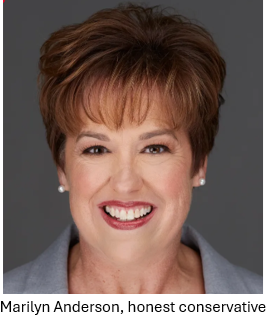
Anderson’s March 23 email returned to the same practical failures: no dynamic advertising campaign, no clear closing date, and continuing inconsistencies in the process. Ali said he would have more information by March 27, but that answer was useless if the board was scheduled to begin reviewing candidates on March 25. Anderson then reviewed the contract and concluded that HYA had not delivered what it promised. These failures led her to “question the thoroughness of the search.” [Emphasis added]
Anderson’s conclusion was blunt: Ali had failed to follow through, deflected responsibility, behaved unprofessionally, and left HYA open to a concrete contractual challenge. She identified the obligations HYA had failed to meet, insisted on a $3,400 rebate, and warned that she had the right to place the issue on a board agenda for public discussion.
More Hide Than Seek?

The Palos Verdes Peninsula USD scandal involving Cherniss was public enough that HYA should have known about it before recommending him to PYLUSD. If Ali did not know, that suggests a serious failure of basic due diligence. If he did know and failed to alert the board, the problem is worse: the search firm may have withheld material information from the very trustees who hired it to vet candidates. The same question extends to Trustees Frazier, Youngblood, and Blades. If any of them knew about the lawsuit or related controversy and kept that information from the full board, their conduct raises serious transparency concerns. The core issue, then, is not merely whether Ali missed a public lawsuit or concealed it. The real question is whether the superintendent search was ever a genuine vetting process at all—or whether it was a managed exercise in concealment, with vital information withheld from the elected board so a preordained candidate could be installed.

The details of the PVPUSD lawsuit are characteristic of the kinds of abuse and lawless disregard that came to characterize Cherniss’ two years in the PYLUSD. Cherniss’s PVPUSD tenure was marked by scandal that remains only partly visible because the Keith Butler wrongful-termination case settled out of court and the district has refused to release a publicly funded investigation reportedly tied to alleged misconduct by Cherniss and Deputy Assistant Superintendent Linsey Gotanda. Butler, PVPUSD’s former Assistant Superintendent of Business Services, settled the matter on February 9, 2023; it was dismissed on March 14. Because the withheld report appears connected to that case, the Butler litigation is the only publicly accessible record we have of Cherniss’ corruption. PYLUSD for Truth summarized it two years ago on YouTube.
The central allegation was a pay-to-play arrangement involving the American Youth Soccer Organization (AYSO) and the Measure PV bond campaign. In August 2019, PVPUSD reportedly sought about $350,000 from AYSO for environmental damage at Ladera Linda Fields. By January 2020, Cherniss allegedly proposed resolving the dispute if AYSO contributed $50,000 to the Yes on Measure PV campaign and made three additional $10,000 payments to the district. If true, the allegation is not merely that Cherniss settled a contested claim on unfavorable terms to the district he presumably represented; it is that he traded a district legal claim for political support that a public official could not lawfully demand.

Butler also alleged that Cherniss tried to use district resources to undermine the campaign against the bond. In a March 3, 2020 letter to the PVPUSD Board, Butler cited Education Code section 7054, which bars school districts from using district funds, services, supplies, or equipment to support or oppose a ballot measure. He claimed Cherniss directed him to prevent the for-profit District Print Shop from quoting work for the No on Measure PV campaign and, when challenged, told him to have the print shop “make a mistake on the flyer, or delay printing it.” Butler refused and directed the print shop to produce the flyer.

Butler (left) closed his March 2020 letter to the board by expressing fear of retaliation. Days later, the district did not renew his contract. Obviously, at least some people in the district besides Cherniss have things to hids. He filed suit on January 7, 2021, and the case settled two years later on undisclosed terms. The Measure PV campaign then lost, leaving behind not only a failed bond effort but a record of disturbing misconduct that HYA should have discovered before recommending Cherniss to PYLUSD.
Blaming Trustees Anderson and Buck for not conducting their own background investigation of the superintendent candidates reverses the chain of responsibility. The board hired HYA precisely to perform that function. At the time, Anderson and Buck had no obvious reason to question the firm’s competence or integrity, though HYA’s later conduct gives ample reason to do so. The two trustees’ objection to the contract was straightforward: HYA cost $21,000 more than competing firms offering essentially the same service.

That Trustees Frazier, Youngblood, and Blades were willing to pay that premium only heightens the concern. School board trustees are modestly compensated public servants who often perform these duties alongside full-time work and family obligations. HYA, by contrast, is a national executive-search firm reportedly generating nearly $20 million a year. The board’s duty was to select a competent firm; HYA’s duty was to conduct a competent search. If material information about Cherniss was missed or withheld, the failure belongs first to the firm paid to find it.
We know that Ali did not inform the board of the PVPUSD scandal because PYLUSD for Truth sent an anonymous inquiry and released this anonymous response. “No lawsuits were ever disclosed to the board regarding Cherniss. After the announcement community members made me aware of one of the lawsuits.” This is surely from either Trustee Anderson or Buck.
Because Trustees Buck and Anderson were deprived information by the search firm that would have enabled them to make a more informed decision, it is not surprising that they joined the board majority in welcoming Cherniss to the district on a 5-0 vote. Trustees Buck and Anderson would soon come to regret that vote.
Next: EPISODE 2
Tragedy and Character Assassination!


SIX parts??? Does Myovich think any normal person is going to slog through all of that?
Some will. Hundreds at least have.
Noting your name, please email Vern with your precise location. He won’t tell Sam.
@Kill Me Now just copy and paste the text into AI and ask for a summary if you don’t want to take the time. Just make sure you stay informed and vote accordingly