My friends involved in education in Anaheim were so excited when they sent me this press release, and invited me to this press conference on August 4 (video below.) I realized, reading and re-reading the release, that I do not speak non-profit. It was clear that SOMETHING called “community schools” had received funding from Sacramento of a billion dollars annually.
Members of the education establishment AND the gadfly-activists running to replace them were ALL there to celebrate, and I felt certain, seeing the enthusiasm in their eyes, that somehow under the warm fuzziness this was a good thing. But clearly there were questions to ask that YOU may have as well!

First, the Press Release.
Historic $1 Billion State Investment Brings
$35.5 Million in Community Schools Funding to Orange County
ANAHEIM, Calif. — Orange County Congregation Community Organization (OCCCO), school district leaders, OC Board of Education [didn’t see anyone from THAT dismal group], CA Partnership for the Future of Learning (CAPFL), partner organizations, and community leaders will hold a press conference Tuesday, August 4, celebrating $35.5 million in new Community Schools funding secured for Orange County.
With the Governor’s signature on the 2026-27 state budget, California secured $1 billion in ongoing annual funding for the California Community Schools Partnership Program — supporting nearly 2,500 existing community schools and expanding to approximately 3,700 additional schools statewide.
This year’s budget brings funding to Orange County schools and educational partners, strengthening shared leadership, integrated student supports, and family and community partnership. [?] Every California county is eligible for funding through the California Community Schools Apportionments Program (CCSAP), with amounts ranging from a single newly eligible school to established community schools receiving expanded support.
In Orange County, community schools help create welcoming environments where multilingual learners and immigrant families are valued as partners in student success. [?] We’re available to connect press with local students, families, educators, and community partners who can speak to what this investment means for Anaheim and Orange County. [Oh good we’re all ears!]
Date: Tuesday, August 4
Speaker Check-In: 8:30 a.m.
Press Conference: 9:00 a.m. (promptly)
Location: Steps of the Historic Cook Auditorium, Anaheim High School
Duration: 30–45 minutes
Speakers: Superintendents from AESD & AUHSD, OCCCO, Partner allies, community leaders
The Orange County Congregation Community Organization (OCCCO) is a community-based organization dedicated to advancing equity for Orange County families through grassroots organizing, family engagement, and advocacy. OCCCO works alongside parents, youth, and community leaders to strengthen community schools, expand access to vital resources, and ensure that the voices of underserved families shape the policies and programs that affect their lives.
OCCCO is part of the statewide CA Partnership for the Future of Learning and PICO CA Education for Liberation.
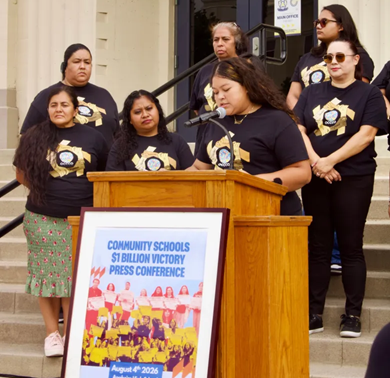
OK, so what does all that mean?
First of all, it seems some schools are just simply schools while other schools are also community schools, they have that attribute. And with this new funding, some schools that are not currently “community schools” will now be able to become community schools.
Also it turns out, not just ANY school can qualify for the program – 65% of the student body there must be “UNDERSERVED.” And how is the word “underserved” defined in education? It means either:
- Foster Youth,
- Low-Income, or
- “English Learner.”
And a student can’t be counted twice just cuz he or she falls into more than one category – it’s the “unduplicated count” in their jargon. But clearly, schools in high-income areas are not likely to qualify for this state-funded “community schools” program.
So anyway, WHICH schools are currently Community Schools in our area? Let’s start in…
Anaheim
Turns out, Anaheim is a “stronghold” of this program; Anaheim jumped on it as soon as the program began in 2021.
In the AUHSD (Anaheim Union High School District) ALL 17 schools – that’s 8 high schools, 8 junior highs, and a special ed school called “Hope” – are Community Schools.
The AESD (Anaheim Elementary District) began more gradually, adding campuses a few at a time over the last few years until now 21 out of 23 AESD schools are Community Schools.
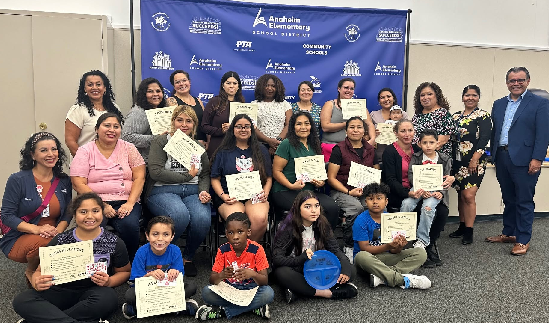
AESD Superintendent Jesus Chavarria (above at right) tells me that for his district, “the current funding for 2026-27 [before this latest development] is $6.15 million, and [now] for 2027-28 it will be $5.3 million. Although the funding is less, the good thing is that it is ongoing, which helps ensure each school can continue to operate as a community school.” And what IS a community school? Patience, we’re still gonna get to that…
The Rest of OC & California
According to the Register, 147 Orange County school sites across 14 school districts, 11 OC charter schools and ACCESS programs, serving about 85,000 students, have already received roughly $215 million in funding towards Community Schools. Andrea Yamasaki of the Orange USD tells me about half their schools (15 of ’em) are community schools, while in the much larger Santa Ana USD there are also 15, which is only a quarter of Santa Ana’s schools. So Anaheim is apparently the capital of Community Schools in the county!
Statewide, there are nearly 2500 community schools, and with the new funding they’re looking at maybe 3700 more!
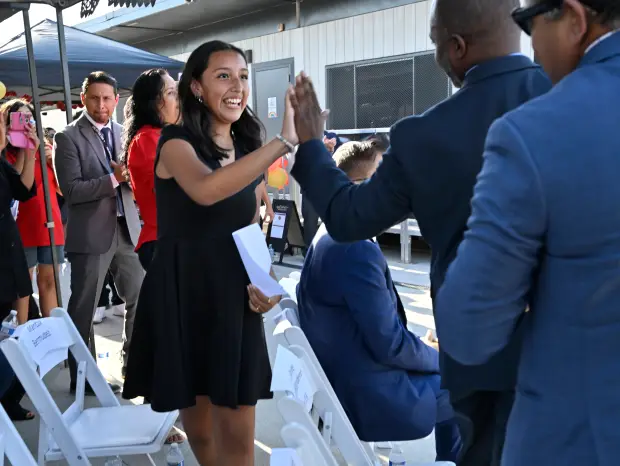
Starting things off at Anaheim’s Sycamore Junior High in ’22,
with class president Emma Alvarez & state superintendent Tony Thurmond.
So NOW, you’re wanting to know, and so am I, what IS a Community School, what does it do that other schools don’t, and why does it need this funding? And of course, since we are nothing if not responsible, is there oversight, are there benchmarks?
Yeah, what IS a Community School?
Basically, it’s a new way of running schools, a model that began in California in the COVID years, with four main features:
- Connecting kids and families with on-site medical, dental, or mental health care, plus food pantries and clothing;
- Offering after-school programs, tutoring, mentoring, summer camps, and real-world projects;
- Inviting parents and local groups into decision-making and welcoming them as active partners; and
- Using shared decision-making models where teachers, principals, families, and students guide school operations.

At the district level and at the school level, decisions are made by a “steering committee” consisting of an ever-rotating membership of 3 students, 3 parents, 3 teachers and the usual admins & staff. [I say anything’s good that’ll get more parents involved in their kids’ educations around here!] Gilbert HS principal Jose Lara tells me this really “flattens” the decision-making process, as in, makes it much more democratic. (Some say this ideal remains somewhat “aspirational” but there’s no pleasing some folks!)
“Partnerships” are a big element here, partnerships with local agencies that share an interest in a well-educated well-rounded healthy young citizenry. The AESD’s Chavarria lists “Villages of California, OCCCO, City of Anaheim, Latino Health Access, Anaheim Public Library and more” as examples of community partners.
- We are simple, literal people, tell us examples of some of these “real-world projects!”
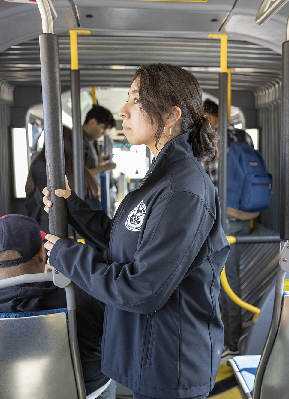
All right, here’s three. A problem at Gilbert was the OCTA bus schedule, especially the time it picked the kids up. It was very awkward, the way it passed by just a few minutes before the bell let classes out, which motivated a lot of kids to leave early. NOT ideal! Community School meetings were held on the topic, the factors involved in bus schedules were studied, letters were written to OCTA, students showed up at OCTA meetings… and a solution was found – the schedule was changed!
Another bus-related project: students from Sycamore, where OCCCO’s tireless super-mom Maritza runs the PTA, wanted to go to.. actually a conference on Community Schools in Ontario, as meta as that sounds. The first thought was to charter a bus, but the Steering Committee determined that if Sycamore used their own district bus they would save a lot of money, AND be able to bring more parents and students. Maritza is proud that this decision was reached by “consensus” rather than majority vote – a practice she brought from OCCCO!
And then there was the Peace Mural at Gilbert that the Steering Committee there decided to make in partnership with City Arts – a huge mural celebrating peace, created by dozens of Gilbert students on their big wall, which they now walk past with pride. And the press took note!
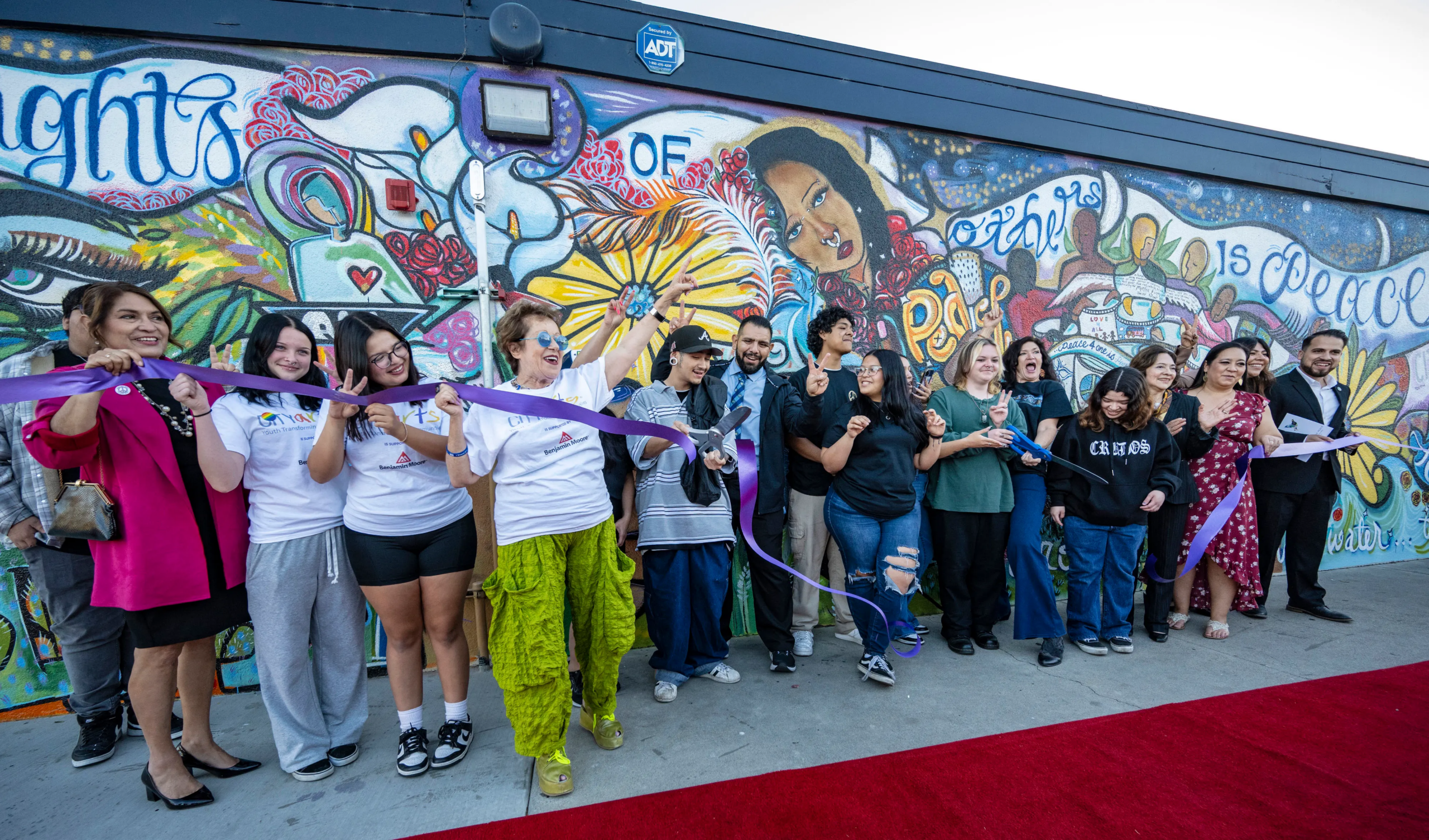

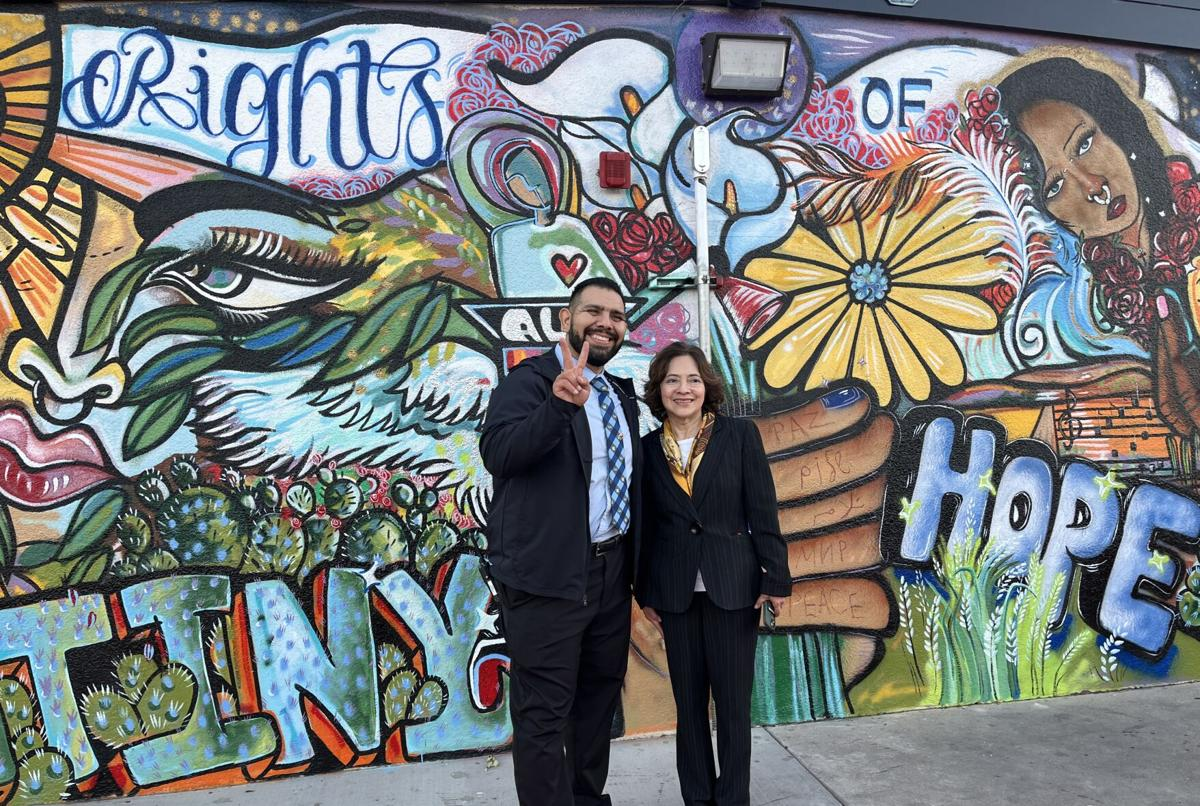
Hey, I know that guy – it’s Principal Lara! And isn’t that Audrey Rivera from the Mexican Consulate?
- And where does all that money go to exactly, this new state funding that we are celebrating? Is it filtered through some bureaucracy?
Lara, if I understood right, says some of the funding goes to the district, but MOST to the school sites “to fund initiatives that each school wants to pursue.” It also funds a social worker AND community school coordinator at each site, and free lunches where needed. AND it enables each teacher to take two periods off per day, to do the things teachers need to do that they’d otherwise have to do at home when they’re supposed to be off!
- And is there some kind of oversight? “Benchmarks?” “Strings attached?” “Deliverables?”
Yes. Each school has to send in a “progress report” annually to the state, to continue getting the Community Schools funding.
- Finally, I know we’ll all want to know this – have five years of “Community Schools” had a discernable impact on academic achievement?
STUDY SAYS YES. According to the Learning Police Institute last year, “With a historic $4.1 billion investment, California created its Community Schools Partnership Program in 2021. Initial results show that community school sites have effectively reduced their chronic absence rates post-pandemic, and forthcoming research documents improvements in attendance, suspension rates, and achievement for the first grantee cohort.”
And what a cohort that was! Even “A.I. Overview” is impressed, noting:
- Higher test scores: Students in community schools make notable academic progress, showing gains equivalent to dozens of extra days of learning in core subjects.
- Math improvements: Math scores increase by an average margin equal to roughly 43 additional days of instruction.
- Reading gains: English language arts performance improves by an amount comparable to about 36 extra days of learning time.”
I DID get up early August 4, as I promised Maritza I would, and watched the Community Schools press conference on the steps of Anaheim High School’s Cook Auditorium. And now you can see it too, if you care to:


