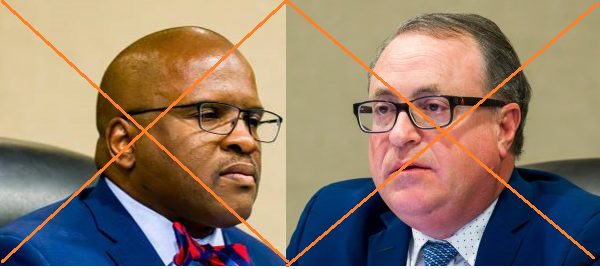
Gates, Cherniss
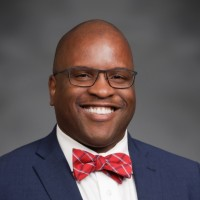
It is perhaps an indictment of the California Commission on Teacher Credentialing that Dr.Isaaic Gates and Dr. Alex Cherniss still hold Administrative Services Credentials. Rather than being held to account, they have been allowed to continue a pattern of waste, fraud, and abuse across multiple school districts for more than a decade. Gates’s $3 million lawsuit against the Placentia-Yorba Linda Unified School District (PYLUSD), filed on March 13, 2026, only underscores the point: litigation has become a weapon for extremists to drain taxpayer funds, strain public-school budgets, and deter honest citizens from serving on school boards.
Gates makes multiple claims of harassment and discrimination against the district, but offers little evidence to support them. The complaint identifies only three supporting documents: two communications from District Counsel Todd Robbins, dated June 20 and August 11, 2025, and a report by Nicole Miller & Associates that Gates cites in accusing Trustee Marilyn Anderson of creating a hostile work environment, engaging in unprofessional conduct, and committing racial discrimination. None of those documents appears among the complaint’s 30 pages of exhibits, which raises serious doubts about whether Gates has characterized them accurately.
The identities of the three people who allegedly accused Anderson will surprise no one familiar with PYLUSD board politics over the past six years. They were Micah Ali, who led the 2023 superintendent search that brought Cherniss to the district; Beth Fisher, former principal of Bernardo Yorba Middle School and the Orange County School of Computer Science; and Dr. Alex Cherniss, the superintendent Ali strongly recommended to the PYLUSD Board of Education. For anyone who knows the district’s recent history, the lineup is entirely predictable.

The most telling part of Gates’s complaint is also the most galling. In paragraph 138, he claims to have suffered “severe emotional distress” including fear, grief, shame, humiliation, embarrassment, anger, disappointment, anxiety, and worry—so severe, he says, that his working conditions became intolerable. Yet dozens of teachers and managers endured those same emotions during the Cherniss-Gates regime of intimidation.
The one emotion they may not have felt, but Gates plainly should, is shame. He should be ashamed of what he did to so many decent people in this district; of the hypocrisy underlying this complaint; and of demanding that taxpayers hand him another $3 million after the money wasted through his malfeasance and the damage his abuse of authority inflicted on the district.
He should also be ashamed of invoking race to explain his placement on paid administrative leave while lawsuits tied to his conduct were still unfolding. Racism is real and pervasive in this country and in our district, but Gates’ treatment is not an example of it. If the district capitulates here, the deeper injustice would be granting him a pass for conduct that would not be excused in anyone else.
PYLUSD should vigorously defend itself against this frivolous suit. Discovery would place under oath many people who could expose the broader pattern of abuse that defined the Cherniss-Gates regime. The district’s key witnesses are likely to be individuals driven out by the threats and intolerable working conditions created by Superintendent Cherniss and his deputy, Dr. Isaaic Gates.
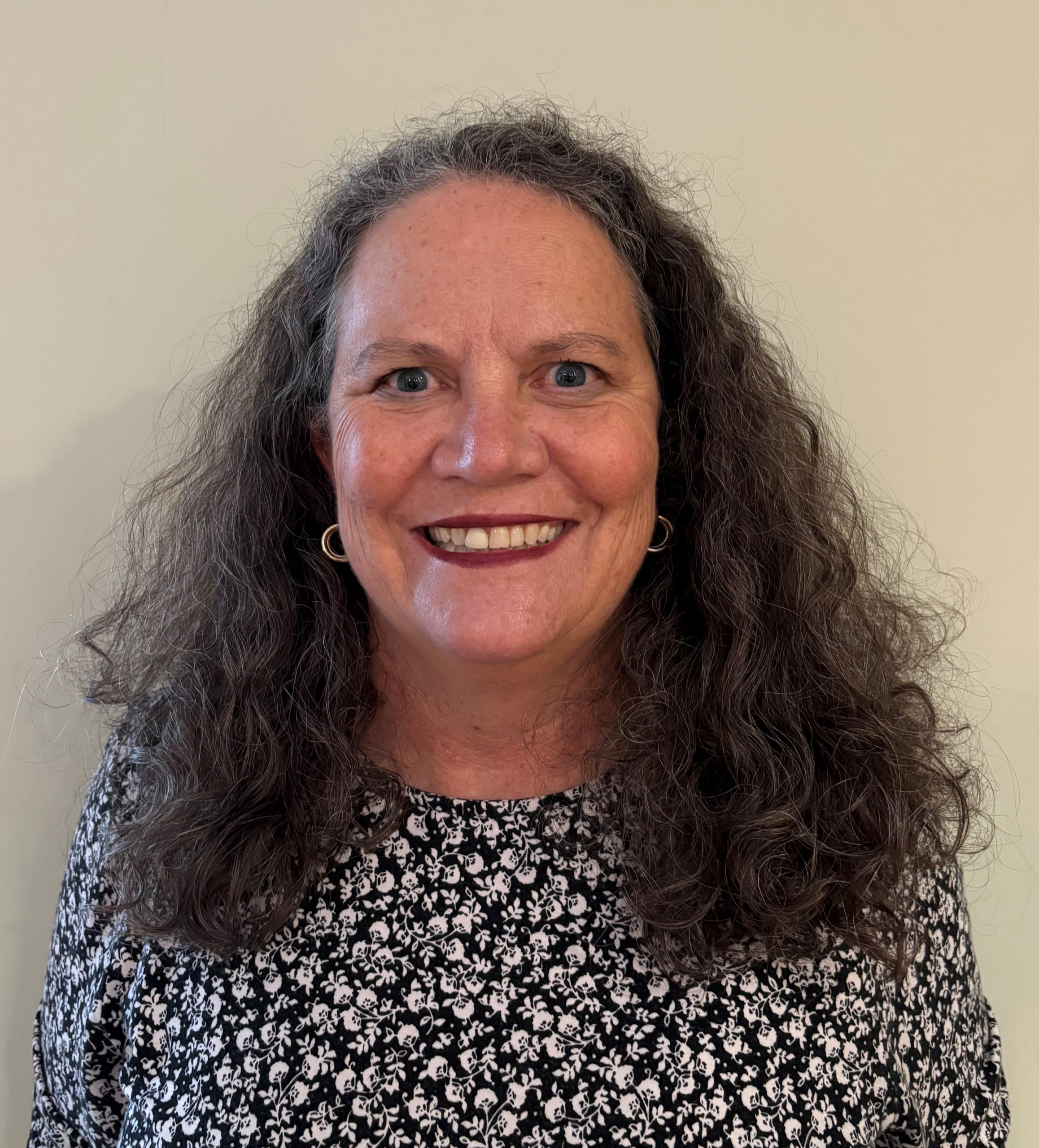
The district appears to be on solid legal ground in contesting Gates’s claim. It rejected his tort claim within six days, suggesting that the filing was deficient on its face. On its current allegations, the complaint may not survive demurrer before Judge Julianne Bancroft (left). And even if it does, the jury trial Gates demands could expose facts that have so far remained hidden and prove valuable in other venues.
Before turning to specific allegations in Gates’s complaint, it is worth reviewing what is known about the relationship between Cherniss and Gates. Patterns in their joint and separate conduct help illuminate the broader context of the lawsuit Gates has now filed. The account that follows is not exhaustive, but it highlights key elements that came into play in PYLUSD and persist in their current association in the Beverly Hills Unified School District (BHUSD).
Cherniss & Gates: The San Marino Years
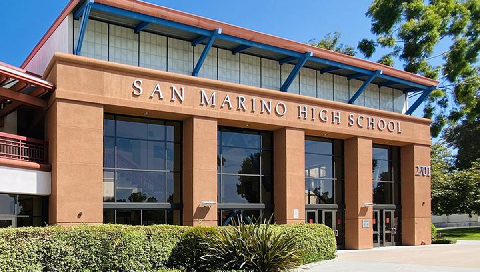
Cherniss first hired Gates in 2017 to serve as the principal for San Marino High School when Cherniss was serving in the San Marino Unified School District (SMUSD) as Superintendent. The district is small (ca. 3,300 students), wealthy, generally conservative, and high-achieving. Cherniss and Gates spent a year together in the district, after which Cherniss left to become superintendent for the Palos Verdes Unified School District (PVPUSD) in August of 2018.
And Why did Cherniss Leave?

Although Cherniss appears to have left SMUSD for reasons that may have been understandable and mutually agreed upon, developments surrounding his departure still raised legitimate concerns. On one level, moving from the small SMUSD to an equally wealthy and high-achieving district with roughly three times the student population could reasonably be viewed as a logical step for an administrator seeking a larger stage and broader impact. The move nevertheless occurred in the context of scandal surrounding the construction of the Barth Athletic Complex. While it is improper to place disproportionate blame on Cherniss for what transpired in this scandal, elements of the story will be all too familiar to people in the PYLUSD.
There is no question that when Cherniss left the SMUSD it was in worse fiscal condition than when he arrived five years earlier in 2013. In 2014, the district had $3.75 million in reserve and when Cherniss left in 2018, that number was down to about $2.5 million. Much of that decline in budget reserves likely related to cost overruns in the Barth Athletic Complex that Cherniss and the Board negotiated with Andy and Avery Barth in 2015. While the vision and private donations toward this impressive complex continued to expand, the portion of public liability in these ambitions continued to grow at a far greater pace than the private donations. By 2017, the district realized that it would fall far short of the $6.5 million needed to complete the project.

Instead of taking this problem to the public in the form of a bond, the SMUSD Board followed the lead of Cherniss and controversially took out a Certificate of Participation loan (COP). A COP is a controversial form of debt financing that allows public agencies to raise money, generally through a lease-style structure. It is a way of borrowing money against public assets without going through the approval of taxpayers, who will be funding that loan. The Board was easier to convince to approve the COP than the taxpayers would have been to approve a bond. When the Board passed the COP in 2017, members of the public became deeply concerned. By the following year, the budget reserves were expected to drop to $1.7 million by 2022 and Cherniss was off to the PVPUSD.
That, however, was not the only scandal affiliated with the Barth Athletic Complex. Andy Barth and his business partner Wayne Boyd negotiated use of some of the facilities at the Barth Athletic Complex to set up the Titan Mercury Wrestling Club (TMWC). Barth had become wealthy as an investment manager with The Capital Group in the 1980s, after an illustrious career as a wrestler at Columbia University from 1979-1983. Wayne Boyd was an NCAA champion wrestler at Temple University in 1969 who moved to California and acted in films and worked in the entertainment industry. Two weeks after the Barth Athletic Complex opened in August 2019, a jury convicted Wayne Boyd of sexual assault, physical threats, and assault and battery involving two women he allegedly lured with promises of stardom. There is no reason to believe that Cherniss could have or should have known about this behavior on the part of Mr. Boyd.
Much of this story was covered in an excellent article in the Pasadena Star News.
And Why did Gates Leave?

Gates also appears to have left SMUSD under a cloud. Before becoming principal of San Marino High School in 2017, he had spent seven years as an assistant principal in Los Alamitos Unified—five at the high school and two at the elementary level. Hiring an assistant principal to lead a high-performing school like SMHS was notable, though not inherently suspicious. His BHUSD biography still centers on his claim that SMHS was “the number one academically achieving high school in the State of California for three consecutive years.” SMHS was unquestionably a strong school, but there is no clear basis for the claim that it ranked number one during his tenure.
What is not in question is that his tenure in the SMUSD ended abruptly after three years. At the end of the 2019-2020 school year, Gates was reassigned from his principal position to become Director of Curriculum in May. Two months later, he was named principal of McGaugh Elementary School in his home community of Seal Beach, a return to the Los Alamitos USD. While there may have been good reasons for the move, including proximity to his children, it would not typically be viewed as a conventional step up from leading a high school.
The abrupt end to his stay in the SMUSD concluded two years later with a dispute settlement in favor of Gates in which he received $150,000. Reliable reports on the details of that dispute are not easy to find. It is very possible that the district chose to settle the dispute for this relatively modest sum of money as a practical concession to the prospective costs of litigation.
When Isaaic Met Alex

The SMUSD years appear to be the first of three times Gates worked under Cherniss, raising the question of when their association began. Given Cherniss’s long ties to Los Alamitos and Los Angeles education circles, their paths may well have crossed earlier. They also may have gotten to know each other through their affiliation at the University of Southern California Rossier School of Education, where they both graduated and currently claim adjunct professorships. Indeed, one of the people who has reached out to me and prefers to remain anonymous has suggested that the entire network of interests aligned with Cherniss and Gates is traceable to USC.

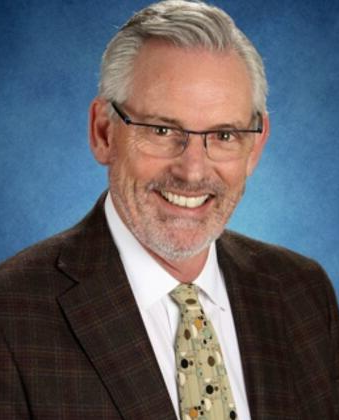
Setting that speculation aside, Dr. Jeff Barke (right) may be the more concrete link in the ongoing association between Gates and Cherniss. Barke served on the Los Alamitos USD board from 2006 to 2018, and Gates worked in that district for at least seven of those years. Cherniss lives in Los Alamitos, and Gates resides only a few miles away in Seal Beach. During the pandemic, Barke and Cherniss aligned in opposing state public-health protocols and in supporting frivolous litigation against the state. Barke is the founder and board chair of Orange County Classical Academy (OCCA), a charter school that critics view as advancing a Christian nationalist agenda under the banner of classical education. His ex-wife, Mari Barke, works for the California Policy Center and serves on the Orange County Board of Education, where she and her allies have promoted charter schools generally and OCCA in particular.
Divergent Paths, and the Cherniss Scandal in the PVPUSD
While Gates’s return to Los Alamitos after San Marino appears to have produced little of note, Cherniss’s five-year tenure in PVPUSD (Palos Verdes Peninsula USD) was shadowed by scandal, much of which remains hidden from the taxpayers who bore the cost. In the three years after he left the SMUSD, Gates spent two years as an elementary school principal in Seal Beach and then moved to become Executive Director of Secondary Education for the Inglewood USD.

Gates to Los Alamitos and Inglewood
Gates’s one-year stint in Inglewood should not be cast as an accomplishment. The district has operated under Los Angeles County Office of Education oversight since 2012, and a one-year tenure in a troubled system is rarely good for students or fiscally sound for the district. If Gates claimed in his interview that he would build sustainable programs and lasting relationships there, his brief stay undercut that promise almost immediately.
The Keith Butler Suit
Cherniss’s PVPUSD tenure was marked by even greater scandal, much of it still hidden from the public. An out of court settlement in the Keith Butler wrongful termination case limited what became public, and the district has so far refused to release a publicly funded investigation reportedly tied to alleged misconduct by Cherniss and Deputy Assistant Superintendent Linsey Gotanda. Butler was the former Assistant Superintendent of Business Services for the PVPUSD. The Butler matter settled on February 9, 2023, and was dismissed on March 14, 2023. Because the withheld report appears connected to that case, the Butler litigation is the logical place to begin. It was summarized two years ago on the YouTube channel PYLUSD for Truth.
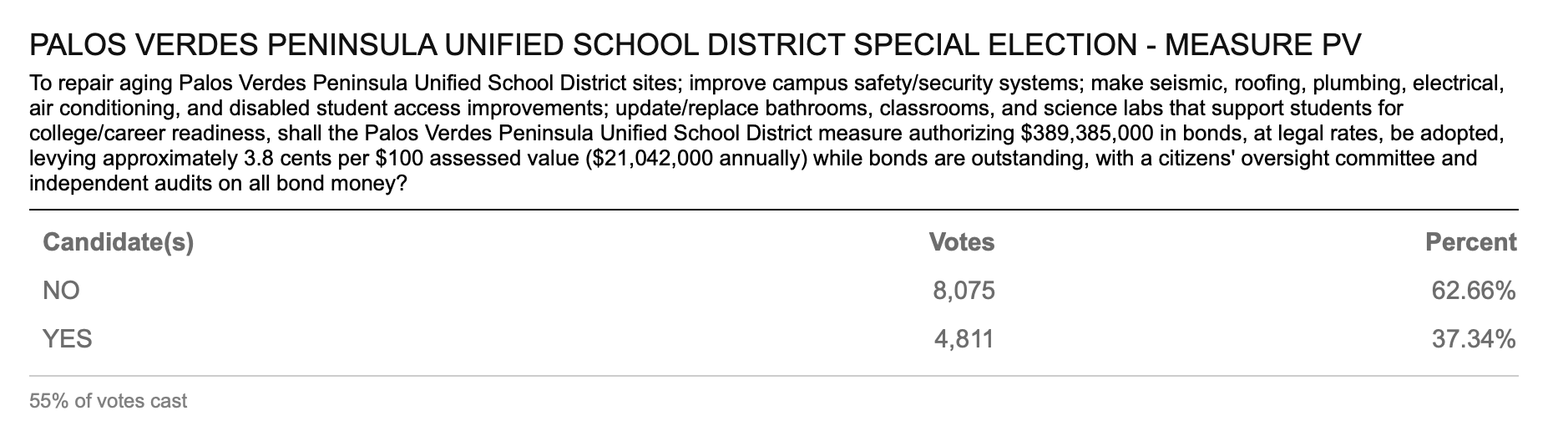
At the center of the Butler case is what appears to have been a plainly unlawful pay-to-play arrangement. Cherniss is accused of settling PVPUSD’s long-running dispute with the American Youth Soccer Organization (AYSO) on unusually favorable terms in exchange for AYSO’s financial support of a district bond campaign, the Measure PV Bond. In August 2019, the district was reportedly seeking about $350,000 from AYSO for environmental damage at Ladera Linda Fields. By January 2020, however, Cherniss offered a settlement under which AYSO would contribute $50,000 to the Yes on Measure PV Bond Campaign and make three additional $10,000 payments to the district. The Butler complaint and an April 22, 2020 letter from AYSO’s counsel to district counsel Terry Tao both reported this arrangement.
In essence, the allegation is that Cherniss traded a district legal claim for political and financial support he could not lawfully request in writing. Even if both parties conceded that this arrangement was the best way to resolve a highly contested resolution of the dispute, the way in which it took place cannot possibly be legal. If members of AYSO and PVPUSD counsel Terry Tao were complicit in this scheme, Cherniss was hardly the only person with a strong interest in making the scandal disappear. This pay-to-play arrangement, however, was not the only part of Cherniss’ corruption in this scandal.

Cherniss further abused his office in allegedly attempting to compel the District Print Shop to undermine the campaign against the Measure PV bond. In a March 3, 2020 letter to the PVPUSD Board, Butler recounts both the AYSO elements of his lawsuit as well as the print shop matter. On the AYSO matter, Butler notes that section 7054 of the Ed Code “forbids a school district from Using District Funds, services supplies or equipment for the purpose of urging the support or defat of any ballot measure, which would include a bond election. “ Butler claimed that if such an agreement occurred, “. . . it is likely that the District may have made an illegal gift of public funds.” The District Print Shop scandal also likely involved a violation of Education Code section 7054.
Cherniss once again used the power of his office and district resources to promote a political campaign that he favored. Both the No on Measure PV Campaign and the Yes on Measure PV Campaign had reached out to the for-profit District Print Shop to have it produce their flyers. While there does not appear to be an indication of special favors or discounts for the Yes campaign’s use of the Print Shop, Butler claims that Cherniss instructed him to tell the print shop not to provide a quote to the No campaign. When Butler told the No campaign what Cherniss had instructed, the No campaign challenged him to cite Board policy allowing the District this discretion. When Butler informed Cherniss of the No campaign’s response, he said: “Tell the Print Shop to make a mistake on the flyer, or delay printing it.” Butler responded: “We’re not having this conversation.” Butler then instructed the Print Shop to produce the flyer.
At the conclusion of his March 20, 2020 letter, Butler plainly conveyed his fear of retaliation for exposing Cherniss’s misconduct. A few days later, the district did not renew his contract. He filed his lawsuit on January 7, 2021. Two years later, both sides settled out of court on terms undisclosed to the public. Well-sourced rumors, however, indicate that Butler is very satisfied with the settlement.
Oh, and the Measure PV Campaign lost. Bigly.
The Mysterious Dickerson Report
It appears that the broader scandal surrounding Cherniss’s conduct—particularly the AYSO and Butler matters—prompted PVPUSD to retain an investigative firm to examine what had occurred. The firm they hired was Dickerson, McColloch and Associates.
Public details about the findings of this investigation have been hard to discover. Numerous people connected to our own PYLUSD have tried—and failed—to obtain the findings of the Dickerson investigation. Public records requests came from Richard McAlindin as early as August 2024, from Marilyn Anderson in October, from Linda Manion in November, and from the cryptic PYLUSDINFO as well.
Worth noting, too, are the requests submitted between November and January 2025 by Cherniss and Trustee Leandra Blades, during the period when Cherniss was on paid administrative leave. What, exactly, were they looking for at a moment when Cherniss was sidelined, Blades was working to undermine the election results, and Beverly Hills was preparing to hire Cherniss?
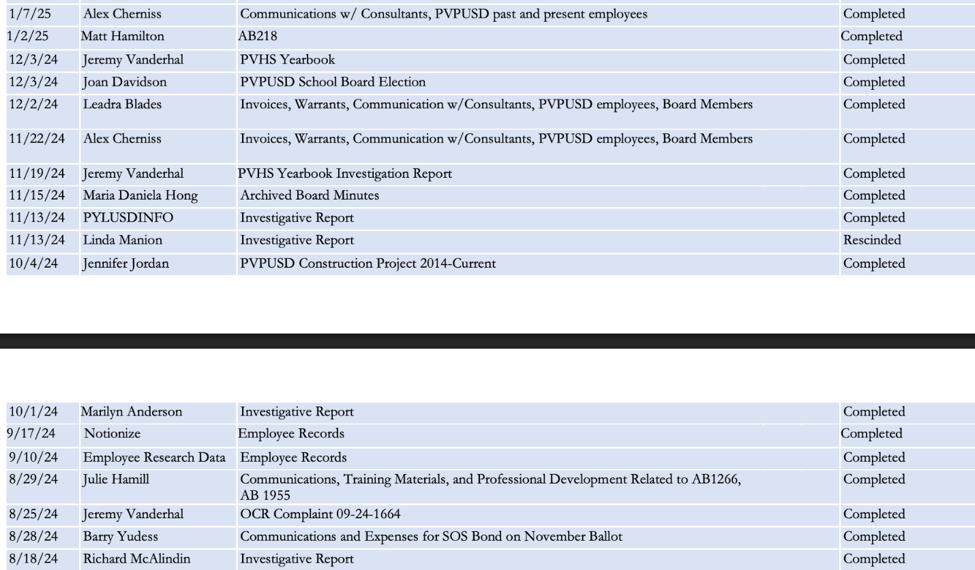
When the PVPUSD indicates that the PRA request has been “completed” it means that the matter has been legally closed and NOT that the requestor has received the document. One presumes that these requests have been denied due to the district’s perceived obligation to protect personnel records. Should Cherniss be called as a witness — he was listed as such in Gates’ September 2, 2025 tort claim– this document will surely be subpoenaed by the district. For now, though, the Investigative Report remains an enticing mystery.
One would expect that the CTC and other agencies are currently examining this. If not, then there needs to be a shakeup in Sacramento.

Was the Micah Ali Search Rigged?
The Butler lawsuit against Cherniss and PVPUSD settled just two months before PYLUSD hired him as superintendent. Yet the PYLUSD Board appears to have made that hire without being told by its search firm that the suit even existed. That omission was a serious failure by Hazard, Young, Attea & Associates (HYA)—particularly its two lead executive recruiters for the PYLUSD search, Micah Ali and Dr. Valerie Pitts. Whether the omission was deliberate or merely negligent remains unclear. But because Gates’s hiring flowed directly from Cherniss’s selection, that failure could become a central issue in the district’s defense against Gates’s claims for breach of contract and racial discrimination. Indeed, there is a lot of evidence that HYA violated its contract with the PYLUSD.
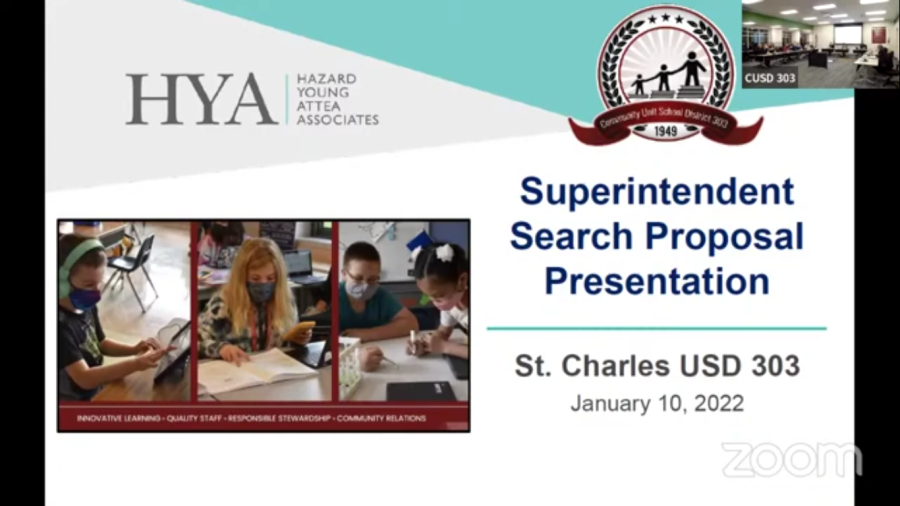
Anyone who argues that Trustees Anderson and Buck were at fault for not conducting their own background investigation of the superintendent candidates misses the point. When HYA was hired, the board had no obvious reason to question the firm’s competence or integrity, although there is ample reason to do so now. Anderson and Buck opposed the contract for one straightforward reason: HYA’s fee was far higher than the competing bids—specifically, by $21,000. That Trustees Youngblood, Blades, and Frazier were willing to pay that premium raises serious questions that should come out in deposition if Gates presses forward with his complaint. School board trustees are public servants who receive modest compensation and typically perform these duties on top of full-time jobs and family obligations. HYA, by contrast, is a national executive search firm that reportedly generates nearly $20 million a year. The board’s duty was to hire a competent firm, not to perform the search itself.
HYA did no one any favors by bringing Cherniss, and by connection Gates, to the PYLUSD. The process that resulted in the hiring of Cherniss in the midst of multiple scandals he was facing in the PVPUSD requires some context.
The Background Story: Culture Wars vs. Education

Before Cherniss and Gates were hired in spring 2023, PYLUSD had already lost two notable education leaders to the board’s extremist turn after the 2022 election. That election brought Todd Frazier onto the board to replace Karen Freeman—a sharp decline in educational leadership, given Freeman’s long service to the district and community. Frazier joined Shaun Youngblood and Leandra Blades, who had been elected during the pandemic cycle in 2020. The first major loss was Superintendent Jim Elsasser, who left in June 2022 to return to Claremont rather than work under a board increasingly consumed by culture-war obsessions. The following year, the assistant superintendent for human resources followed him out the door for similar reasons. Their departures help explain the conditions that opened the door for Cherniss and Gates.
Why Elsasser Returned to Claremont
Although the precise reasons for Superintendent Jim Elsasser’s resignation from PYLUSD at the end of the 2021–22 school year are not public, he appears to have had little appetite for remaining at the center of the culture-war battles that Blades and Youngblood brought to the board after their November 2020 election. Before coming to PYLUSD, Elsasser had spent nine years as superintendent in Claremont, a smaller district where he appears to have been highly regarded. The outgoing PYLUSD board signed him to a generous contract just before the 2020 election and the prospective extremist takeover. Elsasser also presented the unique opportunity to hire a superintendent with credentials of the highest caliber. Even with that protection, Elsasser needed only a year to decide that working under a board increasingly dominated by extremists was not how he wanted to spend this stage of his career.
Elsasser came to the district soon after the previous Superintendent, Greg Plutko, suddenly resigned in September. After Plutko made his announcement, citing personal and family health concerns, the district worked with ESS search advisers, who quickly recommended Elsasser as a replacement. Prior to his nine years as superintendent in Claremont, Elsasser had spent two decades as a teacher, principal, director, and assistant superintendent of human resources. In 2017 the Association of California School Administrators (ACSA) named him the Region 15 Superintendent of the Year (Pomona, Palmdale, West Covina, Pasadena, Burbank, El Monte, Santa Clarita, Lancaster, Glendale, La Puente, and Whittier). Interestingly, Elsasser’s earlier career included time as a middle school principal and director of classified personnel in Los Alamitos, the home district of Trustee Jeff Barke (2006-2018) and a district where Gates worked for at least seven years.
To lure a superintendent of Elsasser’s distinction away from Claremont, PYLUSD had to offer a strong package—and it did. In a 5-0 vote on November 10, 2020, the board approved a three-year contract with generous salary and benefits, along with a more controversial provision requiring a supermajority vote to terminate him without cause. That level of protection was likely necessary to persuade a proven leader to leave a district he valued for the risks of leading a larger one.
Two features of Elsasser’s contract matter here because Frazier, Youngblood, and Blades later used them as cover for the far more self-protective deal they gave Cherniss after PYLUSD voters had plainly signaled they were done with Cherniss and Gates. First, Elsasser’s supermajority protection applied only to termination without cause, and it passed 5-0—not on the extremists’ 3-2 lame-duck vote after the 2024 election. Second, and more important, Elsasser could still be terminated for cause by a simple majority. That contract struck an understandable balance: it protected a respected superintendent from immediate political retaliation while preserving the board’s ability to
remove him for misconduct. The later contracts did the opposite. They insulated Cherniss, Gates, and Assistant Superintendents Renee Grey and Olivia Yaung from accountability and put their interests ahead of the taxpayers’. Those contracts were not a continuation of Elsasser’s deal; they were a subversion of it.
Why did Rick Lopez Leave for Claremont?
When Rick Lopez left PYLUSD for Claremont about six months after his colleague and friend Jim Elsasser did, he appears to have done so reluctantly. Lopez’s ties to the district ran deep. His father had worked there and created an innovative program for at-risk youth (SERVE) that the district later adopted systemwide. Lopez himself had spent 28 years building his career in PYLUSD. Had extremists not taken control of the board in November 2022, he likely would have become the next superintendent. He also spent part of his childhood living across the street from Trustee Marilyn Anderson, and both families have long roots in the PYL community. Those ties gave Lopez strong reason to stay and fight for the district. But once it became clear that the new board’s hostility put his future there at serious risk, he followed Elsasser to Claremont, where he remains today.
The specific trigger may have occurred when the new board refused to follow established custom and name Anderson as the new President. Board bylaws do not provide clear guidelines for the rotation, but customary practice would have placed her in that role. This disregard of established protocol was a message to Lopez that the new era in PYL politics might make meaningful work in the district next to impossible. The following 2 ½ years in the district would bear out that assessment. Lopez informed the district of his plans to leave in January of 2023.

The way Lopez was treated on his way out of the district showed how little respect the new board majority had for proven leaders like him. In a characteristically dishonest move, Board President Shaun Youngblood (left) called a 9:00 a.m. special meeting on Saturday, April 22 to place Lopez on “special assignment.” In practice, that meant paid administrative leave: he lost his office, access to district email, and the ability to visit any campus other than the ones his own children attended. That was how Lopez’s career in the district ended. He is unlikely ever to return.
Despite the short notice and inconvenient timing of the April 22 special meeting, word spread quickly, and eighteen angry speakers came to address the three board members in attendance. Among those outraged by Lopez’s treatment was legendary retired teacher Mike Moore, a conservative Republican, who returned every award he had received from the district in disgust. Another revered teacher nearing retirement, Wendy Umekubo, voiced similar outrage. Several younger teachers who had been mentored by Lopez also spoke, putting their own careers and well-being at risk. It was a striking display of community support for Lopez, especially given the deliberately short notice and the Saturday-morning timing.
The shameless board majority had intentionally scheduled this controversial special meeting for a time when Trustees Buck and Anderson were certain to be unavailable. The morning of April 22 was Love Placentia, the city’s annual community service day, and both trustees serve in organizations central to that event’s operation. Despite President Youngblood’s claim to the contrary, it is impossible to believe the timing was accidental. The obvious purpose was to shut Buck and Anderson out of the deliberations. That maneuver was blatantly dishonest and appears to have violated the Brown Act. Everyone could see it—except, apparently, District Attorney Todd Spitzer. Three days later, at the regular board meeting, Anderson delivered a pointed public rebuke: she handed Youngblood a stack of papers containing her schedule for the rest of the year and made clear that if he intended to call any more special meetings, she would appreciate if he consulted those first.
Trustee Anderson had every reason to be angry. She had known and appreciated the Lopez family all her life, and for at least three generations her family has attended schools where both Rick Lopez and his father worked. She was forced to sit through lies from the board majority’s henchmen about Lopez’s alleged dishonesty and supposed pending investigations. But Lopez was not the only reason Anderson was outraged in the spring of 2023. She also had an insider’s view of the process that brought Alex Cherniss to PYLUSD as superintendent—a process she had ample reason to regard as corrupt, with Micah Ali at its center.
How Micah Ali brought Cherniss to PYLUSD.
Micah Ali’s role in Gates’s lawsuit against PYLUSD matters for two main reasons. First, Ali largely controlled the search process that brought Cherniss to the district. Second, he is one of the three complainants identified in Gates’s October 27, 2025 filing with the California Civil Rights Department (Exhibit B). Gates evidently views Ali’s complaint as further proof that Anderson’s conduct was racially biased, a bias later directed at him as well. But while Anderson clearly had pointed exchanges with Ali, the claim that her anger toward him was rooted in racial animus is as ridiculous as claiming that her anger toward Gates was racially motivated. Both Ali and Gates had earned Anderson’s anger.
Who is Micah Ali?
A casual background search into Ali raises nothing that would lead one to believe that he would have an interest in promoting a candidate like Cherniss. He has been a leader in Compton since he graduated from its public schools. He has served on the Compton USD board continuously since 2007. He has strong ties with the predominantly Democratic political leaders in his community. According to the Hazard, Young, Attea & Associates (HYA) website, “he helped lead a dramatic turnaround of the [Compton] district’s educational outcomes as well as help pull it from the brink of state takeover (or state receivership).” The HYA website does not indicate how long he has been working with that executive search firm. He seems, at least from the perspective of a distant observer, an outstanding young leader with an authentic vision for education.
There is no reason to think Trustees Buck and Anderson opposed hiring HYA for anything other than fiscal reasons. At the January 17, 2023 board meeting, their only stated concern was that HYA’s bid exceeded the others by $21,000. Soon afterward, however, Anderson began raising serious concerns about Ali’s handling of the search.
Marilyn Anderson Questions Ali’s Professionalism
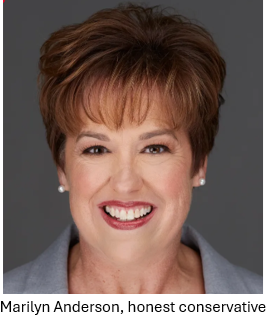
Anderson’s concerns with Ali had to do with problems she perceived in relation to specific elements of the search, a general lack of response to Anderson in her inquiries to him, and a lack of professionalism. Anderson, an inveterate notetaker, presented her complaints in an April 4, 2023 email to Dr. Nanci Perez, COO of HYA. The Trustee presented a timeline of incidents that documented her concerns with the search process.
Anderson references March 3 emails she sent to Ali and an HYA employee, Stephanie Norwalk, in which she noted the absence of advertisements for positions in common publications where they should appear. She also noted that in the various advertisements she did see, there was not a consistent date for closing the search, ranging from March 1 to March 10. Unsatisfied with Norwalk’s answer to Anderson’s questions, a phone call was arranged between Anderson and Ali for March 5. It did not go well.
Ali’s dismissive treatment of Anderson suggested that the real problem was more likely his sexism than any alleged racism on her part. In the March 5 phone call, he repeatedly told her that his personal recruiting efforts were more important than advertisements. Anderson reminded him that advertising was a prominent feature in HYA’s appeal to the board in January and was also part of the signed agreement. An extended argument ensued over these matters. The dispute ended with Ali claiming that Anderson didn’t like him and Anderson simply hanging up in frustration. Mr. Ali then phoned Youngblood and complained to him about Anderson, again claiming that she did not like him. Upon hearing of this, Anderson decided that thereafter all communication with Ali would either be done by email or in a public setting with witnesses.
Anderson then recounts to Dr. Perez her dissatisfaction with Ali’s response to an email she sent to him on March 23. In that email, Anderson reiterated her concerns over the lack of a dynamic advertising campaign, a clear closing date in the ads that were published, and other inconsistencies in the search process. In his response, Ali indicated that he would have the information by March 27, but that was unsatisfactory because the board was to begin reviewing candidates on the 25th.
In frustration that evening, Anderson scrutinized the contract and determined that HYA was not fulfilling their stated commitments. The details of the advertising campaign were laid out indicating the sites that would be targeted and where they would be placed. The cumulation of concerns led Anderson to “question the thoroughness of the search.” [Emphasis added] She then indicated to the COO that she deemed Ali to be “highly unprofessional” in his failure to follow through on commitments, deflecting blame onto others including herself, and even name calling. She then identified the specific contractual obligations that HYA failed to fulfill and requested a rebate from them for $3,400. She indicated that she had the right to place such a request on the board agenda and have it publicly discussed.
Anderson concluded with this:
“Additionally, I would like Mr. Ali to act more professionally. He needs to stop deflecting, name calling, and gossiping. After hearing how he talks about others, I am worried about what he is saying about us to others. I find this behavior unappealing, unprofessional, and definitely cause for lack of trust.
“I would hope Mr. Ali would be reminded that the search and all conversations shall remain confidential. I would hate for our district, superintendent, or board members to become one of his talking points in his work with another district.
“Because of the importance of having a more professional atmosphere during the interviews taking place on April 8, I would appreciate it if Ms. Pitts would accompany Mr. Ali.
“Lastly, while I would appreciate an apology, what I truly want is the best possible outcome. Our community and our children are counting on HYA to assist us in finding the next leader for the Placentia-Yorba Linda Unified School District.”
By all appearances, Anderson’s concerns with the performance with HYA and Ali were justified. The reference to “Ms. Pitts” above involves Dr. Valerie Pitts. When HYA pitched their services to the PYLUSD, she was presented as a partner in the search along with Ali. Instead, Dr. Pitts played a minimal role in the search. Anderson’s concerns with “the thoroughness of the search” raises the bigger question of whether the search was a managed outcome.
Had Ali Steered the Outcome in Favor of Cherniss?

How Cherniss came to be one of the primary candidates to lead the PYLUSD after an allegedly nationwide search may reveal a corrupt network of influences that will come out should Gates’ complaint result in a trial. Blades, Frazier, Youngblood and Cherniss will certainly all be called as witnesses. The mutual connections of these four to Jeff and Mari Barke and the California Policy Center (CPC) will certainly come out as one of the factors leading to Cherniss’ hiring. There is also evidence in Anderson’s correspondence with HYA as well as further anecdotal indications that Ali and HYA were colluding with the three board extremists in determining the outcome of the search. At the end of the search, then Board President Youngblood gloated: “We have hired someone who reflects the values of our community.”
What Youngblood meant was that the district had hired someone he saw as a counterweight to what he regarded as the CTA’s pernicious influence and the broader ideological biases of the educational elite. More broadly, the three extremists opposed allowing Black people to tell their own stories, as reflected in the district’s CRT ban; they opposed allowing students grappling with sexuality and gender identity to maintain trusting relationships with counseling professionals; and they showed open disregard for anyone who did not share the religious and cultural identity of PYL’s dominant group.
The three board extremists specifically admired Cherniss’ willingness to oppose science-based protocols applied during the pandemic. While it is not clear that Cherniss directly colluded with Barke in their individual challenges to California state COVID protocols, their mutual opposition to masking, quarantine, and vaccine mandates and the fact that they lived close to each other around Los Alamitos raises some provocative questions. The close affiliation of the three PYLUSD board extremists to the CPC and the Barkes is obvious. The question is the extent to which Ali knew any of the major figures involved: the Barkes, Dr. Cherniss, and Dr. Gates.
A less speculative question—one that discovery should answer—is whether Ali knew about the serious allegations against Cherniss in the Butler lawsuit and, if so, whether he disclosed them to the PYLUSD board. One board member has said anonymously that the board was not told about the Butler suit before voting to hire Cherniss. If that is true, Ali should face pointed questioning if he is called as a witness in Gates’s case. The timing only heightens the concern: the Butler suit was settled while the PYLUSD search was underway and Cherniss’s hiring was being finalized.

Either way, Ali has a serious problem. If he did not know about the Butler lawsuit, then he failed to investigate Cherniss adequately. If he did know and withheld that information from the board, the omission was far more serious. And if Ali and the three extremist trustees knowingly kept Buck and Anderson in the dark while moving Cherniss forward, that conduct could raise grave Brown Act issues and possibly more. Those questions should matter to anyone concerned about the damage Cherniss and Gates, aided by the board majority, inflicted on PYLUSD.
Cherniss & Gates’ Gutting of the PYLUSD.
In just over eighteen months, Cherniss and Gates did enormous, deliberate damage to PYLUSD. Acting in lockstep with the extremist board majority, they turned a destination district for families, teachers, and administrators into an embarrassment and a place talented people were eager to leave. The ill-conceived and costly Universal Sports Institute echoed the same kind of grift that had followed Cherniss in San Marino and Palos Verdes. The farce of the Orange County School of Computer Science—and of principal Beth Fisher—was laid bare at the January 14, 2025 board meeting. The waste, institutional damage, and legal violations tied to these ventures have already been well documented elsewhere. Because Gates served as Deputy Superintendent of Human Resources, the focus here is on the abuses and losses for which he bears primary responsibility.
Cherniss and Gates drove out a large share of the district’s Generation X and millennial educational leadership. The following partial list illustrates the losses during the year and a half of the Cherniss-Gates regime, with years of district service in parentheses:

- Richard McAlindin (23),
- Missy Samson (17),
- Linda Adamson (11),
- David Giordano (8),
- Tom Craik (30),
- Alyssa Griffiths (7),
- Brad Runge (28),
- Joey Davis (18),
- Jamie Jauch (26),
- Jeff Giles (2),
- Dinah Felix (6),
- Julie Pak (20),
- Greg Kemp (28),
- Scott Mazurier (20),
- Connor Drake (26),
- Jose Miranda (3),
- Beth Scott (3);
- Leighann Swarm (10),
- Jeff Louis (25),
- Geoff Smith (15),
- and Richard Dinh (7).
Not every departure can be tied with certainty to the toxic environment Cherniss and Gates created, but most appear to be.
What the district lost in these departures was not merely personnel, but a generation of real leadership. These were the people who built programs, earned trust, and sustained relationships over decades. They mentored younger staff and quietly carried the institutional memory that held the district together. Because those leaders had already helped develop a new generation behind them, Cherniss and Gates could not destroy everything in their thankfully brief tenure. Even so, the loss was profound. What remains is a district asking people to step into roles for which they are not yet ready, without the steady guidance of the very leaders who should have been there to help them grow.
The Three Pending Court Cases

Violations of the Labor Code, the Education Code, and contract law are well documented in three lawsuits arising from the Cherniss-Gates regime. The details of the Beth Scott, Richard McAlindin, and Tom Craik suits against the district are covered at length here. McAlindin’s case settled for $300,000 to compensate for losses caused by the district’s breach of his contract. He also has a compensation claim seeking to recover the pension loss he suffered when he was forced from an assistant superintendent position into a middle school principal role. That pension claim will surely exceed the civil settlement because assistant superintendents commonly earn about $100,000 more per year than middle school principals, and that difference is reflected in retirement compensation. If anyone deserves a $3,000,000 compensation due to breach of contract, hostile work environment and “intentional infliction of emotional distress,” it is McAlindin. Instead, he is merely asking for what he rightfully earned for his years of work in the district.
Tom Craik’s suit against the district continues despite his tragic death. His wife, Luann, has amended the complaint to add a wrongful-death claim. If that claim survives, the case could become far more serious for Gates and Cherniss, even though neither has yet been named as a defendant. The underlying allegations appear at least as strong as those in McAlindin’s case, which the district has already settled. That leaves the district in a difficult position if it chooses to fight both the Gates and Craik cases. The same conduct that justified placing Gates on leave may also help substantiate Craik’s claims. A district that uses Craik-related facts to defend against Gates will have a hard time turning around and minimizing those same facts in Craik’s case.
The district faces the same dilemma in the Scott case. If anything, Gates’ malfeasances in the Scott case are even more well-documented than in the Craik case. There are more documents showing the violations and more witnesses to the meetings in which other violations occurred. If the district has to explain to a judge or jury why it removed Gates from his office, the evidence in the Scott case will be powerful.
A couple of things should be borne in mind about these three cases.

First, districts usually do not pay such settlements directly; their insurers do. The McAlindin settlement, and any future settlements in the Craik and Scott cases, will not come straight from classroom budgets. The real cost comes later, in higher insurance premiums for a district that repeatedly violates individuals’ rights, the Ed Code, and Labor law. Those rising costs are part of the legacy of electing far-right ideologues to the school board. They are indifferent to this waste because their larger project is to weaken public education, and frivolous litigation and unserious programs are among the tools they use to do it.
Second, suing a public institution is punishing in ways that go far beyond legal fees. It drains time, money, and emotional energy, and it can quietly damage a person’s future employment prospects. Craik and McAlindin were somewhat better positioned to bring their claims because they were near the end of their careers and had less to lose professionally– and because their cases were strong. Scott’s case is also strong, but it has dragged on for roughly four years. In the meantime, despite holding an administrative credential, she has been working as a teacher’s aide. That is the practical reality of suing a school district: even a compelling case can leave the plaintiff professionally stranded while the system wears her down. Try getting a job in any school district when you are suing one!
Other Abused Administrators as Witnesses
If the district chooses to fight Gates’s lawsuit, it will have no shortage of witnesses prepared to describe the abuses committed by Deputy Superintendent for HR Gates and his superior, Cherniss. Many of these former employees had strong claims against the district arising from the superintendent’s office during Cherniss’s tenure, but chose to move on with their careers rather than endure the burdens of litigation. Potential witnesses include Jamie Jauch, Richard Dinh, Sue Sawyer, Brad Runge, Jeff Giles, Keri Walters, Joey Davis and many others. Their accounts of mistreatment are likely to be corroborated by central office staff who watched in horrified silence as those abuses unfolded.
Among the former district employees with strong claims of abuse, few appear to have a stronger case than former El Dorado principal Joey Davis. Cherniss offered Davis a district-office position on one condition: he had to tell the El Dorado staff that he preferred that role to remaining principal. Davis refused to tell that lie. If Cherniss wanted him out, he would have to remove him openly. Gates then signed the letter notifying Davis of his termination. That letter claimed the board had voted unanimously to remove him.
That claim created two serious problems. First, Davis can prove that no such board vote ever occurred. If the board had voted to remove him, Davis would have been entitled to know the basis for that action. Second, if such a vote had occurred, it would have happened in closed session. Gates would not have been entitled to disclose the details in the manner he did, and doing so would itself have raised serious legal concerns.
After Davis was forced out at the end of the 2023–24 school year, his removal became one of the central issues in all three school board campaigns that November. Many observers regard it as the single most important factor in the victories of Tricia Quintero and Marilyn Anderson. Throughout the campaign, opponents of Quintero and Anderson repeatedly invoked the fictional 5–0 board vote. The implication was clear: something must have been seriously wrong for all five trustees to want Davis gone.
At the packed October 8, 2024 board meeting in the lead up to the November election, Joey Davis set the record straight. He described the phony district-office deal Cherniss had tried to pressure him into accepting. He described the bogus 5–0 board vote cited in Gates’s letter. And he described the toxic environment created by the superintendent. He did all of that in a single minute. The standing ovation that followed lasted several times longer. For those who take the trouble to watch the video link, take note of the response of the student board member, Luke Gilstrap of El Dorado High School. It speaks volumes.
The smears against Davis have continued to this day. They largely originated in the notice Gates sent him. Gates was foolish enough to put his abuse in writing, and he did so in other cases as well. Many people have been waiting for a chance to make public what happened during the twenty-month reign of abuse in the Cherniss era. Let us hope Gates pursues his claim. Let us hope the district stands up to it. Let discovery begin.
The People Spoke. Isaaic Gates did not Listen.
The November 2024 election sent an unmistakable message: PYLUSD voters were done with the Cherniss-Gates agenda and the mistreatment of proven district leaders. Quintero flipped Youngblood’s seat by roughly 25 points. Anderson won reelection by about 11. Even Blades, running in Area 3 where Trump received 62 percent of the vote, managed only 53 percent. Voters wanted a new direction, and Cherniss, Gates, and the outgoing board majority should have understood it.
In the lame-duck weeks after the election, the outgoing board majority—soulless agents of a corrupted political system—used its remaining power to make Cherniss and Gates extraordinarily difficult to remove. On November 19, 2024, it amended the contracts of Cherniss, Gates, Olivia Yaung, and Renee Grey, extending them beyond the November 2026 election and requiring a supermajority vote to terminate any of them, with or without cause. Those amendments are reproduced in Exhibit C to Gates’s complaint. That same day, the California Teachers Association sent a cease-and-desist letter challenging their legality.
CTA, however, does not appear to have pressed the challenge beyond its November 19 letter. Why it stopped there is unclear. CTA may have concluded that the letter itself was enough to give the district cover to keep Gates on paid administrative leave until he could be terminated on solid legal grounds. Instead, Gates followed Cherniss to Beverly Hills in November 2025 and began claiming that he had been “constructively wrongfully terminated.” A board may have some arguable authority to extend a superintendent’s contract and require a supermajority for dismissal. It may even have arguable authority to extend similar protections to the superintendent’s subordinates. But whatever legal footing the lame-duck board thought it had, the larger wrong was political and democratic: it tried to lock in control of the district after voters had chosen a different direction. That is a small but telling example of moneyed interests distorting democratic self-government at its most local level—the elected school board.
A Lawsuit Built on Sand.

Despite the 140 paragraphs in his 24-page complaint, Gates offers little compelling support for any of his claims. He provides no evidence at all for his allegations of racial discrimination. The only specific material he identifies that might suggest improper conduct by the district concerns statements attributed to Todd Robbins. That thin showing appears in paragraphs 18 through 20 of the complaint.
The June 20, 2025 “communication” from “PYLUSD’s Attorney, Todd Robbins,” referenced in paragraph 18, raises more questions than it answers. If it was a letter, email, memorandum, or other written communication, Gates did not attach it as an exhibit. Readers are left with only his description of it, just as they are left with only his account that prior “false allegations” against him were found “not sustained.” Paragraph 19 may relate to that same investigation, but the complaint does not make the connection clear.
What is clear is this: on December 19, 2024—exactly one month after Gates and others received enhanced contracts requiring a supermajority for dismissal—the board voted 5–0 to place seven administrators, including Gates, on paid administrative leave. A
unanimous board does not take that step without serious cause.

The same December 19 meeting included another revealing move: the new board retained Atkinson, Andelson, Loya, Ruud & Romo (AALRR). Trustee Blades (left) opposed that contract vehemently, and Frazier opposed it more quietly. Todd Robbins is a partner at AALRR. The connection matters for another reason as well: PVPUSD retained the same firm immediately after parting ways with Cherniss. Blades and Frazier had every reason to worry about bringing in a law firm with both credibility and institutional knowledge of Cherniss’s prior troubles.
A third item on the December 19 agenda reinforced the point. The board had scheduled the appointment of Doug Kimberly as interim superintendent while Cherniss remained on paid administrative leave. Kimberly was the superintendent who succeeded Cherniss in PVPUSD. In other words, the district not only hired a law firm with direct familiarity with Cherniss’s litigious tenure in Palos Verdes; it also tried to bring in the very administrator who had stepped in after him there.
Oh, to have been a fly on the wall at that closed-session meeting. The board could hardly have signaled its priorities more clearly—unless it had also put on the agenda the
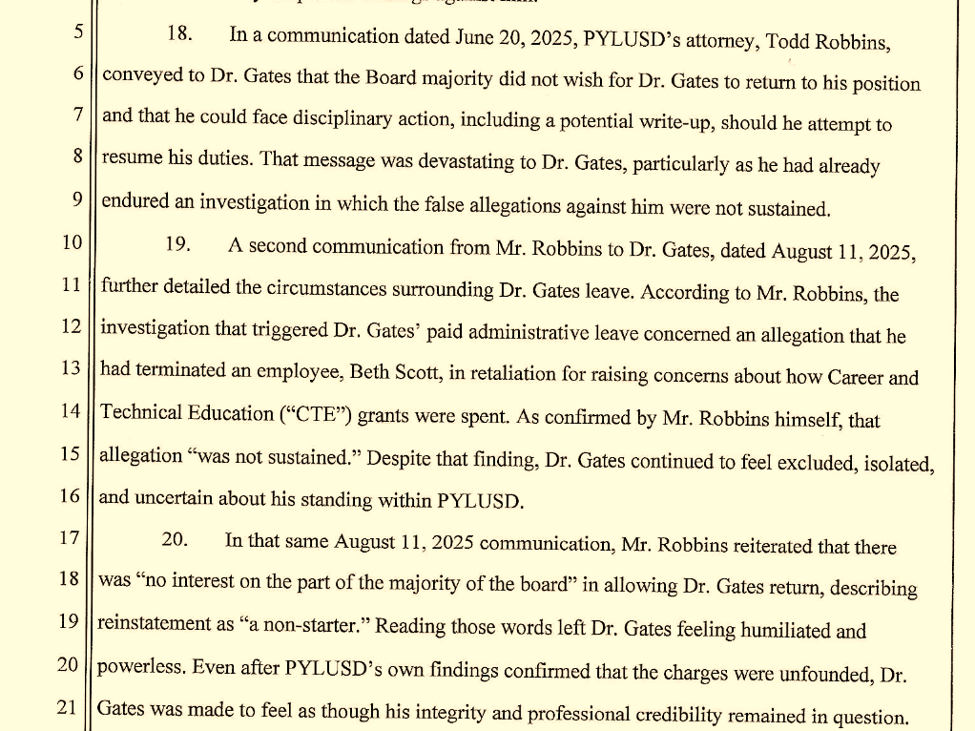
A second communication from Robbins to Gates, dated August 11, 2025, also requires us to trust Gates’ summary of a document that is not in evidence. Both assertions that Gates draws from this “communication” again does little to clarify matters.
In paragraph 19, Gates makes the doubtful assertion that he was put on paid administrative leave because of his role in the Beth Scott matter. If that were the only dispute in which Gates’s malfeasance was at issue, he might have an argument. But we know there were at least two other lawsuits, one of which the district has already settled in favor of the plaintiff, for which Gates was largely to blame. As discussed above, there were also numerous other complaints by employees abused by Gates, and those potential claims also likely weighed on the board’s decision to place and keep him on paid administrative leave. Even if we take Gates at his word that the issue raised in the Scott matter “was not sustained,” there were plainly other allegations that remained of concern.
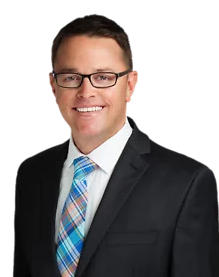
Gates then builds on this weak premise of purported clearing in the Scott case to argue that the district had no legitimate reason to keep him from his assigned duties. Whether Robbins (right) was on sound legal ground to say that there was “no interest on the part of the majority of the board” in allowing Dr. Gates to return, and that his “reinstatement was a ‘non-starter,’” is a question for lawyers to debate. The basic point is simpler: bringing Gates back would have jeopardized the district’s position in the existing and possible future cases arising from his conduct. The board majority is acting in the interests of the district. It is also complying with the will of the voters.
For all the useful facts that discovery might uncover if this case ever reached trial, the more likely outcome is that it will not survive demurrer. On the allegations Gates has pleaded, this is not a strong case. Gates would be better served by taking the money he has already received from this district and turning his attention to staying out of trouble in Beverly Hills. That, too, appears unlikely.
Beverly Hills Swap!

A little more than four months after PYLUSD placed him on paid administrative leave, Cherniss landed in Beverly Hills on April 10, 2025—and quickly reverted to form. Though BHUSD is only a fraction (1/7) of PYLUSD’s size, it is riven by similar political fault lines, and Cherniss has again aligned himself with the board’s extremist faction. He has brought with him former PYLUSD loyalists tied to his most controversial projects, alienated much of the staff, helped violate district bylaws, and now finds himself entangled in yet another lawsuit. Wherever Cherniss goes, turmoil follows.
The political divisions in Beverly Hills resemble those in PYLUSD, even if the local mix is not identical. Both communities are affluent, high-performing, and polarized, with conservative voters retaining substantial strength and recent elections in Beverly Hills suggesting a modest drift to the right. One difference is that the extremism emerging in Beverly Hills has a distinctly Jewish character. There is a strong element among the more recent Jewish immigrant community in BH that identify specifically with the most virulent, pro-Netanyahu elements of the Israeli government. In a district as small as BHUSD, those tensions are especially intense, and they have created an environment in which the same style of factional leadership that operated in PYLUSD can persist there as well.
Those divisions were already visible before Cherniss arrived. After Trump’s victory in the 2024 election, dozens of Beverly Hills High School students reportedly celebrated in the campus courtyard, and some of the resulting confrontations turned violent. Black teachers and students also reported an increase in racist verbal harassment after the election. Two Black teachers have since sued the district, and another teacher alleges wrongful termination after criticizing Trump on her personal Facebook page. Some of the pro-Trump demonstrators also claimed to have been physically abused by staff.
As those controversies intensified in the wake of the rally, the district’s instability created an opening for Cherniss to enter BHUSD and begin bringing in people from his PYLUSD orbit. Superintendent Dr. Michael Bregy resigned effective February 24, 2025. On April 10, the BHUSD board hired Cherniss as superintendent on a 3-2 vote, after Leandra Blades and Beth Fisher spoke on his behalf. In May, BHHS principal Drew Stewart announced his departure, saying he wanted to work closer to home but also describing the November incidents as the most difficult challenge of his professional life. In July, Loan Sriruksa—most recently principal of Esperanza High School in PYLUSD—was approved as Stewart’s successor. Cherniss had brought Sriruksa into the PYLUSD a year earlier from the Garden Grove district.
[Editor: You may be needing a musical break about now.]
Cherniss Aligns with Extremists Again!
Cherniss and Sriruksa further poisoned the climate of division in the district by failing to prevent a deeply controversial speaker from appearing on the BHHS campus. Ben “King” Azoulay has publicly aligned himself with Andrew Tate, who faces serious allegations including rape, human trafficking, and physical abuse. Azoulay’s own public messaging trades in misogyny, white male grievance, homophobia, transphobia, and conspiratorial attacks on public education. If one phrase captures the tenor of his brand, it is this: “Your sperm is your power.” Azoulay is also an adjudicated child sex predator.
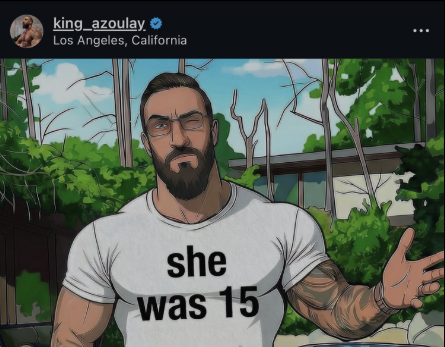
Whatever one’s views on free speech, there are obvious limits to what any responsible school district should legitimize on a high school campus. No district should provide a platform for Holocaust denial, open claims of racial or female inferiority, or conspiracy theories that desecrate the memory of murdered children as in Sandy Hook. Yet that is the line Cherniss crossed when he allowed this speaker onto campus to spread rhetoric that was hateful, degrading, and profoundly unfit for a public-school setting.
School administrators are responsible for anyone invited onto campus under the banner of a district-sanctioned club. In this case, the person most directly responsible for bringing Azoulay to BHHS appears to have been Rabbi Illulian, identified as the “spiritual advisor” to both the Israel Club and the Jewish Club. But the blame does not stop there. Sriruksa and Cherniss had a clear duty to exercise oversight and judgment. Their failure to do so was not a minor lapse. It was a serious abdication of responsibility.
Cherniss does not merely operate within these divisions; he exploits them, consistently aligning himself with the district’s most openly reactionary voices. On the BHUSD board, the clearest example is Russell Stuart, a figure who has tried to build a profile by peddling manosphere grievance politics and blaming the nation’s problems on “feminization” and DEI. Stuart had no objection to Azoulay’s appearance on campus. Cherniss, for his part, attended and applauded a “Men-Tell Health Club” meeting at which Stuart delivered his familiar litany about the supposed mistreatment of white, heterosexual males to a group of male students at BVHS. Another of Cherniss’s principal allies on the board, Sigalie Sabag, likewise went out of her way to defend Azoulay’s visit despite numerous parental objections.
The Sports Report

Whatever one thinks of the place of sports in a public-school system, bringing in two former PYLUSD coaches at salaries above $200,000 says a great deal about BHUSD’s priorities. One of Cherniss’s early moves in Beverly Hills was to install Steve Lawson, a close collaborator in PYLUSD’s Universal Sports Institute venture, as Director of Athletics, a district-office role that also oversees the Joint Powers Agreement with the City of Beverly Hills. Jeff Bailey was then brought in to run the BHHS football program while also serving in the district office as Assistant Director of Strength and Conditioning. Both men started at $205,656, a figure higher than the salary of a Step III high school principal.

Do not expect teachers, coaches, or administrators to say much publicly. Cherniss and Gates have shown that they can make life miserable for employees who challenge them. So most will keep their heads down and wait for the regime to end. In the meantime, some strong teachers and manegers will leave, and strong candidates will think twice before coming in. As in PYLUSD, Beverly Hills is becoming the kind of district people are relieved to have left.
The Law Firm Shuffle

A recurring theme in this story is the shuffle between law firms aligned either with Cherniss or with those trying to contain the damage he leaves behind. On February 10, 2026, BHUSD approved a retainer agreement with Orbach, Huff & Henderson LLP, even though the district already had three other firms on retainer, including AALRR. Huff had been the preferred counsel for Cherniss and the PYLUSD board extremists during a period marked by apparent violations of the Education Code, Labor Code, building regulations, charter-school law, and district bylaws. PYLUSD taxpayers will be paying for that legal advice for years. Cherniss now appears to be leading BHUSD into a similar morass, again with David Huff at his side.
By-Laws Matter!

For Cherniss and the BHUSD board majority aligned with him, bylaws are little more than inconveniences—rules to be ignored whenever they obstruct the faction’s aims and cleaned up later through procedural maneuvering or litigation. In this case, the majority disregarded the bylaw governing who should become board vice president and, by extension, the next board president.
That matters because the president helps shape the agenda in consultation with the superintendent. Giving that office to a compliant ally would only deepen Cherniss’s control over the board’s business. The current president, Judy Manouchehri, supports Cherniss.
But under the plain language of Bylaw 9100, the vice president—and therefore the next board president—should be Amanda Stern, one of the two trustees who voted against hiring Cherniss. The bylaw ties the vice presidency to a trustee’s years of service and vote total in districtwide elections. In other words, the board majority is trying to override the bylaws in order to override the voters. Sound familiar?
In this case, a dubious allegation that Stern had violated the Brown Act became the pretext for denying her the vice presidency. At the January 27, 2026 meeting, the board majority used its 3–2 vote to rewrite the bylaw, block Stern from the post, and strip out the one-year limit on service in offices such as the presidency. It had already installed Sigalie Sabag in the vice presidency at its December 16, 2025 meeting. The sequence suggests a familiar pattern: seize the office first, then rewrite the rules to justify it.
That maneuver, however, encounters a legal problem beyond Bylaw 9100. State law requires board officer elections to take place at the December organizational meeting. If the majority wants to defend what it did, it will have to show that bypassing Stern rested on a legitimate Brown Act violation serious enough to justify overriding the succession process determined in Bylaw 9100.
Even though this illicit coup was done on short notice, it did not go unnoticed. Daniel Lifschitz, a parent and an attorney in the district, appeared in court on January 27 to file a temporary restraining order (TRO) against the district that sought to prevent the board rom carrying out its retroactive rewriting of the district’s bylaws to justify its appointment of Sabag. The TRO sought extraordinary relief, but it was denied by the judge.
BACKFIRE!

Cherniss’s characteristically petty and vindictive response to the denial of the TRO may create problems he is not ready for. He treated the ruling as the final word and had the district issue a public statement declaring victory not just over Lifschitz, but over the law firm where he works. The district released an article in which the headline read: “Beverly Hills Unified School District Prevails over Lifschitz; Gipson Hoffman & Pancione.” There are major problems with that headline.
The first is factual. Lifschitz was acting on his own behalf—pro se, in legal parlance. By naming Gipson Hoffman & Pancione as if it were a litigant, the district made a claim that was simply false. That move was not just sloppy; it may also have been defamatory toward a firm that has every reason to protect its professional reputation.
A graver abuse, however, was the district’s effort to punish Lifschitz for exercising a basic civic right: petitioning his government for relief from what he viewed as an unlawful act. He was acting as a parent and citizen, not as counsel for a client or spokesperson for his firm. That distinction should have been obvious. It is especially striking given that Lifschitz is himself a First Amendment lawyer.
A Legal Breakthrough?
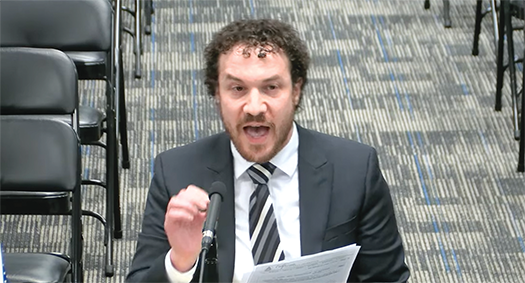
Cherniss and his allies in Beverly Hills now find themselves in a legal fight that could expose not only abuses in BHUSD, but also the broader methods by which school-board extremists operate. On April 9, Los Angeles Superior Court Judge James Chalfant upheld the earlier ruling allowing Lifschitz’s lawsuit to proceed and challenge the legality of the board’s violation of Bylaw 9100. Cherniss’s triumphalism now looks thoroughly premature.
Lifschitz (right), for his part, seems eager to press the case forward. His reaction appeared in an April 9 article in the Beverly Hills Courier:
“I am grateful for the court’s thoughtful opinion repudiating the district’s positions and clearing the way for me to depose the board trustees in connection with this matter,” Lifschitz told the Courier. “I look forward to the seven hours I will have with each of them under oath. In the meantime, they can reconsider whether their Jan. 27 press release calling my case frivolous should be updated for accuracy.”
The trial-setting conference is scheduled for Tuesday, June 9. Updates from the case will appear in the commentary section of this article.
An Appeal For Illumination

The Gates lawsuit sits inside a much larger story—one that stretches across districts, years, lawsuits, political factions, and people who have not yet spoken publicly. What appears here is only the beginnings of a foundation. Much of the public record still needs to be deepened by those who know more, and many of the most important facts remain buried in closed session, attorney-client privilege, non-disclosure agreements, and investigative reports still shielded from view.
Even so, lawsuits have a way of dragging hidden facts into the light. Butler’s NDA did not prevent the public from learning the central allegations against Cherniss. Perhaps the Dickerson report will eventually surface as well, helping explain how someone with this record still holds an administrative credential in California.
Gates’s complaint may well collapse before it gets very far. But if it survives long enough for real discovery, it could illuminate far more than Gates intends. His witness list alone points toward the larger network behind the Cherniss-Gates regime. If the district is serious about defending itself, it should not look for the quickest exit. It should use this case to expose, under oath, what was done to PYLUSD and who did it.
In the meantime, this account remains open. If readers can add facts, corrections, documents, or context, they should. One of the best functions of the OJ Blog is to preserve the public memory that institutions and their lawyers so often try to erase. It is a way of addressing shortcomings in local journalism in the present age. The question is no longer whether something went wrong in PYLUSD. The question is how much remains hidden—and who is finally prepared to drag it into the light.



According to an update from a contact in Orange, when the OUSD Board of Education removed Superintendent Gunn Marie Hansen on January 5, 2023, HYA sent Micah Ali to advocate for his firm’s selection to conduct the search for her successor. Ultimately, members of the board minority persuaded one member of the extremist majority that HYA was not the appropriate choice for OUSD.
Update from Beverly Hills
The trial-setting conference for the Daniel Lifschitz suit against BHUSD will take place on July 21. This conference will determine whether individual board members can be deposed regarding their decision to circumvent and rewrite Bylaw 9100 based on the claim that Stern had committed a Brown Act violation. In the Beverly Press, Tabor Brewster quotes Lifschitz: “It’s unfortunate that the board trustees will not voluntarily comply with their most basic discovery obligations. If they truly believed in the excuses given for not following their own bylaws they would not now be so terrified of having to repeat them under oath. Moreover, this fight is another predicament of the board’s own making. It was, after all, their choice to build an entire defense that hinges on the trustees’ personal testimony and credibility, which demands cross-examination. I look forward to presenting my case for compelling their depositions to the court.”
Let’s hope PYLUSD doesn’t back down! Gates and Cherniss have cost taxpayers far too much already.