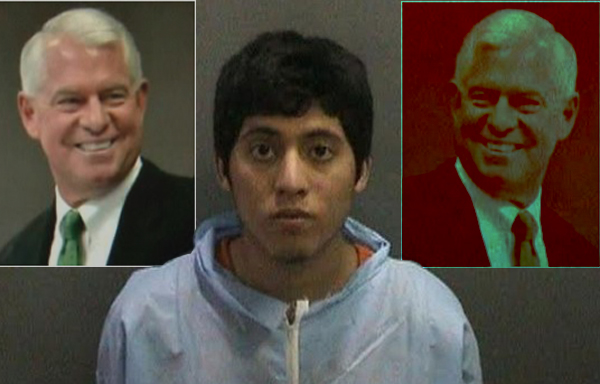
Left-to-right: Judge Mark Kelly, Kevin Rojano, Judge Kelly as depicted in comments sections
1. Law Blogging Has Its Unfortunate Responsibilities, So Here I Go
I can no longer justify my not weighing in on the matter of Orange County Superior Court Judge Marc Kelly. I don’t particularly want to, but there’s too much weirdness out there in local comments sections now to just let it lie. Also, it’s a matter that goes to the heart of our criminal justice system: why and how and how much we punish criminals.
I was about to say that even discussing this is “a no-win situation” — but that’s not strictly true. Politically, it’s “a big-win situation” for the judge’s critics. Few people ever lose out politically by taking the strongest stance possible against child-molesters. If I were to start a Facebook page calling on Kevin Rojano to be tortured to death, I would probably have 1000 likes within a day — or, if properly promoted, an hour.
On the other hand, it’s also “a moderate-sized-win situation” for some of the judge’s defenders. They don’t have to play to public opinion; they have to play to peer opinion. This gives them a chance to stand tall against political opportunism (and perhaps to ingratiate themselves with the local criminal law judges, who don’t like being attacked.)
I’m critical of both groups. And the judge, and the molester. But I’m not so critical of the sentence itself — and not at all critical of the judge’s right to issue it. I’d just as soon not wade into the fray — what I say here is bound to be misinterpreted and misrepresented, sometimes deliberately — but some things really do have to be said. (The first thing that needs to be said is: I don’t practice criminal law, although I did have a good number of cases on sentencing when I was a federal appellate law clerk a dozen years ago, so I’m not as up on some of the details as I’d like — but I’m pretty confident about most of what I have to say below. Where I’m not, I’ll let you know.)
2. On the Legality (or Illegality, Whatever) of Downward Departures
OC Supervisor and aspiring OC District Attorney Todd Spitzer posted something on Facebook earlier today. I hope that he won’t mind my giving it greater visibility, given that that seemed to be his purpose in posting it.
So the criminal defense bar–those who defend those accused of committing crimes by the People of the State of California (District Attorney)–are now attacking [Supervisors] Lisa Bartlett, Shawn Nelson and myself because we are speaking out against an illegal sentence and standing up for a voiceless victim; a three year old relative who was brutally sodomized. Let’s not get distracted–even the attorney’s in their statement shown in this KCAL 9 news piece don’t explain how the Judge failed to follow the law. Judges are not legislators.
This was, unsurprisingly, a good political move on Spitzer’s part. But … “an illegal sentence”? Was it … illegal? I agree that “Judges are not legislators.” But this isn’t “legislation. I do believe that “Judges are judges” — and part of the role of criminal law judges is to issue sentences for the convicted.
There’s a huge and ongoing debate (that I won’t bore you with) over “mandatory minimum sentences,” in which the legislature tries to take the power of sentencing out of judge’s hands and reduce the judge to a ministerial duty of applying the only sentence legally available. (The “three strikes” law, recently partially deflated by a voter initiative, is among the most prominent examples of one, along with “life without parole” sentences for murder and some others.) Instead, I’ll bore you with this: in almost every mandatory sentencing scheme (with, if I recall correctly, “three strikes” and “life without parole” being exceptions), there are still provisions for a judge being able to depart from the recommended sentence when unusual circumstances (or superior law such as the State or Federal Constitutions) warrant it. These are known as “downward departures.”
Downward departures aren’t illegal, although they must be accompanied by an explicit rationale and they can be appealed. But appellate courts tend to give judges a lot of slack in their downward departures (at least in cases not involving “undue influence”) because the judge, after all, is the one who was in the courtroom with the people involved and measuring their character and honesty in real life, rather than making judgments on a “cold paper record.” Nevertheless, some do get overturned — and my attitude in this case is: “let whatever is right win out.”
Now maybe this judge did engage in a downward departure when he legally couldn’t — an easy case for reversal, if so — and maybe he inadequately justified his departure (a question best left for the appeals court.) But if what Judge Kelly did wasn’t illegal, then Spitzer and other critics shouldn’t say that it was illegal, because — how do I say this most succintly? — in that case, IT WASN’T ILLEGAL. (And, in fact, if the judge’s Eighth Amendment “cruel and unusual punishment” analysis is correct, it is not issuing a downward departure that would have been illegal!)
My analysis of the Judge’s justification offered is in part 4. First, let’s have a look at what the judge’s defenders had to say that got Spitzer so riled up. (Hint: If Spitzer and his colleagues are really concerned that we as a society don’t take criminal sentencing of child molesters seriously enough … well, I think that they can relax. )
3. The Criminal Defense Bar Thinks You’re a Mob and Wants You to Settle Down
Yes, the Orange County Criminal Defense Bar Association thinks that you, Outraged Citizen, are part of a mob when it comes to this issue! And they think this because well, on this issue, you are pretty much part of a mob. Don’t feel insulted; your being part of a mob — driven to ever-ascending heights of anger and vengeance, well beyond the bounds of nuance and fairness — is pretty easy to understand. We have a problem in our society with sexual predators who target children (and apparently we have for a long long time) and we want to shut that sort of thing down!
So don’t feel too bad about yourself if you’re part of a mob! Just recognize that it may leave you … vulnerable to certain rational criticisms that are, uh, rational. If they’re rational, then you really ought to at least pay attention to them.
Matt Coker published Friday in the Weekly that he had received a letter from the Costa Mesa office= of veteran Orange County defense attorney Paul S. Meyer, President of the Orange County Criminal Defense Bar Association, signed by Meyer and ten other current and former board members, which defended Judge Kelly. It reads:
IN DEFENSE OF JUDGE MARC KELLY – THOSE WHO ATTACK JUDICIAL INDEPENDENCE ATTACK THE FOUNDATION OF OUR FREEDOMS.
Judge Marc Kelly is a highly respected judge with a decades long history of the highest integrity and careful judicial thought. You may not agree with this decision, but Judge Kelly has always demonstrated the strongest respect for the rule of law. An independent judiciary, free from political fear or favor, is essential to democracy. Would you like to have your case decided by a judge who is currying favor with one political persuasion or the other? Calls for a judge to resign because of decisions that he or she has made are as repugnant as calls for a judge to accept a bribe. Both are attempts to influence a judge from outside the judicial system: one by fear, one by money. Our democracy requires three strong independent branches of government. Recent statements by politicians are a blatant violation of the constitutional rules of our democracy. Beware of politicians who seek publicity for their own personal agenda – we all have a right to a free and independent judiciary.
In other words: if everyone gets heated up and tells judges that they may get recalled if they temper their sentencing decision with mercy, even justifiable mercy, then they will show no mercy — not because they don’t think that legal principles and equities call for it, but because they are afraid of retaliation by those who will manipulate and distort the situation to whip the public up into a frenzy and vote them out of office.
That’s a pretty reasonable concern. Not knowing this judge, I can’t vouch for “highly respected” and “highest integrity” and “careful judicial thought,” but I can tell you that research shows that plenty of criminal law judges seem to be harsher than they think is justified — especially given prison overcrowding and both the costs, toll, and dangers of incarceration to a vulnerable prisoner — because they are afraid that what is happening right now to Judge Kelly might happen to them. And, as the cure for prison overcrowding tends to be wholesale and largely indiscriminate prisoner release, that should be a concern to all of us.
But, of course, if what the judge did was illegal … then that doesn’t matter. So let’s go there next.
4. The Expressed Basis for Marc Kelly’s Decision
As Coker did, it’s worth republishing in full (courtesy of City News Service reporter Paul Anderson) Kelly’s stated rationale for his decision. First read it — the boldface emphasis is mine — and then we’ll analyze it.
In handing down his ruling, Kelly said he considered the general principles of sentencing, which include “protecting society, punishing the defendant, encouraging the defendant to lead a law-abiding life and deter him from future offenses, deterring others from crime by demonstrating its consequences, preventing the defendant from committing new crimes by isolating him with incarceration.”
Kelly went on to say that sentencing “is the most difficult part of a trial judge’s job … It is not an easy task and there are often no bright-line answers to what constitutes a fair and appropriate sentence.”
Kelly acknowledged that he was entering rare legal waters, commenting that in his 15 years on the bench he had never found a sentence “cruel and unusual” and requiring a deviation from the state mandates.
“Sodomy of a 3-year-old child is a horrific crime, and imposition of harsh punishment will ordinarily not give rise to constitutional concerns,” he said.
“However, in looking at the facts of Mr. Rojano’s case, the manner in which this offense was committed is not typical of a predatory, violent brutal sodomy of a child case.”
Kelly said the defendant “did not seek out or stalk (the victim),” and that he “inexplicably became sexually aroused but did not appear to consciously intend to harm (the victim) when he sexually assaulted her.”
Kelly agreed with defense attorney Erfan Puthawala that “in an instant, he (the defendant) reacted to a sexual urge and stopped almost immediately after he put his penis in (the victim’s) anus. Within seconds of commencing his offense, he realized the wrongfulness of his act and stopped without ejaculating.
“Although serious and despicable, this does not compare to a situation where a pedophilic child predator preys on an innocent child. There was no violence or callous disregard for (the victim’s) well being.”
The defendant “has shown extreme remorse for his actions and has been willing to accept the consequences,” Kelly said. “Mr. Rojano was born into and raised in a dysfunctional familiar environment.”
Pointing to a doctor’s report, Kelly said that while growing up, the defendant suffered “a great deal of family disruption and abuse, making him an insecure, socially withdrawn, timid, and extremely immature young man with limited self-esteem.”
Kelly was also moved by the support of the defendant’s parents. He allowed them to hug their son before deputies handcuffed him and took him to a holding cell when the hearing concluded. He also let the defendant’s grandmother hug him.
Kelly said he did not “forget” the victim in the case, but when she testified in the trial, she appeared to be a “happy, healthy child.”
“It is hard to gauge how this crime might affect her mental state in the future, but she did not suffer serious violent physical injuries, and by all counts she appears to be headed for a normal life,” the judge said. “It is the court’s hope that she has fully recovered from this incident.”
The defendant’s parents requested probation in the case, but Kelly said it was necessary that Rojano-Nieto be “punished severely for his conduct.”
It’s easy to miss, but Judge Kelly is somewhat plaintively pointing out that this is not a case of “guilt versus innocence” or “punishment versus probation.” It’s a case of “10 years versus 25 years.” And ten years in prison — or even five years, with time off for good behavior (that his own self-defense alone may prevent Rojano from accumulating) — is a whole lot of punishment for a meek young man. But, let’s all agree — it’s not as bad as 25 years.
And so Judge Kelly asks — less explicitly than I’d bet he’d now prefer — what I think is exactly the right question:
Why IS the sentence for child molestation 25 years? In other words, when we demand that a person serve no less than 25 years for this act, what do we presume that they must have done?
5. The Implicit Basis for Marc Kelly’s Decision — and Why It Makes Sense
I think (and I think that Judge Kelly apparently things) that the answer to these questions is that when we contemplate an act of child molestation, we have in mind act that has many various characteristics that are not actually elements of the crime. (The elements of the crime are pretty simply, given that 3-year-olds can’t consent.) It’s those added characteristics that justify much of the strength of the punishment — and they are largely absent here.
Here’s a partial list taken from his statement., in which the first line of each could also serve as each list’s name:
- not typical of child predation
- not violent
- not brutal sodomy
- did not seek out or stalk (the victim)
- inexplicable sexual arousal
- no conscious intent to harm (the victim)
- impulsive reaction to sexual urge
- stopped almost immediately after he put his penis in (the victim’s) anus
- realized the wrongfulness of his act within seconds of commencing his offense
- he stopped without ejaculating
- no callous disregard for (the victim’s) well being
- has shown extreme remorse for his actions
- has been willing to accept the consequences
- born into and raised in a dysfunctional familial environment.
- socially withdrawn and timid
- extremely immature young man
- insecure with limited self-esteem
- victim seems largely unaffected physically and psychologically
I’m not sure that many or most of these factual findings do render this act atypical of child predation. But let’s reverse each of them and see if they give us a better picture of why we punish this category of act with a sentence of 25 to life:
- typical of child predation
- violent
- brutal sodomy
- sought out or stalked the victim
- sexual arousal tied to young child as target
- conscious intent to harm the victim
- planned rather than impulsive reaction to sexual urge
- continued for extended time after he put his penis in the victim’s anus
- never recognized the wrongfulness of his act
- stopped only after ejaculating
- callous disregard for (the victim’s) well being
- shows no remorse for his actions
- unwilling to accept the consequences
- not product of a dysfunctional familial environment
- average or above amount of social intelligence and assertiveness
- average or above maturity
- average or above self-esteem
- victim profoundly affected physically and/or psychologically
Kelly’s implicit argument is that when we as a society impose a minimum sentence of 25 years to life for sodomy of a young child, it is because this latter list is what we expect that the situation typically entails.
But when each of these factors are reversed (as they are in the first list), it’s no longer the typical situation that in the public’s mind warranted that 25 years minimum sentence. In this “not typical” situation — which the judge finds to be one of a stupid and vile, unplanned and impulsive act by an immature adult that is immediately regretted and almost immediately stopped — treating it as the equivalent of the situation in the second list is so disproportionate when it comes to sentencing as to constitute cruel and unusual punishment.
I’m not sure that I agree — but I’m confident that the judge’s analysis is far from an absurd one. What the judge is saying, in effect, is that we should treat this sort of isolated act of child molestation as a graded offense. By some formula, in one way or another, the presence of each of the factors increases the grade of the offense and demands tacking in additional time to the punishment. This stops when the maximum amount of enhancement reaches 15 years-to-life — thus yielding the 25-to-life sentence we have for a “typical” crime of this kind. There would be many possible paths to max out with the full 25-to-life; this happens so routinely that we rarely find a case like this where these enhancements are (almost) fully lacking.
Why don’t we “grade” the crime of child molestation, as we do with murder and rape? Because for this crime, we apparently don’t want to give the impression that any particular act of child molestation is any worse than any other, because they should all be considered maximally bad.
Of course, this is absurd — and we don’t really believe it. Of course an act of child molestation that is planned, violent, depraved, prolonged, remorseless, and that involves permanent physical injury, transmission of possible incurable and fatal disease, deep psychological trauma, and is one of an expended series of such acts by a sociopath who was not driven simply by a sexually frustrated adolescent impulse to stick a penis anywhere at all and immediately regretted is worse than one that shares none of these characteristics. It still deserves at least ten long years in prison; because some (although fewer than in the prototypical case) of the purposes of sentencing that Judge Kelly begins with demand to be served. But, while still deadly serious, it seems a different and lesser kind of crime than the prototypical case.
Well — we can’t really have that discussion in our society right now. (Just watch what happens to me for explaining what I think was going through the judge’s mind — and I’m not even sure that I agree with him!) We’re too afraid of this subject — and as a father and grandfather I can’t really blame us for that. But it’s the responsibility of the judge, and not of the broader society, to recognize that this was something like “sixth-degree” rape of an infant rather than “first-degree” — and to treat it very seriously, but with greater mercy. That we won’t “grade” the various instances of this offense doesn’t mean that the judge can’t or shouldn’t do so in sentencing.
6. In Contrast, Here’s a Likely Example of Abuse of Judicial Discretion — Starring Judge Marc Kelly
Here’s a good example of an attempt to “grade” instances of (attempted) child molestation that I think goes very wrong. It’s in the news again because it also comes from Judge Marc Kelly — and I think that comparing the cases is useful.
Kelly reportedly went against the wishes of prosecutors when he ignored a prosecution request and gave a sex offender probation instead of jail time.
CHP Lt. Stephen Robert Deck, then 51, was arrested in 2006 during a Laguna Beach sting to catch child predators. When he was sentenced in 2010, Deck said he was remorseful. The judge, meanwhile, said because Deck was formerly involved in law enforcement, his past should account for something.
Even though a jury found Deck guilty of engaging in explicit sexual conversations with young girls online and attempting to meet a 13-year-old for sex, the judge declined to give prosecutors what they were asking for: a maximum sentence of four years in state prison.
Kelly required Deck to serve probation and register as a sex offender on Megan’s Law database. According to the Orange County Register, Deck’s conviction was overturned in October.
I am given great pause by what’s noted last in the story: that Deck’s conviction was eventually overturned, which suggests that there’s more to the story than what’s included in this capsule of it. But all I want to focus on is the sentence at the end of the second paragraph: that a man attempting to have sex with a 13-year-old girl should be able to receive leniency in sentencing because he used to be a cop.
This drives me absolutely bonkers. I think that that background should “count for something” too — like maybe tacking an extra year onto the sentence.
We have to hold our police and our military to the highest ethical standards for one basic reason: because we allow them to kill people (and, necessarily, to coerce people with the threat of killing them) and give them guns and other weapons to do so. That’s an awesome responsibility. To me, that demands a sentence enhancement provided for in the law, much like the one for using a gun to commit a crime. It would certainly not be the basis for a reduced sentence; for a cop to do this would mean that someone essentially had fooled society into giving him or her this awesome power and license by letting us think that they were not inclined to abuse it — and it calls everything they had done under color of law into question. So here’s a boo for Judge Kelly there! We have a massive “abuse of authority” problem in our society — which is one reason why I am so chronically pissed off at the rights-abusing OC District Attorney Tony Rackauckas.
So yeah — that case (and its departure, if there was a mandatory minimum) bothers me a lot more than this one.
There’s another case that this brings to mind as well — one I was struggling with a year ago.
7. Remember that Rape Sentencing Case from Judge Derek Johnson?
A year ago, Judge Derek Johnson was in the news thanks to his own statements in a sentencing hearing in which he appeared to establish his own finer gradations of rape cases. He said that he was inclined to be less harsh in sentencing a rapist before him given that there was no sign of physical damage to the woman, including her vagina. My friend Ryan Cantor hounded me to condemn him and support his Republican opponent until I finally gave in — but still with some misgivings. It wasn’t until the above analysis that I truly understood my mixed reaction.
First, the sentence for rape probably isn’t as high as it ought to be — and perhaps that’s because we as a society remain unsure about what constitutes a prototypical rape. Note that in a case of rape the lack of consent is not simply a prototypical characteristic of the crime, but a defining one, so the question here is: what else should we expect to be true in a case of rape given that there is necessarily a lack of consent?
Johnson’s position was that we would expect some degree of bruising on or lesions in the vagina. (Tearing would also be prototypical in anal rape, but I suspect that when society’s legislators assign the penalties to rape they are most likely thinking about vaginal rape.) This, as I understand it, is not always true — women can experience lubrication even in the absence of consent or arousal as a protective bodily reaction to penetration. (And rapists — a category that includes more than violent stranger-attacking sociopaths — may prefer penetration that has lubrication as well. I’ve no personal basis to know.) So — unlike some of the differences we saw in the child molestation case — the lack of bruising and tearing in a rape may not tell one much. (In fact, such injuries can also occur in consensual sex for benign reasons, for example if the participants don’t take appropriate steps to address a lack of natural lubrication.)
In other words, Johnson’s expectation that in a “really bad ‘real’ rape” (my phrase, so far as I recall, not his) there would be bruising doesn’t satisfy an analysis of the type offered above: that society really intended the full minimum sentence for a rape only where there was bruising — and that if there wasn’t bruising then the judge was justified in departing downward from that number. But (although it wasn’t a downward departure, as I recall, but within bounds) his is why it was fair to say that Johnson’s analysis apparently placed some responsibility on the female rape victim for not acting in such a way (presuming that she even could do so) that would have led to vaginal injury. “No physical injury” meant “not deserving of the full power of the rape conviction” because “not as serious of a crime.” That — given that the rapist deserves no credit for, for example, threatening the victim into total — submission, seems very wrong.
There’s one other way, though, that Johnson might have had a point — although it too doesn’t mean that there would necessarily be a departure from the standard recommended minimum sentence for rape. Even in a consensual sexual interaction, men can probably (I don’t know this from experience) cause vaginal injury even if a woman is sexually aroused and receptive. If so, then this sort of sadistic roughness may also justify a greater punishment — but if it is not “factored into” the standard recommended for punishment for rape, its presence would be considered an aggravating factor (augmenting the “standard” punishment) rather its absence being considered a mitigating factor that diminishes it. So, yeah — even though he too was “merely” thinking things through at a sentencing hearing, I still think it’s fair to say that Johnson’s analysis isn’t “saved” the way that Kelly’s is in Rojano’s case.
8. Finally, Back to Spitzer — With a Mixed Message
Declaration of bias: despite everything I say here, I would still expect to support Spitzer over Rackauckas if they run against each other in 2018 (and I might well walk precincts for him if he were running against Susan Kang Schroeder.) But I would probably support any Democrat against him (at least in a primary) as well as someone like Judge Thomas Goethals — who I think has shown, in his handling of the Scott Dekraai case and the District Attorney’s Offices misconduct therein, that he has the right stuff to be a righteous DA himself. But I still have to take Spitzer to task here.
Spitzer is a complicated guy, always driven by ambition, but driven both in the direction to do something righteous and in the direction to do something popular. (These are not the same direction.) When he gave his press conference after Judge Goethals’s recent rulings in the Dekraai case, my feeling was: “good for him!” We need a strong public spokesperson for doing right in the DA’s office — and not a lot of people besides Spitzer and auditioning for that job. (Well, there’s me — but he’s the better fundraiser, among other things.) So when it comes to that, it’s “Go, Todd — more more more!)
And then there’s this.
I know, I know — he’s a longstanding victim’s rights guy, just like he’s a longstanding anti-drunk-driving guy, but neither of these any particularly “despised underdog” positions. He probably comes by his position on the Rojano case entirely honestly — although I presume that he’s aware that his position is also one tailor-made for populist pandering.
But, gol-darnit — Spitzer has also got to be honest when he makes allegations. His main point of criticism in the statement way up near the top of section 2 above (without which his thesis falls apart) — that this was “an illegal sentence” and “even the attorney’s [sic] in their statement shown in this KCAL 9 news piece don’t explain how the Judge failed to follow the law” — entirely depends on the unproven point that Judge Kelly DID IN FACT FAIL TO FOLLOW THE LAW.
As I explain above, I’m just not convinced that’s that’s true. If anything, I’m convinced that it isn’t true. And I suspect that Spitzer knows it. He either believes that there is no such thing as an allowable “downward departure” or he thinks that Kelly failed to do what he had to do, in the sentencing hearing, to adequately justify it. But, for Lady Justice’s sake — failing to sufficiently justify a downward departure (and from what I can tell Kelly did clear the bars of cogency and good faith, even if I’m not fully convinced he was right) does not mean that a judge “broke the law” and “acted illegally”!
So, I issue a challenge to Spitzer: justify your statements that this was “an illegal sentence” and “a failure to follow the law.” If you can’t, then back up to a position that you can factually defend. You’ll eventually be a better candidate for it. And if you’re up against the OCDA’s monstrous Chief of Staff in 2018, that’s exactly what I’ll want you to be.


Leave a Reply