(I’m working on some serious political stories right now, but since Vern is taking over the Weekend Open Thread this week for a higher purpose (seriously, it is!), I’m converting this piece to a mostly lighthearted regular old story. OK, fine, it’s a little political. So what? — G.A.D.)
Pay attention here, because so far as I know I’m about to coin a new English word that has a legitimate chance of gaining widespread cultural relevance. I will try not to forget my friends from way back when (i.e., now) if that happens.
The word is “mapola.” (Yes, it’s a botanical word in Spanish. Doesn’t count.)
“Mapola” refers to charging someone in order to — as many cities and other locations desire — “get on the map.” Literally. This is often done by tourist bureaus and such in their printed maps without much bad effect on the world, because those maps are produced in limited quantities and for limited purposes. But when The Mighty Google does it — well, then it becomes something more serious. To use the example of “payola” — a kind of “commercial bribery” defined by the Mighty Wikipedia as “the illegal practice of payment or other inducement by record companies for the broadcast of recordings on music radio in which the song is presented as being part of the normal day’s broadcast.”
With “payola,” one would secretly pay for product placement. Because it involves the regulated public airways, secret payments for product placement are illegal. For a DJ to openly say “I’m playing this song on the radio because they’re giving me $1000!” is legal. It just doesn’t lead to the desired inference that this song must be popular and good. The difference in how much one is favorably impressed by a song when the song placement is paid for versus appearing ” is probably evident to the reader, and it is why this sort of payment is usually secret.
Well, hang on to your hats: Google Maps is going to introduce personalized maps that appear in response to your mapping requests. Yes, your “official sense of the world around you” (i.e., the map you are shown) will differ from mine, in terms of what landmarks (and especially businesses) are and are not labeled.
This already happens in response to your search requests, which are tailored based on previous searches you’ve done and links you’ve clicked. This is why when I type “Mexican food” — without any other context — into my Google Chrome browser, my first result is for a search engine for Los Angeles, my fifth is for a place in Anaheim, my seventh is for one in Orange, and my ninth is a place in Santa Ana. (The algorithm isn’t perfect: the sixth result is for a place in Glendora, the eighth Monrovia, and the tenth in distant — given the lack of a north-south freeway between the 57 and the 605, Huntington Beach.)
Now is Google going to tell places “hey, give us some money and we’ll make sure that you appear in everyone’s maps”? No, of course not! That would be crass! They will include in your maps the sorts of establishments in the sorts of places in which you’ve expressed an interest on Google.
So … perhaps you’d like to buy an online ad, which may — incidentally, of course — put you on more people’s personalized maps? Sure you would!
And there we have “mapola.”
Unlike payola, so far as I can tell “mapola” is not likely illegal and is certainly not without a rational basis. I care more about knowing where the awesome Brea’s Best Hamurgers (which doesn’t even have its own website, so I can’t try to charge them for this mention) or the yummy Oaxacan restaurant El Fortin in Fullerton (which also has no website — damn, I am doing this payola thing totally wrong!) are than some place I’ve never heard about. But the effect of this, as the Slate article I link to here again notes, is to diminish the amount of serendipitous discovery in my life. My highlighted choices lead me to do whatever it was I did before. Google has prodded to trod the beaten path.
Thus, what is popular become more popular. And, to the extent that popularity depends on advertising — which, of course, is why advertising exists — those who advertise more get even a larger share of popularity than they did before. In other words, the effect of this technical Internet innovation, as is so often the case these days, is that the rich get richer and the poor get poorer.
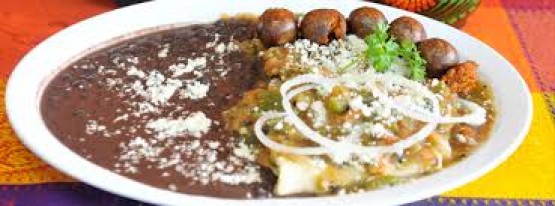
Oaxaqueño dish from El Fortin, 700 E. Commonwealth Ave. Fullerton, CA 92831. When you go there, tell them that Orange Juice Blog sent you! They will have absolutely no idea what you’re talking about.
(Warning: this is the weekend of the annual “Brea Summerfest” at St. Angela Merici’s church — so Brea’s Best, which is just across the street, will be packed. No, no payola for me from promoting Summerfest either. Sad face.)


Is this the weekend open thread?
The Weekend Open Thread is always clearly labeled by the “thread labeling” force of guest workers locked in the basement and kept docile by the fumes from fire rings. In other words, “no.”
no skally, just something else that unraveled…. 😉