[Editor’s Note: I’m reposting with permission this excellent essay from California environmentalist RL Miller, which was initially posted at Daily Kos, on bad reporting in the LA Times about solar power. It should be obvious why I want more people to see it. If the LA Times is screwing up the story, maybe that gives the OC Register a chance to show them up. — Greg]
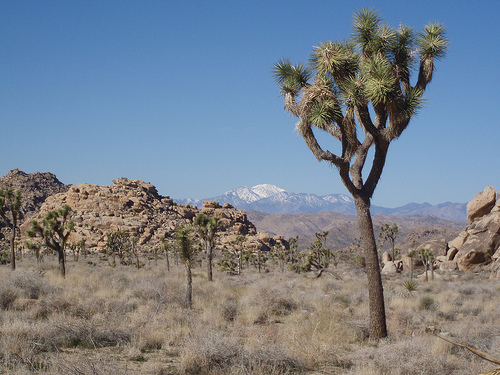
Photo of California desert by RL Miller.
Julie Cart of the Los Angeles Times has published yet another anti-solar piece there. This time, in Solar power plants burden the counties that host them, she discovers that sprawling rural counties that vote Republican would like more money from the federal government, please, and it’s all the fault of Big Solar. And when a sprawling rural county that votes Republican tries to tax just the solar industry alone, solar advocates organize opposition to a Sun Tax.
The horrors!
Among other journalistic nuggets, she reports that construction workers laboring near the California-Nevada state line are more likely to spend their money in Nevada (i.e., Las Vegas) than in the middle of California’s Empty Quarter. Because Joshua trees don’t take ATMs.
And she indulges Republicans opposed to the Obama administration’s treatment of renewable energy:
“The solar companies are the beneficiaries of huge government loans, tax credits and, most critically for me, property tax exemptions, at the expense of taxpayers,” said county Supervisor John Benoit, referring to a variety of taxpayer-supported loans and grants available to large solar projects as part of the Obama administration’s renewable energy initiative. “I came to the conclusion that my taxpayers need to get something back.”
Republican John Benoit, shorter: If they’re going to get special treats, I want a cut.
Among Benoit’s recent campaign contributors: Occidental Petroleum, California Independent Petroleum Association, Chevron, Valero Energy… but no solar folk. (That information is not in Julie Cart’s story. I did the research.)
Also missing from Cart’s story is any sort of perspective or critical analysis. If a plant will end up with only five permanent workers, then how accurate is the county’s claims of wear and tear on its roads and increased emergency room services?
Julie Cart has been assigned to the California desert solar beat for several years. Anyone whining about Big Solar finds her writing a sympathetic story.
Her reporting that Taxpayers, ratepayers will fund solar plants was widely criticized as getting the facts wrong, very wrong.
In Environmentalists feeling burned by rush to build big solar projects, every single small desert-tortoise-loving green group whines that the Sierra Club and other big green groups think stopping climate change is more important than saving the habitat of the desert tortoise.
In Sacrificing the desert to save the earth, she decides that a big plant taking up six square miles of California desert constitutes a sacrifice of the entire region, never mind the 50 million acres of public lands available to fossil fuel developers, never mind the relatively small footprints of all of the solar projects put together, and never mind the vast desert habitat being protected from solar development.
Land speculators see silver lining in solar projects bemoans the fact that some people are getting rich selling virtually worthless pieces of private land to solar developers. Other pieces by the same reporter bemoan the use of public land for solar development.
The Los Angeles Times is effectively the national paper of record for the California desert. I’ve searched the Los Angeles Times site for all 170 stories written by her (many on unrelated topics) and reviewed them all. All of her solar stories portray the solar industry in a bad light. As only one example, today’s story could – but doesn’t – note the negative impacts of climate change on Riverside and Inyo counties, the health burdens of relying on existing dirty energy, whether Inyo County’s worries about the impact of Big Solar on its roads is overblown, whether Riverside County Supervisor Benoit is motivated by Big Oil contributions when he proposes a solar tax (see my research above), and many other angles. The Times has other good reporters who cover environmental and climate issues, but it’s woefully understaffed.
The Los Angeles Times in a nutshell: no appetite for covering a dramatically warmer world in this century, but front page headlines for the impact of Big Solar on Inyo County’s tax revenues.


I read that article differently……but you might be right.
I got the feeling that the writer disagrees with the “Big Corporate” solution to Solar. Building an enormous 6 mile wide section of the desert with solar panels is stupid.
Solar panels need to be used to cover every parking lot, reservoir (reduces evaporation), school, hospital, and on private residences. They need to be placed where they are being used, not wired in from a hundred miles away. Also Solar is just one component of complete withdrawal from fossil fuels. It must be used in conjunction with Wind and where possible Geo-thermal. Wave power is gaining “steam” so to speak.
Also battery storage for homes must be developed so that energy storage for the average home and consumer becomes as easy and as cheap as buying a gas powered generator. That coupled with energy efficient appliances and fluorescent LEDs, will help the average consumer be able to actually stay powered up off the grid. Which is what the “Big Corporations” DO NOT WANT.
The solutions are out there , we are just fighting over their applications.
Big Energy wanting to control the Solar Power, is like Big Oil and the Car Companies buying up the Old Red Line. It’s all about the monopoly.
That’s a fair criticism — but I think that you need both local and some centralized. Out here where most people live, you have both June Gloom and a longer-lasting marine layer. The deserts — not that far away — have relentless sunshine. At a minimum, plants in the desert could be used to charge car batteries by, literally, the truckload — brought here on electric-powered trucks to subsidize use of electric cars.
You’re right about what Big Corporations want — but if they truck or transmit power out here when needed, on top of robust domestic use, I don’t have a problem with it. It’s the hobbling of the competition that I can’t stand.
P.S. — I’d like to see the environmental impact statement before covering reservoirs with solar cells.