The great orator Martin Luther King Jr. famously said these words of comfort for those in the midst of long struggles: “The arc of the moral universe is long, but it bends towards justice.”
I have hope — I have faith, as part of my religious belief — that that is true. But there’s a critical corollary: it doesn’t happen by itself. It happens if, and because, we all put our arms up against that arc and bend it. King’s prediction depends on an implicit prediction of the decency and industry of common people willing to sacrifice for a cause.
Without our force, that arc never bends towards justice. It remains, at best, a line. King’s point, in talking about a long arc, like that of a meridian around the Earth, is that in the short term it will generally look just a line — but we have to have faith that it is, indeed, an arc.
Here is the arc of the universe this week in Florida, with a hat tip to jezebel.com:
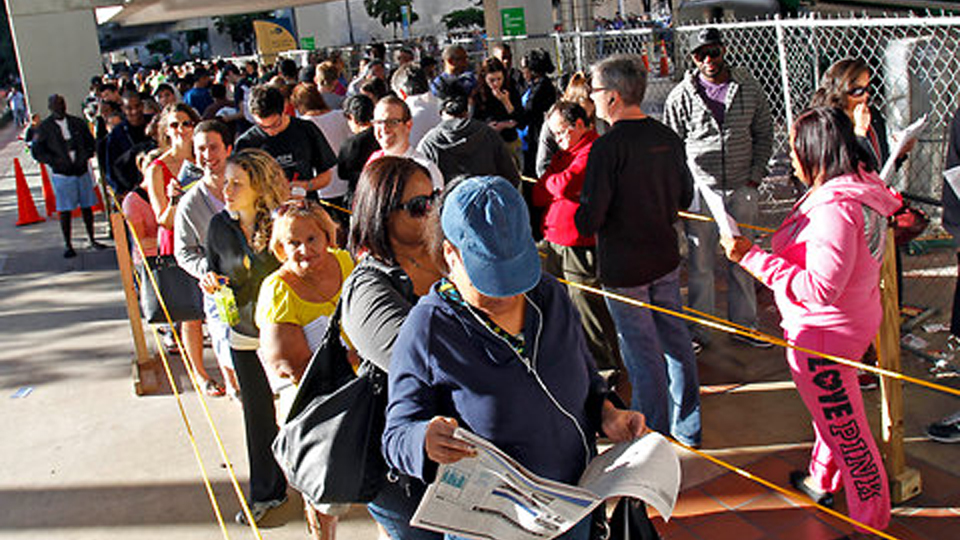
If this doesn’t disgust you, then you disgust me.
As King implied, it looks like a line.
These are voting lines in Florida — lines that have reportedly been stretching for up to seven or eight hours. Their length and duration is entirely unnecessary. All we have to do to allow people to vote in an expeditious matter is to provide the resources — enough time, enough space, enough people — for them to do it. It’s not rocket science.
These lines are so long because the Governor of Florida, like the Secretary of State of Ohio, like so many others across the country, WANT them to be that long. If they’re that long, then people will give up and go home without voting.
Time, as the saying goes, is money. Especially in a country where we stubbornly refuse to make Election Day a national holiday, seven hours in line can be a missed day at work, ruinous child care costs, the sorts of things that people with economic privilege can handle and those without cannot.
They are, in short a poll tax. States can no longer charge people to vote — so this is what they do instead.
The poll tax was declared unconstitutional by the Twenty-Fourth Amendment. This, too, should be unconstitutional. If there are exigent circumstances, such as exist in New York City due to Hurricane Sandy, that can be excused. When it comes about as a matter of choice, of calculation for political advantage, it is disgusting. That we put up with it, that it is not front page news every day until it goes away, is disgusting.
It is anti-American, counter-Constitutional, and provides a rationale for revolution. It is an anathema to democracy and we should not be just staring at it like it’s an act of nature, we should be screaming about it like it’s a crime — because, in every sense but the fact that the Supreme Court apparently thinks it’s legal, it is a crime.
I have no problem working with conservatives and with Republicans, many of whom I respect immensely. I may disagree with them about reproductive rights, about privacy, about torture, about war, about allowing starvation and lack of housing and medical care, about taxation, about agriculture, about regulation. I can live with all that.
But I have a litmus test.
If you can look at the efforts to deny the franchise to voters in this country for political advantage by making people jump through hoops to have their say in the process, then I do not want to deal with you. I do not want to make nice, and if I shake your hand it is only because doing so requires less effort than refusing. If you would deny citizens their vote, you are not part of the political process that I respect. You are foreign to our system of government. You are not, at heart, an American. And I do not think that you have a moral right to govern a representative democracy.
We don’t have a Supreme Court that agrees with me yet. We may be deciding whether we will have one, in the intermediate future, this very day.


They don’t have a vote by mail option?
Even if they did, if a person chose not to avail themselves of that option, does it then follow that their penalty is to stand in line for hours to vote?
you’re right, that going to the polls shouldn’t be like that regardless what other options there might be. That’s messed up.
From Adam Liptak’s article:
“In the last presidential election, 35.5 million voters requested absentee ballots, but only 27.9 million absentee votes were counted, according to a study by Charles Stewart III, a political scientist at the Massachusetts Institute of Technology. He calculated that 3.9 million ballots requested by voters never reached them; that another 2.9 million ballots received by voters did not make it back to election officials; and that election officials rejected 800,000 ballots. That suggests an overall failure rate of as much as 21 percent.”
If the walk-in failure rate was this high …..
What’s happening in Florida is a national disgrace, no matter what side of the political aisle you’re on. There’s simply no excuse for not having enough polling places to handle the population load in a particular area.
Let the lawyers begin lining up!
You are so right Greg! But people are not willing to be bullied by their representatives. They are showing up and willing to wait in line for hours to vote. I read that in New York taxi drivers were taking people to the polls for free. At my polling booth, I saw 3 people observing. We are on to these crooks and liars and we will win this war they have waged against us.
I voted for you Greg and Duane Roberts
p.s. please vote Yes on 37 😉
Why is it so bad in FL compared to here in CA? I am being serious about the logistics…Are there fewer voting places, are there not as many machines per voter (I am sure there is some sort of ratio to apply), are there ballots complicated so it takes longer for each to vote, is there not enough budget money, are there few people to check folks in, is the vote by mail option not utilized as much as here, do they actually have to prove that they are who they say they are instead of just give a name, address, and a signature, etc…
For the first time ever I had to wait more than a few minutes to vote today…that was only because half of the machines at the local school were down. It took a bit for them to get them up and running- total time about 30 minutes but nothing compared to FL and massive lines?
Do you really want to know, Boutwell? You’re not going to like the answer, but it’s simple and true.
It’s because Florida has a Republican Governor and legislature. As do all the states that have tried to restrict voting in one way or another these past two years. Republicans figured out a long time ago that, for various reasons, the harder it is to vote, the better Republicans do.
You didn’t know that? I could tell you a lot of other true things about your Party that would make you sad, but I’ll just let it out in dribs and drabs.
I know that is your opinion on the rationale but I am looking for the logistics behind the long lines. I cannot imagine that a Republican likes to stand in line any more or less than a Dem. Just the logistics…for example, in my precinct the long line at 7:15 was caused by 4 machines being down and what appeared to me to be voters taking too long to vote (I.e. likely not everyone comes prepared with their sample ballot completed)
Um … ANONSTER. Explain to Boutwell the logistics of how Republican governors and legislatures make voting more difficult. And how it doesn’t tend to discomfit most Republican voters, or not enough to matter.
Yes, I would love to know the logistics of how they get these long lines and how the R’s are not discomforted as much as D’s or I’s in those long lines…I am being serious on this (hopefully it comes through).
We issue “Voter Supply Kits”, which are a lot like earthquake kits. K-rations, 3 days of water, ammo, cigs, some sort of fossil fuel, and two tickets to Canada that may only be used in a case of true emergency.
We also have secret handshake to allow admittance to our own private polling stations, although the handshake is falling out of use due to voter ID laws.
It comes down to demographics, the republicans know which areas are democratic strongholds (this was evidenced beautifully on Fox News last night when Rove tried to deny that Obama won Ohio, the demographers knew that the areas not yet counted were democratic) and these areas tend to be poorer, denser and urban. Sure, some republicans are going to be discomfited, but the majority will be democrats. So they play the odds.
From the NYT’S;
“Over the course of 2011 and 2012, battles over voting rights and voting fraud were fought in state legislatures and courthouses across the country.
Since Republicans won control of many statehouses in the November 2010 elections, more than a dozen states have passed laws requiring voters to show photo identification at polls, cutting back early voting periods, imposing new restrictions on voter registration drives or redrawing electoral maps.
Republican legislators say the new rules offer a practical way to weed out fraudulent votes and preserve the integrity of the ballot box. Democrats say the changes have little to do with fraud prevention and more to do with placing obstacles in the way of possible Democratic voters, including young people and minorities. …”
Here’s a good over view of recent voting changes;
From The Brennan Center for Justice;
Fourteen states have passed restrictive voting laws and executive actions that have the potential to impact the 2012 election, representing 185 electoral votes, or 68 percent of the total needed to win the presidency.
A breakdown of laws and executive actions in effect in 2012:
Florida
Early voting restriction
Executive action making it harder to restore voting rights for those with past criminal convictions
Voter registration drive restrictions are still in place, but the most onerous aspects of the law were blocked by a federal court
Georgia
Early voting restriction
Georgia also has a photo ID law, which passed in 2005
Illinois
Voter registration drive restriction
Iowa
Executive action making it harder to restore voting rights for those with past criminal convictions
Kansas
Photo ID required to vote
New Hampshire
Voter ID required — non-photo IDs allowed for 2012 election, but photo ID required starting September 1, 2013
Pennsylvania
Photo ID requested but NOT required to vote, per October 2, 2012 court decision
Rhode Island
Voter ID required — non-photo IDs allowed for 2012 election, but photo ID required starting January 1, 2014
South Dakota
Law making it harder to restore voting rights for those with past criminal convictions
Tennessee
Photo ID required to vote
Proof of citizenship required to register
Early voting restriction
Texas
Voter registration drive restriction
Texas passed a law requiring a photo ID to vote, but a federal court blocked that law in August — it will NOT be in effect for 2012
Virginia
Voter ID required, including non-photo ID
West Virginia
Early voting restriction
Wisconsin
Voter registration restriction
Wisconsin passed a law requiring photo ID to vote, but two state courts blocked that law — it will NOT be in effect for 2012
A breakdown of laws passed that will NOT be in effect in 2012:
Ohio
Early voting hours were restored for the three days before the election
South Carolina
A federal court did NOT approve South Carolina’s photo ID law for the 2012 election — a voter can use their non-photo voter registration card after 2012, so long as they state the reason for not having obtained a photo ID
http://www.brennancenter.org/
Almost all those states have republican governors, coincidence? I think not.
But still, that Ryan Cantor of ours, funny guy, eh?
Thanks Anonster…not really what I would consider to be the logistics of why the FL lines were so long, but my gut tells me I won’t get an answer to that question and even further from getting an answer to how any logistical challenges with the lines impact D’s more than R’s.
I would think that the OR and WA vote by mail requirements would also be considered to be voter suppression if those states happened to be Red instead of Blue, but maybe requiring vote by mail is OK.
Well, if you have a group of working class people (meaning they’ve gotta go to work on election day) living in dense areas with too few polling places and you take away or restrict their ability to vote early, you get long lines.
In Florida they say redistricting and budget cuts affected the number of polling places.
I also think that in Florida and Ohio that republican voters tend to be wealthier and in Florida retired and Ohio more rural or suburban. Those factors can make a huge difference on whether or not you wait in line to vote.
Are you saying that the wealthier you are, the more likely you are to wait in a 7 hour line?
My observational experience is the opposite…often the wealthier one is, the more irritated the person is that they have to wait in line- ever go to the DMV and watch a lady who obviously has “means” by the bag she carries and the shoes she wears who is waiting in line? That’s entertainment for you…you can just see the irritation build up until there is an explosion.
There are plenty of conservatives who also have to work on election day…I was actually surprised when I tried to get a hold of a gov’t office in Louisiana on Monday- they appear to close down their offices to allow people to vote.
From what I am reading, it seems that the local elected voting officials really bungle it up in certain areas. Coupled with some bad technology, a 10 page voting ballot (i.e. some people taking 40+ minutes to vote), complex issues, and unprepared voters seem to be high contributors along with too few voting stations. Aren’t these same people who are voting for the elected local voting officials, voting them in? Crazy.
“Are you saying that the wealthier you are, the more likely you are to wait in a 7 hour line?”
Is that how you interpreted my comment? Are you being purposely obtuse? Not only did I provide you with specific legislation that different states have enacted that restrict voting opportunities, but it is all over the news how poorer, minority areas had longer waiting lines in those states, yet you still can’t figure out how these two things can possibly be connected.
I get the feeling that you don’t like the answer so you’re pretending there isn’t one.
My question originally was with why the lines were so bad in FL compared to here in CA and specifically about the logistics behind them and then further why long lines impact D’s more than R’s (still bad no matter what). So, while I appreciate the various state legislation you provided, IMO it did not address the FL line issues (yes, one of them you cited was early voting restriction with the most onerous aspects being blocked).
You did provide some logistics of the FL problems with regards to redistricting & budget cuts lowering the number of polling places as well as early voting restrictions, which was greatly appreciated. I can definitely see how that could create long lines especially with a large ballot of items to vote on, although I am not sure why one group is more willing to wait in a line than another.
However, right after those logistical reasons you state “I also think that in Florida and Ohio that republican voters tend to be wealthier and retired and Ohio more rural or suburban. Those factors can make a huge difference on whether or not you wait in line to vote.” I was puzzled by the Republican-Wealthy comment and relating that to waiting in line…I don’t think I am all that off base by questioning what you mean by it. To me, it seemed as if that is you were saying that wealthy R’s were ore willing to wait in line to vote- does not sound like something like most would say, so hence the question…
I am a novice in this whole political “stuff” so I have a lot to learn.
I guess I needed to be a bit more specific.
In general higher income folks have more flexibility in their work hours,they probably have their own transportation and they might have more resources for child care and anyone of those things can make being at the polls in off hours easier.
In Florida, most retired folks usually have all day to vote, that means they can go to the polls during work hours. In Ohio if you live in a rural or suburban area, they are usually less dense population wise, again that makes it easier to vote.