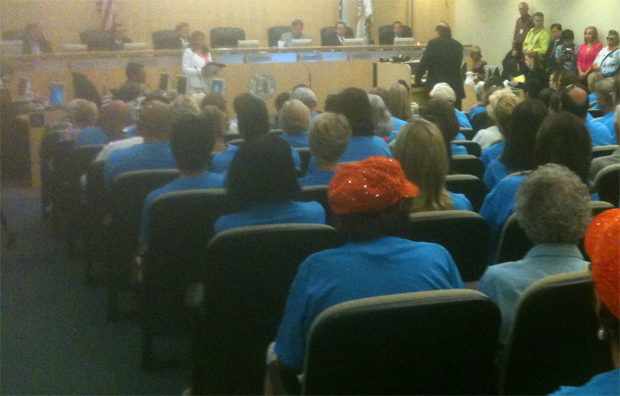
Mayor Quirk Silva and City Council in front of blue-clad FPD supporters
For connoisseurs of the Frantic and Frenzied Fullerton politics of the recent past, last night’s City Council meeting was a special treat. It had everything — conflict, drama, humor, threats, ripostes, people who can’t follow instructions (including a defensive council member), suspense — and an earthquake that caused no damage. I heard people complaining last night, as most of the audience filed out around 11:30 after the critical vote of the day, about how late they had had to stay to see the matter at hand resolved. Come on, folks! This was democracy in action; enjoy it!
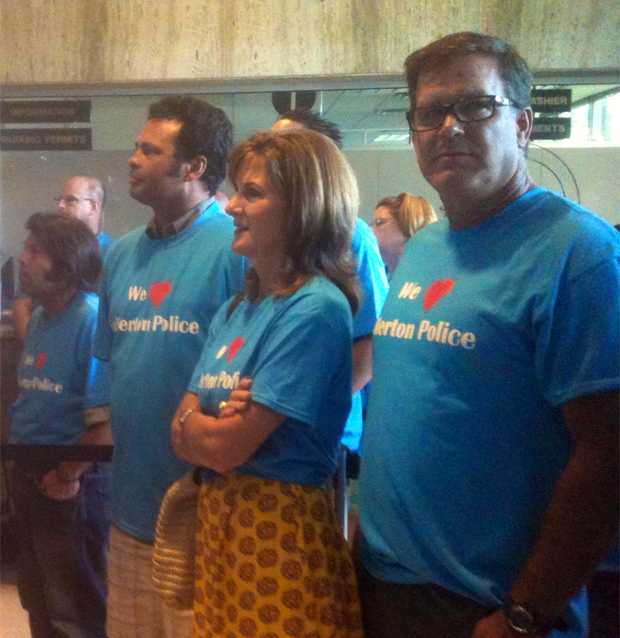
To get a sense of what the chambers and the spillover area in the City Hall looked like, you have to imagine he scene at right multiplies by 50 or more. Peacock blue t-shirts were yours for the asking; at least 75% of the audience was wearing them — as was, after the break, 20% of the City Council. (Doug Chaffee received an ovation when he put one on.) Judging from the speakers, another 20% might as well have been wearing them. Several members of Kelly’s Army were prominent supporters of the FPD (and of Interim Chief Dan Hughes specifically), saying that they had found him to be reasonable, responsible, and cooperative over the past year.
I’ll cut to the end of the chase: the City Council voted 3-2 not to seek a bid (or an initial report or something of the kind) from the Orange County Sheriff’s Department about the possible provision of police services to Fullerton — a move that would entail disbanding the Fullerton Police Department.
Mayor Sharon Quirk-Silva and Councilman Doug Chaffee were against seeking what would be the basis for a bid — noting that three years remain in Fullerton’s contract with the F.P.D. and that, while they opposed the motion, they also considered it to be premature. (Starting renegotiations with a threat to disband the department, sort of the nuclear bomb of negotiation, was seen by many speakers as a somewhat rude and confrontational posture towards the police.)
Mayor Pro-Tem Bruce Whitaker and Councilman Travis Kiger favored the proposal to see information from OCSD. For Kiger, the issue seemed to be less one of the desirability of the OCSD as the benefits of getting leverage with FPOA in labor negotiations. (This is a good point for my disclosure: I spoke against Kiger’s position on this point and others; I share a campaign office with Democrats including Sharon Quirk-Silva, though our operations are at arm’s length; my daughter is keeping the books for one of the Council candidates; etc.) Both of them are up for re-election in November (along with a replacement for Quirk-Silva, who is leaving office to run for Assembly against Whitaker’s boss Chris Norby); even though the proposal failed, their cards are now on the table, making possible replacement of the FPD a likely prominent issue for November.
Two of their November opponents, Democrats Jan Flory and Kitty Jaramillo, spoke against the proposal — although formal Councilmember Flory taunted them a bit, saying that she hoped that she would pass the proposal because it would mean that her campaign against them would be a cakewalk. That theory will probably get put to the test; while Whitaker and Kiger can’t be charged with putting into action the murder of the F.P.D., they did enough last night to warrant a charge of attempted murder. (To be fair, neither of them said that they would necessarily go with an OCSD bid over FPD; they just said that they wanted to see the price tag. I agree with them that that doesn’t really qualify as even “attempted murder” of the F.P.D. — I just don’t think that voters will agree.)
Flory’s trenchant speech to the Council clearly got under Whitaker’s skin, who defensively said that he should be able to speak then and there to rebut (or at least denounce) the “political” speech of a prospective opponent. This put Mayor Quirk-Silva into “fourth-grade teacher mode” for at least the second time I saw last night, asking Whitaker to wait his turn before responding. Eventually, Whitaker wore her out and had his say against Flory, which I presume will mean a stint in detention.
(The first such instance of Mayor Sharon lowering the hammer came during public comments, when Ron Thomas wanted to finish off his speech by addressing the F.P.D. issue — he favors retaining them — and was told that he couldn’t address an agenda item during public comment and would have to come back. Thomas “yes but” attempts to sneak in his sentiments despite the Mayor’s admonishments drew laughter from the crowd in the lobby.)
All of this was prelude to Sebourn’s turn to speak and cast the deciding vote. He was clearly of two minds about this — believing that the city should be able to get information from the OCSD — “no harm in asking, after all,” one might say — but thinking that the timing might be wrong. He also noted that Councilmembers could get the needed information from other sources, including the OCSD directly. (Just be aware of the Brown Act, Greg!)
As many speakers (especially those with the FPOA and its sister organizations, there was little reason to get numbers now for a bid that wouldn’t take place until 2014 — and little reason to trust the figures from the OCSD as being (1) reliable or (2) indicative of the service that would be provided. Yorba Linda’s recent experience with moving from being serviced by the Brea P.D. to the OCSD, and the problems they’re allegedly having with increases in costs and deficiencies in service, was cited often — and of course in doing so Yorba Linda wasn’t considering anything as dramatic as disbanding its own longstanding police force.
As for the timing issue — not only is the information not yet likely to be useful, but there is a harm in asking for it now: going for three more years with a pissed-off and perhaps demotivated police force. (The only real timing issue seems to be that this is the only time when the Bushala/Norby/Whitaker forces can be assured of having a majority; Kiger in particular is thought to be vulnerable in November.) On balance, the lack of gain and the prospect of loss tilted Sebourn to the “not yet” position, which on this particular question turned out to be “no.”
All was quiet in the room when Sebourn spoke — and as he spoke the room itself trembled. Yes, amazingly enough, the tectonic plates beneath Yorba Linda chose this precise moment to jolt the room twice, maybe half a minute apart. Sebourn handled it with aplomb as Quirk-Silva dispatched the fire chief to ensure that the room was safe enough for them to continue the meeting. Some rueful laughter punctuated the room, Sebourn wondering aloud whether it might be some sort of omen (and perhaps wondering privately if Tony Bushala really can control such things.) In my opinion, though, it was less an omen than a metaphor for the shake-up to come.
Sebourn has been a darling of the FFFF blog — although apparently he’s been seen as a little too independent-minded. (I’ve also heard from supporters of his ideological opponents on the Council that he was someone who was responsible and could be reasoned with.) The FFFFsters were FFFFrantic and FFFFurious today, accusing Sebourn of betraying his campaign promises. To anyone who actually heard him speak, this was absurd. He is clearly as devoted to his libertarian colleagues to the notion that government needs to be cut back and that pension obligations particularly are a particular problem. He just doesn’t conclude from that that every solution that someone puts forward at any given time is necessarily worth immediately supporting.
Sebourn said something else at the meeting that I think bears mention because it is so admirable and politically wrong. After having pissed off his fellow libertarians by voting with the FPD supporters, he chastised the very people packing the audience whose appreciation he had just won, saying that he found it disturbing that people would be against the simple act of seeking information. (If he was jumping ship, it was while wearing a bungee cord.)
There’s surely something to that — but there’s also something against it, which I think speaks to what now looks like a major issue looming in November. It comes down to whether people feel that they have a relationship, beyond a simple business arrangement, with the F.P.D.
Consider how the notion that “there’s no harm in seeking information” works with relationships that matter to us. Consider a wife going onto a dating site and telling her husband “I’m not saying that I want to leave you or that I plan on cheating on you while we’re married; I just want to find out if someone else is interested in me who might be a better provider.” That is “just seeking information,” but it would not go over well, would it? (There are less dramatic examples of this, of course; I’ve even gotten into trouble when telling one mechanic that I was thinking of seeing a different mechanic.) Existing relationships matter.
Of course, the libertarian critics are right in saying that if one is not prepared to step out, one invites abuse. Still, there is wisdom in not packing one’s bags three years ahead of the time one might leave. Those can be three very long years.
Kiger pretty much out and says that what he’s seeking is additional leverage with the union — despite the fact that, unless he wins re-election, he will not be one of the ones negotiating with them. It’s not hard to imagine that the current contract is too favorable to police; one of the strongest points made by the critics was that past relations between Council and police have been so friendly that the contract has really never gone through serious scrutiny in negotiations. Some non-trivial specific criticisms have been leveled — for example, that the department is overburdened with management. By all means, let’s talk that one ut.
Certainly, there’s no problem with saying that Fullerton should want a contract that is about as good, in terms of “bang for the buck,” as that of its other peer cities. I hope that the next council will be willing to cast a jaundiced eye at the contract, just as I hope that all sources of fat in a government budget receive special scrutiny. But there are ways to do it and ways not to do it. What we saw Tuesday night was a way not to do it.
Greg Sebourn may get slammed — actually, there’s no “may” about it, he is getting slammed — by his FFFFster colleagues for his vote, but he did the right thing by not going along with the program this time. He and Chaffee will be involved in negotiating the contract — and they will face the voters in 2014 to be judged on how well they perform at that, not on what happened last night.


Regarding the “we’re just seeking information” canard from Kiger and Whittaker (and to some extent Sebourn). 1) As FPOA President Barry Coffman said during comments, if its about reducing costs, why didn’t the Council, presumably via the City Manager, approach the PD and/or the association to solicit cost-reduction ideas first? Really, are the only two options maintaining the status quo or totally contracting? Surely people as sharp as Travis and Bruce can put their heads together with other stakeholders and come up with an array of options, something Bruce, especially, is always demanding from staff. 2) If its about cost, why hasn’t the same level of scrutiny been aimed at other departments?
Clearly, Tony and his Wild Bunch overplayed their hands on this one, assuming the legitimate outrage at the Kelly Thomas killing equated to outrage at the FPD in general. But when you have members of Kelly’s Army supporting the acting chief and the reforms he’s already implemented, its pretty clear the city is taking its responsibility seriously.
The speakers were correct: getting cost information two to three years before you can use it is pointless. Timely information would be helpful.
During their comments at the end of the meeting, Travis and Bruce tried to tie the City’s infrastructure deficits to employee compensation, rattling off the millions of dollars in deferred repairs to streets, water systems, etc. and suggesting that if only we didn’t pay these darn cops so much, we could use the money for repairs. That’s a little like blaming the Empire State Building for causing lightning because it gets hit so often. Bruce kind of blew his own logic out of the water when he said all of the deferred repairs were equal the several years of the City’s total operating budget. If so, the amount saved (if any) by contracting police would be a small plug in a big dam. The two issues are separate and require very different approaches and solutions.
And, not to sound petty, but there was a certain level of satisfaction seeing Bruce get slammed after spending the last year encouraging the same treatment of his fellow Council members.
Rick Alvarez, a former candidate, summarized it well: This Council was elected with the expectation they’d support the healing already started by Capt. Hughes and others in the community. Instead, they were trying to continue the divisiveness. Perhaps because that’s what got them elected to begin with and that’s the only card they can play….
That marriage analogy is way off the mark, Mr. Diamond. Last I checked, vows were for life.
It’d be more like looking at a Ford for your next vehicle purchase, even though your father only bought Chevys. This is a brand loyalty argument and not a scared relationship being torn asunder.
We’re going to be talking about a contract worth something in the neighborhood of $200,000,000 over 5 years. It would be completely irresponsible to wait to analyze the decision and make shoddy inquires into alternatives until 2014.
The city council has a duty to explore all alternatives before making an informed decision and the decision should be ready to execute if the FPOA elects to not pursue their 1 year option. We’re looking for a new police chief who will be called upon to make long term reforms. Before bringing in an appropriate person– who I can only assume will require a significant investment (otherwise they really can’t be up to the challenge, right?)– we ought to know what the costs (financial and non-financial) look like. This at least includes the FPD, Brea BD, OCS, and a consolidated North OC PD.
I don’t think a full year to look at alternatives is out of the question. After all, it’s taken much longer than that to pull cops off the force who beat a man to death. With that in mind, information gathering ought to be done early next year so that an analysis and plans can be examined before the FPOA’s option is executed. If the FPOA elects to “pull the trigger”, then an additional delay may be warranted, but for the city council to assume as much is just bad management.
On a side note, I lived in San Dimas for 5 years. San Dimas is a contract city and hosts a LACS station. Their service and involvement in the community is nothing short of extraordinary. While San Dimas’s situation is substantially different from Fullerton and the LACS is not the OCS, I’m a bit troubled that everyone seems willing to dismiss their level of service as some how substandard. From my experience, the contracted service is better in every way from locally managed police in every city in which I’ve lived.
“Last I checked, vows were for life.”
Check again, Ryan. Empirically, they are not.
“A full year to look at alternatives means getting it delivered around November 2013, not November 2012 — and even that’s generous.
Greg, I don’t understand either line. Sorry.
Ryan–I agree with your basic premise, but compare what you said–which is the correct approach–with what the agenda item said. It is always helpful to find ways of improving an organization–in fact the most successful organizations are constantly looking for improvements. If the Council was really interested in looking at all the options, then the direction to staff would have been to start a ground floor-up review. What do we want our police services to look like? What will be its core values, etc.? By all means, let’s look at how we can combine some or all services with other cities, or what the services OCSD may offer.
In the OC Register article yesterday, the OCSD said it would take about four months to create a preliminary bid, so lets make that the end of December 2012. The current FPOA contract expires in mid-2014; so the figures would be nearly two years old by then. The numbers would mean nothing. What they should be looking at now is what direction they want to take and how they want the organization to look. Then get a cost for the service they want.
But the only thing on last night’s agenda was a cost estimate from the County for total replacement. There was no mention of a new direction, new or different services, no comparison of touchstone issues like dealing with the homeless or mentally ill, etc. The only “reform” they were interested in was their obsession with pension costs, mostly becuase its a hot button political issue.
As for the quality of contract services, judging by the turnout last night, the residents, who pay the freight, made their desires pretty clear. Take a look at Brea/Yorba Linda. The only way the OCSD came in cheaper was by reducing services compared to the present contract with Brea. And a lot of Yorba Linda residents aren’t happy about that at all. Its one thing to be used to contract police services if your city has always used that model, but its a whole different animal switching from local to contract services. And like some of the speakers said lat night, contracting and reform are unrelated; chances are the OCSD would hire most of the FPD cops anyway.
If its about reform, then reform what you have and make it what you want. If its about saving money, explore all your options, not just one. If its about both, don’t go down one road to the exclusion of all the others.
I don’t disagree with defining what we want from a PD organization up front. If you haven’t sent that suggestion in to council, please do so. We can’t fix the problem if we don’t define it first.
Second, yes– the numbers absolutely will be out of date and not applicable, but that’s the whole point of an initial estimate. In project speak, we’d expect an initial estimate to be around P50 (correct or lower about half the time). In addition, the estimate wouldn’t be binding. In other words, it’s not supposed to be a material estimate. It’s just supposed to be good enough to make a decision to either put resources into getting a sanction quality estimate or to not be good enough.
But seriously, you make a great point on defining what “good looks like” up front. Well done.
Thanks, Ryan, I’m a project manager myself and certainly appreciate the value of the P50 perspective. It really sounds like we’re talking about the same goals, just from slightly different perspectives. But that’s what democracy’s about, I do believe 🙂
” Consider a wife going onto a dating site and telling her husband “I’m not saying that I want to leave you or that I plan on cheating on you while we’re married; I just want to find out if someone else is interested in me who might be a better provider.” That is “just seeking information,” but it would not go over well, would it? (There are less dramatic examples of this, of course; I’ve even gotten into trouble when telling one mechanic that I was thinking of seeing a different mechanic.) Existing relationships matter.”
In this case, the husband is not just a serial abuser but a soon-to-be convicted killer. Threatening the relationship is completely appropriate, as is ending it. The only reason NOT to end it is because you might end up with something worse.
CONTINGENCY
1.
a. a possible but not very likely future event or condition; eventuality
b. (as modifier) a contingency plan
2. something dependent on a possible future event
3. a fact, event, etc., incidental to or dependent on something else
4. (Linguistics / Grammar) (in systemic grammar)
a. modification of the meaning of a main clause by use of a bound clause introduced by a binder such as if, when, though, or since Compare adding [3]
b. (as modifier) a contingency clause
5. Logic
a. the state of being contingent
b. a contingent statement
6. dependence on chance; uncertainty
7. (Mathematics & Measurements / Statistics) Statistics
a. the degree of association between theoretical and observed common frequencies of two graded or classified variables. It is measured by the chi-square test
b. (as modifier) a contingency table the contingency coefficient
===========================================================
*Ain’t nothing that bad about having a bad up plan……so we agree with Dr. Whitaker!
1.b, 2., & 3. are all good!
Jt – “The only reason NOT to end it is because you might end up with something worse.”
*It could happen……but it won’t be pretty for either side!