.
.
.
I will be reading the opinion in Perry v. Brown this morning and providing some comments on it. Don’t let that stop you from giving your impressions before then!
11:24 — For those who are not law nerds, Stephen Reinhardt, the author of this opinion, is probably the most prominent liberal federal judge in the country. He is sometimes called by terms such as “The Chief Justice of the Warren Court in Exile.” The Warren Court was the liberal (though often only barely so) court led by Chief Justice Earl Warren, the philosophy of which held sway until roughly 1975, when moderate (yes he was at the time!) Justice John Paul Stevens replaced liberal/libertarian firebrand Justice William O. Douglas. Reinhardt sits on the Ninth Circuit Court of Appeals, which (along with twelve other Courts of Appeals) is one step below the Supreme Court. He will turn 81 on March 27.
Due to his prominence and unfashionable liberalism, Reinhardt is among the Justices that the conservative majority loves to pound on most. (Frankly, the center-left minority of the court, sometimes mistakenly called the “liberal” wing, often likes to pound on him too, the better to show that they are distinct from him.) He is one of, if not the, most overturned Circuit Judges of our time. As he says, that’s not his problem: he’s applying the law as it is written; the Supreme Court, if it chooses, is the body with the power to change it. So, when he is overturned, it doesn’t mean that he was wrong; it could mean that the Supreme Court has just changed the law.
(Conservatives hate it when he says that. The law, the theory goes, never changes, but its truth is only “revealed.”)
A major decision from Reinhardt would usually be a direct express ticket to Supreme Court review. In this case, though, that might not happen.
The reason is simple: right now, this ruling applies only to the Ninth Circuit, which is admittedly the largest and most populous in the country. (It stretches from Arizona to Montana to Alaska to Guam.) While it undoes the law in California, it might well be used to argue that either other Ninth Circuit states must accept marriage equality, or that at least if they do so they cannot back out of it. (Hawaii, for example, sort of did; Washington is on the verge of doing so as well.)
If four Justices decide to take up the case next term, though, a resulting decision on the merits would apply to the entire country. Is it worth it for conservatives to rely on centrist-conservative Anthony Kennedy to roll back this decision — and thus to risk applying the rule of law created to the entire country? For that matter, is it worth it for the moderate-liberals to do so? Only Kennedy knows (probably already) which way he’ll come down — and he ain’t telling.
There is good reason to think that Kennedy might side with the liberals in what would probably be the capstone opinion of his career. (The one near-certainly is that he’ll get to write it.) He wrote the opinion in Lawrence v. Texas, the case that declared “sodomy laws” unconstitutional (for straights as well as gays, by the way.) Fellow Justice Antonin Scalia laid into him with full force in his stinging dissent. Of course, at that time, 8-1/2 years ago, the Justices took pains to note that Lawrence could not directly be used to justify the unconstitutionality of same-sex marriage. That was then — this, not so long afterwards, is now.
11:51 — I’ve by now had some discussions on Facebook with commenters including my friend Michael Fox about why the panel chose to stay the ruling (preventing it from going into effect) for now. Here was my comment, slightly re-edited:
Michael, the betting seems to be that the plaintiffs will not appeal, with the rest of the country “letting California go to the dogs” (from their perspective) and take the states of Washington and maybe Hawaii with us.
(You’ll know this next stuff, as will other non-lawyer law geeks, but for the benefit of those who are neither): If I recall correctly (and I may not, it’s been a while), the time allowed for request for cert to the SCOTUS is 60 days after the final disposition by the Circuit Court. That could take a while because the Ninth Circuit could take up the case en banc. Usually this means a twelve-Judge panel, selected randomly from among the couple of dozen judges, but there is a procedure in place to call for a hearing in front of all of the judges.
I think that you may see a call for an en banc hearing (which would stay this decision and would eat up a lot of time, probably pushing the date of a SCOTUS hearing until after the November election) because — why not? They could get lucky with the draw of justices; it happens. But they also know that if an en banc court reversed this decision, it would certainly get appealed. Somewhere, Republican Party tacticians are deciding what to do, if they hadn’t already — this decision was unsurprising given the three-judge panel assigned it — and will let their favored Judges know whether they do or don’t want to see it go en banc.
It’s the prospect of the Ninth Circuit taking it en banc, more than the Supreme Court granting cert, that I will bet was behind the stay. If they hadn’t stayed the order then there would have been more pressure on the Ninth to take it en banc, which I’ll bet that Reinhardt wants to avoid. He’d probably love to see this argued in the SCOTUS less than a month before the election!
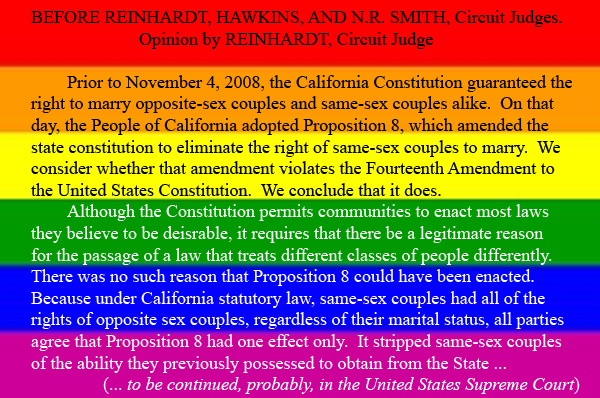
12:18: I need to get back to work, so I won’t go into that much depth about the substance of the decision, but here’s the gist: it’s about whether the state has a rational interest in passing a law for the sole purpose of symbolic denigration of one group. All that Prop 8 did was to leave the same-sex couples the substance (or “incidents”) of marriage while taking away its “status and dignity.” Is this a legitimate basis for state action to the detriment of a given group? To pass constitutional muster, a law must have a “rational basis.” Animus against a group, by itself, is not a rational basis; this was the finding of the Supreme Court in Romer v. Evans, written by Justice Kennedy. This has led some to argue that the Supreme Court now requires something that has been called “rational-plus” review, which says that if the only “rational” reason is to put someone else down, that’s not enough. To the majority, that’s what’s going on here. To the dissent, the intent behind Prop 8 is rational enough to bear scrutiny.
That’s based on only a quick skim after the first few pages; I’ll have more later.
The next day: … or, maybe I won’t. Most of what I’d want to say is already wrapped up in this nice package by Talking Points Media. My own (longshot) prediction is: appellants will seek an en banc rehearing in the Ninth Circuit, hoping to get lucky in the random draw of judges, but will not even bother to seek a grant of certiorari to the U.S. Supreme Court.


Now we’ll have to endure the uproar from the aggrieved religious right, who will take this as the precursor to a massive smiting from their primitive deity.
Otherwise, really good news–what is the rational basis for denying this rite to a minority? Well, there isn’t one, of course.
Once again it’ll be “A handful of liberal judges defies the will of the people WAHHHHHHHHHH!”
As though that wasn’t exactly what the judicial branch is SUPPOSED to do when the majority tramples on minority rights.
The rational basis is that calling gay marriage “marriage” might promote tolerance among children.
You may think I’m being facetious there. I’m not.
For the “Lay” family the arguement is simple:
seperate is not equal
At my Son’s college this past weekend, it was not lost on many of the “boosters” that at the same time they were rioting in Little Rock, a black man was delivering BIG TIME in Milwaukee. While it sounds like Peter Cooper song, it is strikingly familiar, both with Prop 8 and Barry Bonds.
Talk about PEOPLE POWER: Support CAL BEAR’S BASEBALL!
Is it not suprising that openly (closeted) homosexual peoples won’t comment on this.
Man the economy must be tough for journalists………
(http://totalbuzz.ocregister.com/2012/02/07/appeals-court-declares-prop-8-unconstitutional/82224/ )
Andrew should start a blog. DISGUSTING>
Who’s Andrew?
You mean Galvin? Did he do anything wrong there? Looked fine to me.