Let’s see, what do we know about Asm. Blanca Pacheco’s anti-transparency bill AB 1821 that we didn’t know when we wrote about it on Wednesday? Well, a lot, actually. On Wednesday we chewed out the Assembly Democrats – apparently ALL of em across the spectrum – for passing this CPRA-kneecapping monstrosity. But as it turns out, the bill we’re looking at now (and on Wednesday) is NOT the same one Democrats passed in May.

Here’s how it works, apparently, with Blanca Pacheco’s bills. In March she filed AB 1821, the original version, which immediately drew fire from the press and fellow Democrats for allowing gov’t agencies to charge unspecified fees for complying with PRA requests. The bill said “reasonable fees” but who’s to determine what’s reasonable? The First Amendment Coalition’s David Snyder responded “California Shouldn’t Price the Public out of Public Records: Democracy is at Stake!” and progressive Assembly Judiciary Committee head Ash Kalra agreed.
So to get her bill passed, Blanca Pacheco took out the fees and watered the bill down to one that just gave agencies EXTRA TIME to comply with requests. This less controversial version is what passed the Assembly May 27 with (I think) all Democrats voting aye.
(Republicans to their credit voted against even this watered-down version; and whatever their reason it was a good vote: as Duane Roberts wrote here, “delays [in responding to requests] aren’t neutral—they push disclosures past key votes, hearings, and elections, allowing officials to bury inconvenient facts until the political moment has safely passed.“)

And THEN, as the bill made its way to the Senate, Ms Pacheco got to work not only adding the fees back in (specified now to “administrative fees” of $22.35 per hour and a “professional fees” of $66.26 per hour with cost-of-living increases included) but adding in even more tyrannical provisions – among other things, agencies can charge us more if they decide our interest in the info is “commercial,” or if they can convince a court that our intent is “malicious” – whatever the hell that means!
And THAT is the current version of AB 1821, unveiled June 10, the one that created such a firestorm in the press Tuesday and Wednesday, starting with Borenstein in the Mercury News, this blog here, and a fierce Register editorial probably written by Greenhut. But what really rattled Sacramento Democrats was Yue Stella Yu’s Thursday CalMatters article entitled “This Lawmaker’s Proposal Could Make California ‘the Most Secretive State in the Country‘,” in which gov’t watchdog Tracy Rosenberg called the bill a “virtual horror show of governmental non-transparency.”
But first…
¿SERIO?
Can a lawmaker just do that? Pass a bill one way, and then add or subtract a bunch of shit from it? Asm. Sharon Quirk-Silva says no. She knew right away what bill I was asking about; since the press storm it’s become a real hot potato. She says that if these additions aren’t taken back out in the senate, the bill will have to come back to the assembly in its new form, where it sounds like it’ll have a much steeper chance of surviving. Apparently this kind of sneaky amending happens sometimes, and is called a “jailbreak,” but rarely has it been seen so shameless and blatant.
About Blanca Pacheco.
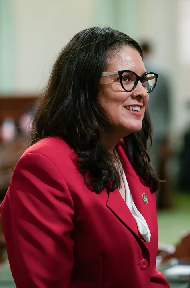
We’ve never paid much attention to this Downey-centered assemblywoman, but she does represent the OC town of La Habra and apparently we have to start. She has recently taken a special interest in whittling down the California Public Records Act, not only sneaking this bill through but passing, last year, both AB 1178 making it easier for agencies to redact police misconduct records, and AB 343 allowing more public officials to withhold personally identifying information.
But to point out that Blanca Pacheco likes to regularly take a chainsaw to the Public Records Act is to also call Blanca Pacheco a cat’s paw of the League of California Cities and the Cal. State Ass’n of Counties. These are the lobby groups for Cities, Counties and their agencies, which consider the CPRA a huge pain in the ass, both because complying with requests takes them extra time and because it forces them to part with secrets they’re loath to part with. These two groups literally write Blanca Pacheco’s bills.
But that’s not all we’ve learned this weekend about Assemblywoman Blanca Pacheco – she has also distinguished herself as the legislature’s largest recipient of special interest-funded travel, having received over $45,000 in sponsored travel in 2025 alone! Not to worry, claims her spokeswoman, those trips gave Blanca Pacheco opportunities to learn about “challenges and solutions affecting California,” and even “helped inform” this bill we’re discussing now, this AB 1821!
This claim leaves us readers with a few questions:
- Did the idea to allow agencies to charge us unspecified fees for public information occur to Blanca Pacheco while she was at her $16.8k, 12-day energy-study retreat in SPAIN with representatives from Edison, PG&E, Chevron and others?

- Did the concept of charging the public extra for public information if it’s deemed that it might have commercial use dawn on Blanca Pacheco during her $5700 “policy conference” last year in MAUI with pharmaceutical and tech representatives?
- And when Blanca Pacheco hit on the plan to give government agencies the power to sue public information requesters for having “malicious intent,” was she in the middle of the golf tournament and fundraiser in Pebble Beach that special interests paid $4500 to take her to last year?

What can the poor voters of AD 64, the voters of La Habra, Downey, Bell & Bell Gardens, Cudahay, La Mirada, Norwalk, Santa Fe Springs, and parts of LA & Whittier, what can those voters do? Blanca Pacheco, like all assemblymembers who aren’t termed out, is up for re-election. But her only opponent is this sad-sack Culture Warrior named Raul Ortiz, Jr., who only managed to get a third of the vote in the primary.
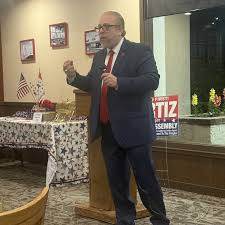
I would think you guys out there, in such a solidly Democratic district, could do better than Blanca Pacheco next time. (Of course, I’m writing here, ironically, from the 46th Congressional District, so I know what it’s like to hear that…)
Well, what can be done about AB 1821 at least?
Enter the Undertaker.
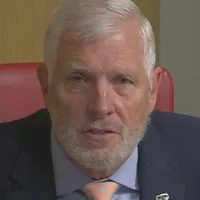
Blanca Pacheco’s oppressive and ever-changing anti-transparency bill is now in the Senate Judiciary Committee, presided over by Senator Tom Umberg. Greenhut, in the Register, urges Umberg to “send the bill to the bottom of the sea.”
Greenhut knows whereof he speaks. Umberg’s Judiciary Committee, like the biblical Valley of the Shadow of Death, is littered with the bones of once-healthy bills that withered and perished in those inhospitable climes. Look over there! The carcass of a rent-control bill we’d been cheering on. Careful, don’t trip – that is the rib cage of a single-payer bill, and over there, the skull of a police accountability measure.
If there is a time that we would all cheer for Senator Umberg to kill a bill in committee, it is this one, Blanca Pacheco’s pro-secrecy AB 1821. And here is where we urge you to call, e-mail, or snail-mail Tom (who just happens to be termed-out and running for the Board of Equalization!)
(916) 651-4034
(714) 558-3785
senator.umberg@senate.ca.gov
Senator Tom Umberg Contact Form
1021 O Street, Suite 6610, Sacramento, CA 95814
And a great place to get talking points for your call or mail would be from what our friend Duane Roberts wrote for us on Wednesday:
*******************

AB 1821 is a bill designed to protect the powerful and punish the public. It takes a basic democratic right—the right to see what your government is doing behind closed doors—and turns it into something you can only access if you can afford it. The wealthy walk away untouched. Ordinary people get priced out, slowed down, or threatened into silence.
Under this bill, agencies can charge steep hourly fees if your request takes more than two hours of staff time. Those fees can easily run into the hundreds or thousands of dollars. Wealthy corporations, developers, and political insiders won’t even notice the cost. But working‑class residents, neighborhood groups, parents, activists, and small nonprofits will be forced to think twice before requesting anything. The message is clear: transparency is for people with money.
AB 1821 also stretches out deadlines, giving agencies more time to delay releasing information. Those delays aren’t neutral—they push disclosures past key votes, hearings, and elections, allowing officials to bury inconvenient facts until the political moment has safely passed. And by forcing people to prove who they are and why they want the records, the bill hands bureaucrats even more power to decide who gets access and who gets stonewalled.
But the most dangerous part is this: the bill gives the government the power to sue you if they decide your request is “malicious” or “frivolous.” That means if you’re a persistent critic—someone who keeps uncovering uncomfortable truths—an agency can drag you into court simply because they don’t like what you’re digging into. Wealthy interests can fight back. Regular people cannot. The threat alone is enough to shut most people up.
AB 1821 creates a two‑tier system of transparency. The wealthy, the connected, and the institutional players keep their access. They can afford the fees, the lawyers, and the delays. Everyone else—the people who rely on public records to expose corruption, challenge bad decisions, or simply understand what their government is doing—gets pushed out.
This bill doesn’t strengthen accountability; it destroys it. It turns public records into a privilege for the rich and a risk for everyone else, shielding government from the very people it is supposed to serve.



I can’t even imagine what this woman thinks is in this for her. She will have no allies and tons of bad press, and of course her peregrinations will become the topic of lots of conversation.
Here’s something: will your friend Sharon Quirk actually DO something about this? She’s known in some Fullerton circles for political go-alongism (remember Albert Rincon and socks for the homeless as a palliative for the Kelly Thomas murder.).
I’ve received more e-mails about this story than usual, thanking me for it. One first amendment activist wanted to alert me to Pacheco’s role in killing legislation that would have forced lawmakers to release lobbying letters:
https://calmatters.org/politics/2026/05/secret-capitol-lobbying-letters/
Transparency sure is Blanca’s enemy! Meanwhile, it sounds like Umberg’s scheduled a hearing on AB 1821 next Tuesday, June 30. We have a week to get all those calls and e-mails in!
Today, Umberg’s office tells me “The author [Pacheco] has agreed to amend the bill back to how it came out of the Assembly, which changes the time for response to a request from “days” to “business days”. The amendments will be in print tomorrow.” And they sent this PDF of how the bill read in April, the way Assembly Democrats passed it in May:
http://www.orangejuiceblog.com/wp-content/uploads/2026/06/AB-1821-first-version.pdf
Our speaking out worked, but obviously there are politicians out there (and they are Democrats) who are way too eager to weaken our Public Records Act. Gotta stay vigilant!
More recently, Greenhut thoroughly takes this Pacheco lady to the woodshed. And opines that the legislature should reject even the scaled-back version of the bill.
“The Queen of Government Secrecy!”
https://www.ocregister.com/2026/07/02/will-california-lawmakers-bow-down-to-the-queen-of-government-secrecy/