Not so many years ago, someone I respect very much decided to run for Irvine City Council. I don’t want to embarrass him by naming him. But let it suffice to say that he’s a person of great perspicacity and character who knows the issues affecting Irvine and who wanted to do his part to make Irvine better. I see so many candidates who seem to run as an ego trip or an opening act for larger political ambitions. They learn Irvine issues on the fly. When I ask their supporters why they’re running and what they hope to accomplish, I get radio silence.
That wasn’t my friend. And I was excited to support his candidacy. But it transpired that there was another Democrat running in the same district whom my friend judged to have a better chance of winning. He didn’t want to split the vote, so he gracefully bowed out. I respect that decision greatly — many of us on the Left wish that more of the umpteen Dems currently running for governor had the same willingness to put the greater good ahead of their own campaigns. But I do not respect the electoral system that forced my friend to make that decision: plurality voting — a.k.a. first-past-the-post.

It’s funny what baked-in assumptions we’re willing to accept in our society. I once found myself arguing with someone about the merits of public transit. This person thought that public transit was dangerous because crime occasionally happens on public transit vehicles. “You realize,” I said, “that someone is killed by private automobiles every 12 to 15 minutes and that the private automobile has been responsible for killing more Americans than all our wars combined, right?” Didn’t matter to him, though. All those deaths are just baked into the equation. It can be so easy for us to commit to business as usual, even when we’re in the business of insanity.
Now, the logic of fairness in democracy is very sane. It’s almost playground-simple. We need to decide what to do as a group. Let’s do the thing that most of us want to do. But when your elections allow for the thing that only some of us want to do to win, that logic is shattered.
Here in Irvine, 10 of the 16 mayoral elections in which someone wasn’t running unopposed were won with only a plurality of the vote. In 2024, Larry Agran won with 38.76%. It’s possible that if you could ask the remaining 61.24% of voters who their second or third choices would have been, enough of them would have said “Larry” for him to reach a majority. But it’s also possible that all those voters would have preferred someone else in the event that their first choice didn’t win. The playground-simple logic of democracy is that we should be governed by those whom the majority support. But our system doesn’t insist on it. Our system can even allow rule by those whom the majority do not want in office.
And there it is again: the business of insanity as usual. The entire basis for the legitimacy of government in our society is “majority rules”. But we routinely don’t even bother to do the work of figuring out what the majority really wants. Enter Ranked Choice Voting.
Ranked Choice Voting answers the question “what if you could ask every voter who they’d support if their first choice couldn’t win?” And its answer is simple. It just bothers to ask.
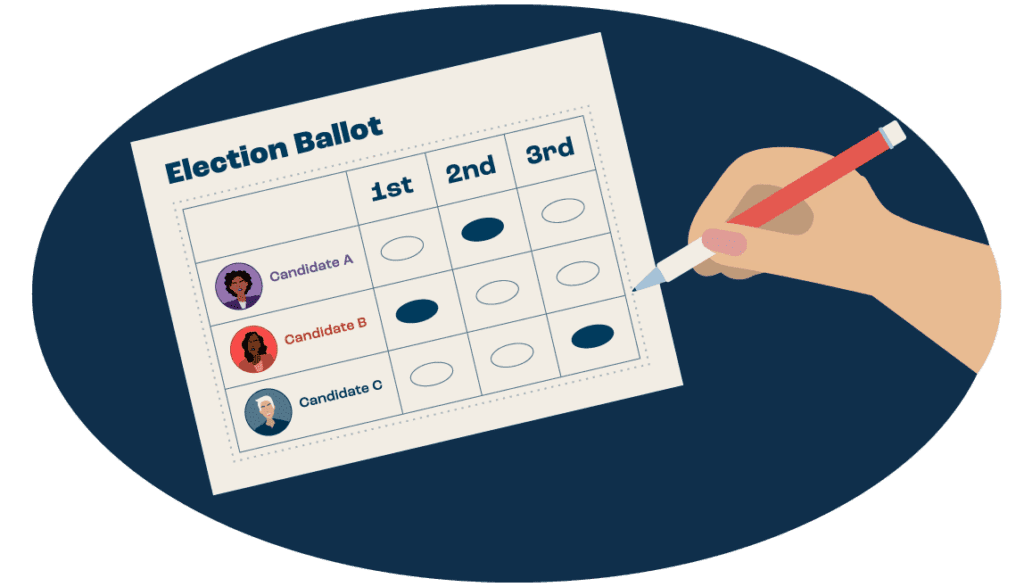
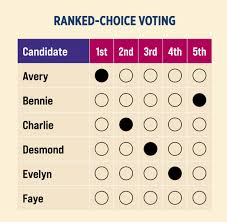
Ranked choice voting has voters rank the candidates in order of preference. Only like one candidate? That’s fine. Just vote for that one. Only like two? Rank only those two. But the system doesn’t stop at asking you who your first choice is, and ballots are redistributed to the second, third, or fourth choices and so on as each lowest vote-getting candidate is eliminated.

Think of it this way: if you and a group of friends were trying to decide on where to go out for dinner and you were the only person who said “Chili’s,” you wouldn’t expect to be frozen out of the rest of the conversation, would you? No, you’d expect to be able to weigh in when half of your friends want to go to Outback and the other half want to go to Olive Garden. Why should the way we run our democracy be any different?
RCV turns an election into a negotiation between all the voters — the same kind of negotiation you and your friends enter into when deciding on dinner. Only with elections, the stakes are our future and the legitimacy of our governments! And I, for one, think we ought to know what each of you have to say once Chili’s is ruled out.
My friend who dropped his candidacy for city council might not have won. His contribution to the election might only have been introducing ideas and more options to the voters. Or he might have surprised everyone — and himself. Sadly, we’ll never know. Polls currently show that around half of voters support a Democrat for governor to the roughly 30% of voters who support a Republican. And yet we face the possibility that we’ll be choosing between two Republicans in November because that Democratic support is split between eight candidates! Every kid on a playground knows that’s not fair or just. Every kid on a playground knows it’s not democracy. And we already have an alternative system we can turn to that would allow us to do better — to make sure that future mayors of Irvine and governors of California aren’t achieving power because some small group of voters liked them best. This coming Tuesday, Irvine City Councilmembers Kathleen Treseder, Betty Martinez Franco, and Melinda Liu have put the adoption of Ranked Choice Voting on the agenda. Here’s hoping that sanity can win the day.
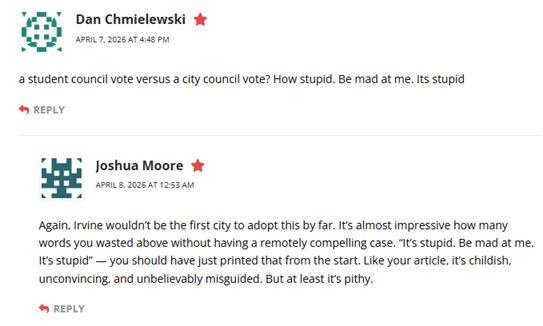


I had to invite Joshua to write this here, after watching the comical sight of him trying to talk sense into the dense Dan Chmielewski here:
https://theliberaloc.com/2026/04/07/irvine-city-council-asking-to-add-ranked-choice-voting-for-city-elections/comment-page-1/#comment-289097
A high point:
Great article on Ranked Choice Voting Josh! I wholeheartedly agree. I want more control with my vote. We only have one vote and it would be great if the individual voter had more control into how our sacred vote will play out. I fully support RCV in Irvine!
My advice to Mr. Moore, who seems like an eminently reasonable man is the same as I always give Vern. DON’T TOUCH GODDAMN THE PINK TOAD.
The indigenous tribe folk of Guatemala know this very well.
If it touches me first, all bets are off.
Yes, I know that’s the impulse but you gotta know what the Guatemalan hill folk know: you get poisoned and Pink Toad just goes on being a happy, stupid Pink Toad.
If we’re talking about Dan C, he has never seemed “happy.”
Content being a Pink Toad? I guess it depends on an amphibian’s level of sef-awareness. The lower, the happier.
In any case don’t touch it.
Self-satisfied? Outside of a comix store, that may be as good as it gets for him.
Oh, that pink toad! I’ve not been terribly impressed. As a debater, he just fails to respond to your points, clumsily shifts the goal posts, mistakenly accuses you of making a straw-man argument, and then eventually goes silent and slinks off. No one could be all that happy with a performance like his. And the only poison I see is his crude contribution to public discourse.
There have been three or four really good comments on his two RCV stories, I wish they would comment here. I may copy them over here or something.
You are not licensed to wield the “pink toad” metaphor. Eric isn’t either, but he’s irrepressible.
RCV should be adopted statewide so cities and counties don’t have to do it piecemeal. It saves money, discourages negative campaigning, guarantees a winner with actual majority support, and eliminates the spoiler factor, thus encouraging participation.
Now that many cities elect council members by district, using RCV is much easier to implement than it would have been for tallying at-large votes.
If California had adopted RCV instead of the current top two system for state office elections Democrats wouldn’t be freaking out right now about the gubernatorial primary possibly landing two Republicans on the ballot in November.
The Green Party has advocated for RCV for decades. Why does it take Democrats so long to learn? Would they really rather lose to Republicans than let anyone else into the game?
You’re absolutely right that California should adopt it statewide — and should already have done so. And you’re absolutely right that we Dems have been too slow to push for it. (Which is depressingly on-brand for us.) I think piecemeal implementation is unfortunately our best road to get there. A lot of people need to be able to see a good idea in action in familiar settings before they can believe in it. (I hear it in Irvine politics all the time — “it’s already been implemented in the following OC cities” is always a strong selling point.)
I strongly prefer RCV, but the track record of voters being able to understand it is not good. For every Mamdani election, there seems to be three where voters retract if after its adoption. Maybe it’s a function of too much lead in the drinking water.
They say that when Stravinsky premiered his Rite of Spring, it was so dissonant and confusing to the audience that fights broke out and a riot nearly formed. Now people hear it and it’s tame. Human minds love the comfort of familiarity, true. We recoil at too big a tax on our neuroplasticity. But our minds are malleable. We can be taught.
Well, the Rite of Spring is still exciting to me, I jump around the house when it’s on, just like when I was 11 and first discovered it.
It’s a gorgeous piece! And thankfully no longer so alien in its discordance as to drive someone to violence! And culture at large has changed as a result to make us more readily accepting of the strange and dissonant. I’ve never heard someone so much as directing casting a mean look in response to listening to Elliott Carter’s 1st String Quartet.
This conversation led me to an insight: it’s not just that it’s confusing that has led people to reject it. It’s that it’s cognitively demanding.
I realize that it doesn’t need to be cognitively demanding: one can still cast a vote for one’s single most preferred candidate in an RCV race. (I prefer the more specific term, STV, for “single transferable vote, but whatevs. Political elections are largely a win-or-lose proposition; something good for your opponents is generally not good for your preferred outcome. And so less sophisticated voters believe — rightly! — that those who are willing to put in more cognitive work the rank more candidates gain an advantage over those unwilling to be that familiar with the crowd. In the current Governor’s race, do you really want to choose Matt Mahan vs. Antonio Villaraigosa to be your sixths vs. seventh choice? Could be decisive! I’d obsessively go through the whole list, but most people wouldn’t want to — and they’d be afraid that I was gaining some advantage over them. Because I might well be! I think that that may be a big part of the turn-off.
I suspect that for most voters the operative motivation will be keeping the other party from winning, even if that means doing a coin flip between Mahan and Villaragosa for their sixth and seventh choices.
I’m also given to understand that some implementations of RCV limit the number of choices you can rank. So, your desert-island top-5 picks for our next governor. Perhaps such a feature would mitigate your concern.
Yeah here you go… this Haughey guy tore the hell out of Dan’s anti-RCV nonsense… and there are other good comments if you scroll down from there
https://theliberaloc.com/2026/04/15/a-fact-check-on-ranked-choice-voting/comment-page-1/#comment-289209
Haughey actually wrote a “paper” on the topic:
https://papers.ssrn.com/sol3/papers.cfm?abstract_id=5238675
That is excellent!
The Haughey guy is director of California RCV Coalition, Inc.
https://www.calrcv.org/people
Joshua Moore is not much different than the pink toad. Josh likes to split hairs among other things.
Hey Joshy, not much difference between direct and circumstantial evidence, clown.
https://www.justia.com/trials-litigation/docs/caci/200/202/
https://www.justia.com/criminal/docs/calcrim/200/223/
Not sure what this has to do with this post. But “Direct evidence can prove a fact by itself” and “Circumstantial evidence does not directly prove the fact to be decided, but is evidence of another fact or group of facts from which you may logically and reasonably conclude the truth of the fact in question.” It’s in your own links. It’s also right there in the definition of the word “circumstantial”: of or pertaining to circumstances — i.e. the circumstances are consistent with a supposed theory of the facts of the mater. But they cannot directly prove that theory. You are a lawyer, yes?
Ease of constructing and deploying? You’re right that they can both be weighed into the ultimate calculus, but that’s also true of things like judicial and juror prejudices.
Again you are splitting hairs and picking and choosing language that supports your position.
As far as the law is concerned, there is no difference between direct and circumstantial evidence. You missed that part Joshy. It’s called myopia.
You are not a lawyer, yes??
You’re a dog with a bone on this. Equally valid legally, fine (though distinctly defined in law as different in kind). Epistemologically? They’re essentially different and clearly have different scopes.
And didn’t this come up within the context of you trying to convince me of something? What the devil would I care how the law treats them? As you point out, I’m not a lawyer. Neither am I a court. The relevant standard here is how I (and probably most people) weigh the difference between you knowing that something happened and you inferring that something happened. And in that balance, you failed to convince me.
A plurality is a majority.
A plurality now want Bob Page to adopt a policy of hand counted (in one day) at the precinct level, voting in person (except military and out-of-towners submitting requested mail-out ballots), I D and proof of residency required, with no statewide mass mailed-out ballots.
A plurality don’t want their votes computed by outsourced (and out of country) Dominion’s uncertifiable soft and hardware.
Just ask Tina Peters, a 70-year-old gold star Mom, in a Colorado prison for doing her job as a county Registrar. She has 7-1/2 years left of her 9 year sentence.
A plurality in my neighborhood must dine at Olive Garden because Chilis and Outback are Gone With the Santa Ana Winds. Poor Tina may never get to the Olive Garden.
ps. Shirley Weber will continue as Secretary of State because she is the one who is in charge of counting the votes! Sorry, Don Wagner.
At the 10 minute mark, the numbers on Katie Porter’s “selection” prove she lost! The outsourced machines gave each of Baugh’s votes 70%, and Porter’s 130%:
https://rumble.com/v30o0o0-katie-porter.html?e9s=src_v1_cmd%2Csrc_v1_upp_a
Professor David Clements “Let My People Go”:
https://www.youtube.com/watch?v=wkCtDhqZfa4
Please be quiet.
That time Joshy encouraged Irvine to violate the California constitution and ignore the electorate. What a pompous putz.
https://irvinewatchdog.org/opinion/opinion-the-city-of-innovation-needs-to-take-a-moonshot-in-oak-park/
That time I called upon people to look to something other than their own narrow self-interest and support a land use for Oak Park that respects the context of the land and attends to vital needs of Irvine in 2026 — not 1988.
And I think it’s pretty debatable that 88-1 created any kind of automatic protection of Oak Park or even constitutes a will of the people to do so. It created programs for phased and negotiated public acquisition of lands for the purpose of protection. Oak Park doesn’t appear to have ever completed that process.
The whole greenshirt movement is just yet another instance of NIMBYs grasping at any reason they can to kick the rest of the curb.
It’s real simple Joshy.
The new oak creek proposal if not placed to a vote of the people violates state law. Orange Citizens for Parks & Recreation v. Superior Court of Orange County (2016) 2 Cal.5th 141
https://ocindy.com/2016/12/16/state-supreme-court-sides-with-orange-park-acres-residents-in-ridgeline-development-case/
Why are you throttling my response with the case law cite, Vern???
Ironic that the council members who passed rcv this week in Irvine refused to let the voters decide if they want it. How illiberal.
Wait, it PASSED? Agran joined the other Dems? And it didn’t need a vote of the people?
I see this: “A draft coming May 15”? https://www.facebook.com/DemsofIrvine/posts/ranked-choice-voting-ordinance-drafting-passed-irvine-city-councildraft-coming-m/1430335085800471/
They passed it without knowing how much it will cost.
4-3 vote. Carroll, Mai and Agran voted no. The only people who spoke in favor were the kooks from DGI and some folks who weren’t from Irvine.
https://www.facebook.com/BrandaLinIrvine/photos/-thank-you-to-councilmembers-kathleen-k-treseder-betty-martinez-franco-melinda-l/1279142694407067/
https://www.facebook.com/story.php?story_fbid=1279146444406692&id=100069340464367
Change is hard, for old farts.
Here is the footage of the agenda item.
https://irvine.granicus.com/player/clip/7324
Identify one pro speaker that is a resident of Irvine and not associated with DGI or an ngo. Martinez’s commissioner is branda lin. Treseder’s commissioner is Doug elliiott. Lin introduced rcv to dgi earlier this year and Elliott wrote an opinion piece in Irvine watchdog – controlled in part by Lin. The dgi hardly representative of all Democrats in Irvine or the makeup of the Democratic Party.
Rcv is really beneficial to incumbents.
https://sciety.org/articles/activity/10.31235/osf.io/4azy7_v1
Progressives are afraid of the electorate.
Typical Dan C argument: I don’t understand it, so it is bad. I refuse to study it in any detail. My conservative puppetmasters don’t like it so I will rail against it. The concept likely will not bolster the candidates I support so it is a terrible idea. Be like me and stand against it.
It is a pattern with this clown. Wear his opposition like the badge of honor it is.
“Something about it just doesn’t make me feel experienced and the smartest guy in the room.”
Don’t touch the Pink Toad. You will get poisoned and it will just keep going on its ignorantly blissful way.
If it’s such a great idea how about the city let the voters decide if they want it.
The progressives and city don’t even know how much it will cost to implement it and the county is not prepared for it.
Until the county has the capacity to conduct it and the city will know how much it will cost to hold it with or without voter mandate, this great idea is a resource drain for a city that has been besieged with costly pet projects including those led by progressives.
Progressives can’t handle reality. It was a reason we lost against Trump last election.
Newsom knows it. Governor Moonbeam knows it.
Maybe the my pretty pony posse needs to start their own political party. We’ll see how that goes! Pfffft.
Progressives don’t like rules or voters. Why is that?
This is what happens when progressives have control of bureaucratic bodies. I mean ficarola is an attorney and he didn’t think about whether his HOA needed a permit to build a pickleball court contra to the park plan?? Wenger is mentioned in article as blog contributor who mixed it up with dhs officer er how president ficarola. Coward wouldn’t answer Sforza’s calls. Lol!!!
https://www.ocregister.com/2026/04/24/plunk-plunk-plu-on-the-front-line-of-the-pickleball-wars/
https://www.facebook.com/cityofirvine/photos/starting-today-april-1-all-tennis-courts-are-being-converted-to-pickleball-court/1375321684629495/?http_ref=eyJ0cyI6MTc3Nzc1MTgyNTAwMCwiciI6Imh0dHBzOlwvXC93d3cuZ29vZ2xlLmNvbVwvIn0%3D
Doug Elliot takes credit for expanding the council and district voting in Irvine and admits he is not really an Irvinite.
“I lived I a city that had rcv voting….”
Footage of IRVINE’s rcv agenda item last Tuesday
https://irvine.granicus.com/player/clip/7324?view_id=68&redirect=true
Queue to 37:37 and 48:35, for dgi members defending Kev over his dismissal as Larry agran’s sustainability commissioner apparently over this article. Commission reform? Branda Lin is a career commissioner bouncing from council member to council member.
https://irvine.granicus.com/player/clip/7324?meta_id=184383
https://irvinewatchdog.org/city-hall/opinion-an-earth-day-report-for-irvine-and-a-response-to-the-climate-misinformation-circulating-at-city-hall/
But wait you can hear directly from bitter butt hurt kev. How dare he got sacked right before his son’s birthday party. What a snowflake and my pretty pony posse member. He encourages council to remove an agenda item about ocpa from the agenda and silence the citizens from speaking on it. Listen to Treseder demonstrate she has no appreciation of Robert’s rule of order. She doesn’t even have the courage to explain why she wants to silence the council or Irvine citizens from speaking about the agenda item concerning ocpa. This woman takes credit for Irvine creating ocpa. Listen to kev talk about the import of OCPA for further sustainability. Progressivism in action. Silence your colleagues and constituents. One speaker had a presentation prepared for the actual agenda item. And these same folks are taking about rcv is going to tamper down candidates attacking each other. What is the use if they can continue to attack each other or even silence each other on the dais? Is that democracy in action? In furtherance of the democratic process? Doug Elliott member of the ocpa advisory board is also in support of silencing council members and Irvine citizens too. Surprise surprise. Queue to 1:42:46 to hear kev whimper like a wounded animal.
https://irvine.granicus.com/player/clip/7324?meta_id=184389
Even Progressive icon Barney Frank knows it. There are folks in the Democratic Party that have taken things too far. It’s not that it’s incomprehensible, it’s plain unacceptable.
https://www.politico.com/news/2026/04/28/barney-frank-hospice-democrats-00897112
https://www.cnn.com/2026/05/03/politics/video/barney-frank-mass-democratic-party-hospice-care-legacy
Btw, Doug Elliott’s only past domiciles that I am aware of that had rcv were anchorage and San Francisco. Alaska has rcv for all federal and state elections. He also previously lived in Los Angeles and San Francisco. It was adopted in Alaska In 2020 and its repeal is on the ballot In Alaska this election cycle.
https://alaskapublic.org/news/politics/2026-02-23/alaskans-trying-to-repeal-ranked-choice-voting-sue-over-ballot-wording
Some background on California RCV Coalition, Inc., an ngo that backed DGI and others lobbying Irvine for rcv at last Tuesday’s meeting.
Incorporated in CA on 7/02/2021. Originally operating out of a Suckramento mailbox with all officers from Suckramento. Currently operating out a Laguna Niguel mailbox with a CEO from Suckramento.
She couldn’t condemn khan, rafiei or Kim but she wants you to condemn Pulido. Muy rico.
https://www.facebook.com/story.php?story_fbid=1938288386808688&id=1267537805528996
https://voiceofoc.org/2026/05/political-action-committee/
(Does Ada appreciate that pulido has lived in what is now the 67th for the past 50 years? He has livdd there before she reached the good ol USA. Stealing the district)
Ada sounds scared.
Funny story I haven’t been able to tell yet – I was somehow included in the small DPOC group that decided whether to endorse Farrah for Supe against Wagner. Because my Club was still chartered.
I was scolded and warned by both Ada and Florice that everything said was SECRET and I should never tell! All I’ll say is there was a lot of dissent and the vote to endorse sure wasn’t unanimous.
Your pal Ada is taking a tsunami of shit from the PACs supporting this Pulido guy.
They are also paying precinct walkers to promote Pulido. One of them came to my house.