.
.
.
Today’s WOT features a group that really knows how to put on a great political stunt. I don’t particularly support the group “Neighborhood Legislature” — which wants to create over 12,000 new legislative seats in California (unpaid, I believe) to keep politics close to the people — for reasons I will bury well below this lede. But I sure support what they did last week in Sacramento. Here’s a quote from its Chair John Cox’s email blast that reached me (and presumably many others) this mid-week:
We took 121 life-size cutouts of California State Legislators (40 senators, 80 representatives, and of course, 1 governor) to the State Capitol and staged a visual protest. Each cutout featured the logos of corporations and unions that contribute to their campaigns. The goal was to raise awareness of the fact that our government is for sale.
…
To see the full rundown of the encounter, visit the Huffington Post article titled “The Most Hilarious Political Protest I’ve Ever seen”.
This isn’t the last time you’ll see these cutouts. We’re taking them on tour across California! To see where your favorite corrupt California lawmaker ends up next, join us on Facebook!
You want pictures? Here’s one from the HuffPo site:
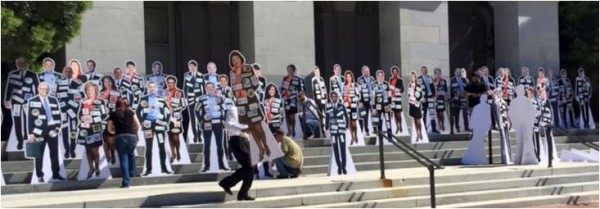
Assembly Speaker Toni Atkins’s cutout arrives late to the party.
The HuffPo article to which Cox links, by Jessica Riley, gives a great sense of the event:
The idea has come up before, back in 2013 a group filed a We the People petition which called for Politicians to wear their donors’ logos on their jackets similar to a Nascar driver. The petition didn’t meet the 100,000 signature requirement, but the idea did cause quite a stir in the media.
The idea is based on a simple concept: big money has a lot of control in politics. If you ask people on the street, this is what they will tell you. It’s sad to say, but it’s very true. Corporations and unions contribute massive sums of money to politicians, to the sum of hundreds of millions of dollars each year.
…
While the [12,000+ new legislators] idea sounds far fetched, a short conversation with [Cox] shows he’s not messing around and means business. He comes across very aggressive, almost like Donald Trump but instead of immigration, he nearly yells until he is red in the face about taking California back from greedy unions, corporations, and politicians.
Even if it doesn’t happen, I think this protest will kickstart a movement from others on the state and federal level doing the same thing, shedding light on the fact that big money owns politics and if we want to take back control, we need to make sure everyone in our country understands just how serious the problem is.
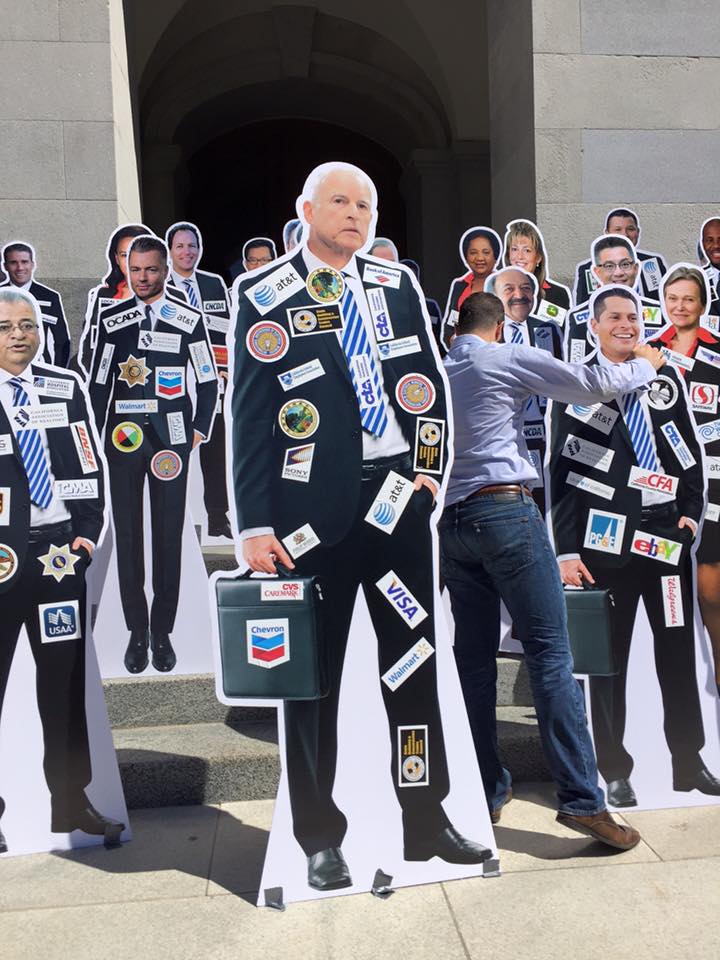
Governor Brown (at least his face on someone else’s body) with Asmb. Travis Allen looking over his shoulder.
Now I can quibble over “Neighborhood Legislature’s” proposal to create this many new legislative seats — and so I will. A famous essay on the best size of a legislature in one of the Federalist papers, noted that while having one or a small group of people making decisions (dictatorship, triumvirate, etc.) concentrated too much power into too few hands, having a huge group of people making a decision did the same because one or a few people could control a mob. While I believe that our Assembly and State Senate are too small, I suspect that they should be around triple the size, not magnified 300x, so that individual legislators still feel a sense of personal responsibility and agency. While I think that the proposal is a good and welcome prod to think about the problem of corruption, it can really only be resolved by making the public itself the “donor” by implementing public financing of elections — of the sort that the Supreme Court declared unconstitutional a few years ago in the Arizona Free Enterprise PAC case. (That would not be enough — there are still other ways to influence legislators, such as providing prostitutes and paid junkets — but it would be a start.)
A few criticisms of the event itself — only the last two of which (saved for the end and titled in boldface orange!) are really critical.
Both Cox and HuffPo slam on Democratic State Senator Bob Hertzberg for laughing at the display and posing with his cut-out image. Well, sorry, but I suspect he laughed because it was funny — as it was intended to be, after all, despite its serious intent. Criticizing someone for getting the joke of politicians as NASCAR drivers is dirty pool. If Hertzberg doesn’t try to change the system where and however possible, despite recognizing its absurdity, then he’s subject to criticism. But he’d be far from alone in that.
Also, if you’re going to do cutouts, and you’re rich enough to pull something like this off, then do them right. Pasting faces on the same body — notice that all of the women seem to be wearing the same blouse? — is not classy. I was struck when I first saw her photo by Speaker Toni Atkins’s shapely and slender legs — until I noticed that all of the other women had those same legs in that same pose. (I have no idea why Travis Allen is dressed differently from Brown most of the other men in the photos, but if he posed especially for Cox then good for him.)
But here are the two real serious criticisms I have of this NASCAR-style display:
(1) BADGES SHOULD REFLECT NOT ONLY DIRECT CONTRIBUTIONS BUT APPORTIONED INDEPENDENT EXPENDITURES ON CANDIDATE CAMPAIGNS!
Money doesn’t corrupt politics even primarily through contributions to a campaign fund. Receiving a $10,000 contribution is great — or so I’m told — but it’s generally not going to be enough to capture the fealty of a person in a $1,000,000 race. It’s the independent expenditures — remember how much JOBSPAC, led by Chevron and Phillip Morris, spent to push Tom Daly past Julio Perez in the June 2012 primary in AD-69? — that candidates in competitive districts need and can’t ignore.
(2) THE BADGES SHOULD BE PROPORTIONAL TO THE SIZE OF THE CONTRIBUTIONS!
“Received money from Chevron” is not so much the problem. “Received LOTS of money from Chevron” is the big problem. Here, anyone with a reported Chevron contribution — or one from the Sheriffs or AT&T or Teachers Association — gets the same size badge, and that leaves out critical information as to how much they received, how dependent they are on each contribution. Some of the politicians in the photo should be wearing a few very tiny patches — there’s not much evidence that they’re really “bought.” (Although some are, especially if they have an eye on higher office and know that they’ll eventually need the big money.) Others should have patches so huge that they would need to be blown up to woolly mastodon size just to have room for them all.
You’ve probably got a pretty good budget to play with there, John Cox — so go back, spend a bit more on research, and do it right!
This is your Weekend Open Thread. Talk about that, or whatever else you’d like, within reasonable bounds of decency and discretion.


Here’s another picture to cheer you up:
Sorry, but gender-bending Mike Huckabee and Kim Davis is not resistible.
Horrible news out of Long Beach tonight. I’ll let the news do their job. But we love you Nadia. We pray for you. We love Diego.
One Day At A Time. It is a hard road with hard stumbles NDL!
We Love You. GET WELL!
What happened?
I’m guessing that it may have been this fatal traffic accident that took place in Huntington Beach:
http://www.presstelegram.com/general-news/20150911/long-beach-bicyclist-killed-in-collision-with-motorist
Sounds like a bad day for Long Beach Nadias. Our tip was obviously in relation to Nadia Davis Lockyer though.
That was my first thought — but she was apparently not in the news on Friday night or for the rest of the weekend. So this tip was either based on inside knowledge or was in error. And the ability to post “tips” about notable people can be misused.
I tried twice to post a reply to Vasquez in the LOC, I kept getting this message:
Go back and try again.
Error: answer is wrong. [3.5]
Comment was blocked because it is spam
Vern, could you please post the comment below in the LOC. I’m also curious why Dan C says ” Ricardo is one of my best readers! …I know that Big Brother is watching us but is Dan C part of the klepto nomenklatura? I thought he was just a PR for them, oh well, el mundo esta loco loco loco….
“Hello Mr Vasquez,
Vern mentioned to me that you are very upset at me. I understand it is due to a reference I made about you. It seems that you don’t read the OJB so let me tell you what I said :
“Dan C will have another hit piece (on you and by getting a high number of comments). I will even suggest a title : OJB-Censortorpia! Tardif, Clark and Vasquez will have a ball. BTW give them the time when you were blocked, 3:15 AM? ”
My apologies if this made you upset .
Now I am very interested in knowing why you think I am “filthy racist soul”. The only reference that it comes to my mind is the reaction of Mr Tardiff about a post I wrote called “Dios los Cria y El Diablo los Junta”.
We should get together, drink a Yerba Mate, and talk things over.
Saludos. Ricardo.”
I know what you’re doing wrong. They’ve got a new deal under the comment form where they ask you what year it is. Keeps out spam bots. You can do it.
I tried it again. I didn’t get the message , it may be in moderation.
He banned me a few weeks ago. Don’t worry about it.
UP now, for what it’s worth…
*In more important news: We lost all three of our Fantasy Football League games. Terrible. Terrible. What is worse of course were the College Football Bad Ref Calls.
Watched 8 or 9 games and in each and every game…….someone is getting paid off
for making sure one team wins. The Oklahoma-Tennessee Game is a prime example.
Pretty sad……..then you watch the Pro’s to see how professionals make sure that one
team wins. The Cowboy-Giants game tonight was a prime example. This could well be
the end of our Fantasy Football Career. Our Seahawks even lost to the dreaded Rams and the evil Foies QB. The only fun thing today was seeing Cutler lose to the great Aaron Rogers Packers. How about the Mariota…..can’t believe we might wind
up routing for the dreaded Titans….too!
.
Fantasy football is what I give up to do districting. Soon I will have to give it up to do something else.
Happy New Year to my fellow tribespeople!