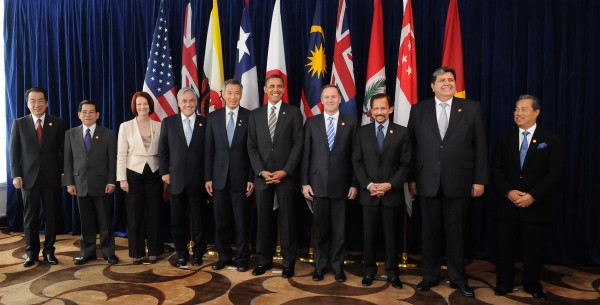
Leaders of the 10 TPP nations, circa 2010. Is the confidence in them overwhelming you?
We’ve covered the Trans-Pacific Partnership Agreement, or “TPP,” literally for years now — ahead of even most non-mainstream-media venues. The arguments against it — that it would be a latter-day NAFTA, undermining labor and environmental regulations, plus also allowing foreign corporations the ability to strike down U.S. laws that they argue undermine competition — are pretty well-known here. The main argument for it is, essentially, that trade is gonna happen — and the TPP excludes China and ensures U.S. economic influence over countries such as Singapore, Malaysia, Brunei, and Vietnam that would perhaps otherwise fall under China’s economic domination.
The Obama Administration already has likely support from most Congressional Republicans for “Fast-Tracking” approval of the TPP, meaning that the houses of Congress could only offer a yes-or-no vote on the agreement rather than offering amendments. (Even more troubling is that, at the time that the “fast-track” vote is taken, the secret classified terms of the agreement would not yet even have been made known to the public.) His remaining problem is getting the approval of Democrats.
That makes your reading this story really important if you want to figure out what’s going on.
Unions, activists, and progressive lawmakers have united against the “fast track” authority Obama seeks to put back into place — a provision that would allow the president to negotiate trade deals and give Congress a simple up-or-down vote. They also oppose the Trans-Pacific Partnership, the Asian trade deal that the administration believes would become a cornerstone of Obama’s legacy. Another potential deal with the European Union has also rankled organized labor in the U.S.
Most expected some level of progressive opposition, but not for the issue to turn into a coalition-building rallying cry, drawing in national labor and the high-profile activism of Sen. Elizabeth Warren in a united front. Last month, the AFL-CIO suspended all political donations to focus all its financial resources on fighting the White House trade deals. This week, the group launched a “week of action” featuring a rally of union workers on Capitol Hill and events in every state publicly opposing trade deals. The message is clear: Democrats who cross labor on trade could be on the short end when it comes time for labor to fire up its massive political money machine again.
But progressives have used strong-arm tactics in plenty of fights. On the trade fight, they say the White House is taking its pushback to a new level they haven’t seen. Hour-long calls to lawmakers, secret classified briefings on Capitol Hill, bully-pulpit wrangling by Obama, and even a shadowy new progressive-focused group launched by Obama’s supporters solely to sell the trade deals have all been part of the effort. Obama’s trade opponents see an organized effort by the White House to find any opening in the left-wing anti-trade-deal firewall to exploit — or, failing that, to create one through pressure on activists and lawmakers.
“I don’t know of one crack,” said Larry Cohen, president of the Communications Workers of America and one of the most vociferous opponents of Obama’s trade plans. “They’re desperate to find a crack, but they won’t find one.”
Check it out; there’s much more.
For progressives — or, hey, just this once, let’s call us liberals — this continues a long-standing source of irritation towards the practices of our Democratic Presidents. They are often blocked by Congress from getting things done, except when they are engaging in some practice that serves traditionally Republican ends. (For example: Clinton’s NAFTA and GATT, immigration crackdown, anti-welfare legislation, and deregulating the banking industry; Carter’s draft registration and industrial deregulation efforts; and I’ll guess that you know about the criticisms of Obama.)
One really interesting here is that the Obama Administration, notoriously unwilling to “pull out all of the stops” to promote legislation, is going full-bore towards the goal here. And another thing is really interesting: if this story is to be believed, they’re not doing it particularly well.


There ARE Congressional Republicans against it – I only know about the OC but Rohrabacher is solid, and Issa sounds like he is at least going to oppose fast track. (Thanks for making that call, Issa constituent Paula Was Here)
Right — but they generally favor it. I presume that Royce does.
Royce and Mimi Walters, “slimy kleptos that they are,” yes. Statement on its way from Lowenthal and Issa…
JUST IN FROM ALAN LOWENTHAL (D-Long Beach and part of NW OC)
“I have serious concerns about the up-down language within the trade promotion authority. While I am a strong believer in trade, I believe Congress should have more ability, not less, to review and amend trade deals of the Trans-Pacific Partnership Agreement’s magnitude.
“In the end, it comes down to an issue of transparency. If the people’s representatives in Congress cannot review terms of negotiations that will impact our nation for decades to come, how can we be certain that these terms are in the best interests of all our citizens?” – Congressman Alan Lowenthal
Like I told his guy, that comes short of “I will oppose Fast Track,” but it’s hard to see how he could MEAN all that and NOT oppose it.
Meanwhile, yesterday, our commenter Paula Was Here who is a constituent of Darrell Issa, called him and reported back: “He has not issued a position at this time but is on record as being against the law’s lack of transparency.”
Same response from me.
*The secret of all Free Trade Packs……..are the banking connections and how International Companies that participant get to hide their cash…..in a whole new set of banks – at various interest rates. The easiest example was in ’76 when Mexico was offering 20% interest…..per month to Americano Gringos. That lasted about a year and a half and suddently those funds were Nationalized and all PRIVATE investors lost their entire bundle. The US Corporations however, were protected and just didn’t get the 20% per month……that was reduced to 7% per month….because they were Institutional Investors……that had relations with companies like Merrill-Lynch, Chase and others. This is the canary in coal mine on this TPP. Will Private Investors get
FDIC type Banking Insurance as we do here in the US and for how much?
*This was also the Prime reason the Reagan Administration was able to negotiate with Pemex for $20 dollar a barrell oil for 20 years. That ran from 1981-2001. Then there was 9-11…wasn’t it?
i have just seen the video that makes me want to forgive barack obama for everything that i dislike about his politics and his administration. apparently the white house hosts these non partisan music and cultural events in some back room at the white house.
in celebration of black history month they did a blues concert with people such as bb king, keb mo, trombone shorty, buddy guy, mick jagger and a bunch of other people that most of you have never heard of but who comprise a significant portion of the blues community. the band closed the show with “sweet home chicago” a classic blues number attributed to robert johnson but made famous by everybody from eric clapton to robert cray.
at the end, the president got up at the urging of buddy guy and sang a verse of the classic. you know, at the end of the day, you can take the black man out of the ghetto but you cannot take the blues out of the black man
*Yeah, thank God John McCain or Mitt Romney hadn’t tried to do any of this…..”Praise the Lord…….and pass the Ammunition”…they used to say. Of course, now you have Ted Cruz, Marco Rubio, Scott Walker or maybe Mike Huckabee…..to audition for the part as a poor black man……. Oh, we forgot Steve Martin already did that movie.
Fast track passed the Senate today as was pretty much expected, we’ll have a better chance in Congress. As our friend D’Marie writes, “There seems to be some confusion on where we are with the #TPA. Folks, today was just the first round. The fight is hardly over! This is what we have been training for. It’s time to let Congress hear our roar!!!”
Here’s a good article on all the ins and outs today, “What Does It Mean When the Press Says Obama/Congress Has a Deal on Trade Promotion Authority?”
By Jonathan Weisman APRIL 16, 2015
WASHINGTON — Key congressional leaders agreed on Thursday on legislation to give President Obama special authority to finish negotiating one of the world’s largest trade accords, opening a rare battle that aligns the president with Republicans against a broad coalition of Democrats.
In what is sure to be one of the toughest fights of Mr. Obama’s last 19 months in office, the “fast track” bill allowing the White House to pursue its planned Pacific trade deal also heralds a divisive fight within the Democratic Party, one that could spill into the 2016 presidential campaign.
With committee votes planned next week, liberal senators such as Sherrod Brown of Ohio are demanding to know Hillary Rodham Clinton’s position on the bill to give the president so-called trade promotion authority, or T.P.A. Trade unions, environmentalists and Latino organizations — potent Democratic constituencies — also quickly lined up in opposition, arguing that past trade pacts failed to deliver on their promise and that the latest effort would harm American workers.
The deal was struck by Senators Orrin G. Hatch of Utah, the Finance Committee chairman; Ron Wyden of Oregon, the committee’s ranking Democrat; and Representative Paul D. Ryan, Republican of Wisconsin and chairman of the House Ways and Means Committee. It would give Congress the power to vote on the more encompassing 12-nation Trans-Pacific Partnership once it is completed, but would deny lawmakers the chance to amend what would be the largest trade deal since the North American Free Trade Agreement of 1994, which President Bill Clinton pushed through Congress despite opposition from labor and other Democratic constituencies.
While supporters have promised broad gains for American consumers and the economy, the clearest winners of the Trans-Pacific Partnership agreement would be American agriculture, along with technology and pharmaceutical companies, insurers and many large manufacturers that say they could also expand United States’ exports to the other 11 nations in Asia and South America that are involved.
More here: http://www.nytimes.com/2015/04/17/business/obama-trade-legislation-fast-track-authority-trans-pacific-partnership.html
Activist’s notes on the Times article:
* USTR Michael Froman assured the committee that the #TPP would ensure that agricultural exports will not be stopped because they are genetically engineered, insinuating there will be no labeling or banning of GMOs.
** U.S. Chamber of Commerce is basically a lobbying group for the transnational corporations. They do nothing to foster small business. US Chamber of Commerce is responsible for the corporate take over of our US Government. See bit.ly/bagfulofcash
*Chairman Vern, good job drawing a clearer picture. Did you mention that Monsanto is for TPP, because according to some sources in Oregon, it would restrict GMO labeling forever. This would not be good for US Agriculture, in our opinion. Could they change
the labeling segment of the trade agreement? Probably, but the question is when?
Gonna do another anti-TPP rally at the HB pier tomorrow (Sunday) at noon because the last one was so fun. This time with musical instruments, and our re-written version of Twisted Sister’s “We’re Not Gonna Take It” (which will be on YouTube a day or two later)
This is going to the House of Representatives next, where we have a slightly better chance of killing it. Either way it is worth the fight. It SOUNDS like this county has Dana, Loretta and Alan against it, Darrell leaning no, Ed and Mimi yes. Pretty good for a county, if that holds!
Be here: https://www.facebook.com/events/879613318728275/
You forgot Linda Sanchez, a definitive “NO” on behalf of La Palma!